

*英訳版は日本語版の後に掲載しています。/ The English translation follows the Japanese text below.
「思想輸出進行度指標」 (Ideological Infiltration Index)
日本のサイバー安全保障における早期警戒モデルの構築
–ダーク・エンライトメントはどの国家を選び、どの順序で浸透するか
2026年6月28日
発行元: 一般財団法人 日本危機管理研究所
目次
段階①:思想的接触(Ideological Contact)
段階②:インフラの代替(Infrastructural Substitution)
段階③:政策言語への翻訳(Policy Codification)
段階④:政権への直接接触(Direct Political Engagement)
フレームワークの運用方針
第二章 思想の解剖——リバタリアニズムからダーク・エンライトメントへ
2-1 出発点:ティールの2009年エッセイ
2-2 体系化:カーティス・ヤーヴィンと新反動主義
2-3 政治権力への翻訳:ヴァンスという回路——その強さに関する留保
2-4 統治文書化:Project 2025
3-1 「私の未来観に最も一致する国」——市民権という最小単位の接触
3-2 情報・防衛機関との接続——段階②への接近
3-3 国境の外側に統治単位を作るという、一貫した実践
4-1 Dialogの実在と構造
4-2 参加者構成の分析
4-3 Dialogの機能仮説
第五章 指標の適用①:アルゼンチン——三段階まで進行した事例
5-1 なぜアルゼンチンが選ばれたか
5-2 段階①:思想的接触
5-3 段階②:インフラの代替
5-4 段階③:政策言語への翻訳
5-5 段階④への接近:イサク協定
5-6 評価
6-1 なぜ日本は「アルゼンチン型」では実装されないか
6-2 段階①:思想的接触
6-3 段階②:インフラの代替——当初評価よりも深い相互依存
6-4 段階③:政策言語への翻訳(現時点では未確認)
6-5 二つの経路の比較表
6-6 評価
7-1 代替層:宇宙インフラ
7-2 個人データ層:保険・金融インフラ
7-3 軍事AI層:同盟の非対称化
8-1 文化的要因と思想用語の認知における内外差
8-2 制度の実効性という、もう一つの構造的脆弱性——放送法外資規制の事例
9-1 インド型:孤立による脆弱性の放置
9-2 フランス型:制度分離による両立、ただし運用面の課題も残る
9-3 二類型の本質的な違い
9-4 二類型を超える第三のリスク:基盤モデル依存というサプライチェーンの死角
提言① 思想輸出進行度指標の制度的運用
提言② 情報と権限の制度的分離(フランス型モデルの応用)
提言③ 経済安全保障推進法の概念拡張
提言④ 外交・防衛における思想的リテラシーの制度化
提言⑤ AIシステムの基盤モデル依存の可視化
本稿の位置づけと注記について
本稿は推論と事実を明確に区別するリスク分析である。本文中、確認済みの事実には「※以下は確認済みの事実である」、現時点での推論・仮説には「※以下は現時点での作業仮説であり、今後の実証を要する」と注記する。注記のない記述は文脈上明らかな事実または広く認知された情報である。
本稿の新規性・ねらい
● 反民主主義的・反平等主義的な統治思想「ダーク・エンライトメント(新反動主義)」についての分析は、これまで米国内政治の文脈(思想家カーティス・ヤーヴィン、ヴァンス副大統領、トランプ政権、Project 2025)に限定されてきた。なお、ダーク・エンライトメントとアルゼンチン・ミレイ政権との思想的親近性を指摘する批評的論考は既に存在し、また中国式デジタル権威主義の国際的拡散についてはCNAS等が先行する分析枠組みを提示している。本稿の新規性は、米国発の反民主主義的統治思想を観察可能な四段階の診断指標として構造化し、これを日本という従来論じられていない対象国に適用した点に限定される。
● 米国内の思想分析、南米の政治変動分析、日本のテック企業提携分析は、これまで別々の文献・報道として存在してきた。本稿はこれらを同一思想の異なる発現として接続し、単一の理論枠組みで統合する。
● 本稿独自の貢献として、「思想輸出進行度指標(Ideological Infiltration Index)」という四段階の診断フレームワークを提示する。これにより、「依存か自律か」という単純な二項対立を超え、自律性そのものを「孤立型」と「制度分離型」に分解した上で、思想浸透の進行段階を観察可能な基準で判定する分析ツールを構築する。
● 南米(アルゼンチン)における進行事例と、日本における初期兆候を、この指標に基づいて正確に位置づけることで、誇張も過小評価もしない、検証可能な早期警戒モデルを提示する。
キーワード
● リバタリアニズムとダーク・エンライトメント(新反動主義)
● 思想輸出進行度指標(Ideological Infiltration Index)
● テクノクラシーと国家解体の二重構造
● Dialog(思想ネットワークの制度化)
● 技術主権的アクター(Techno-Sovereign Actor)
● 自律性の二類型(孤立型/制度分離型)
● 日本のサイバー安全保障における文化的盲点
エグゼクティブサマリー
まず平易に言えば: 「国家は非効率だから縮小すべきだ」という思想と、「データとAIで国家機能を代替する民間インフラを拡大すべきだ」という動きは、矛盾しているように見えて、実は一対の構造である。国家の民主的統制が退場した場所には、必ず何かが入り込む。その「何か」が、説明責任を負わない特定の民間アクター群であった時、国家は形式的な独立を保ちながら、実質的な選択の自由を失っていく。本稿はこの構造が、米国で生まれ、南米で実装され、日本にもその兆候が現れ始めていることを、検証可能な事実に基づいて示す。
● 米国シリコンバレーで体系化された「ダーク・エンライトメント」と呼ばれる思想は、民主主義を非効率な制度として退け、データ・AI・アルゴリズムによる統治への代替を志向する。この思想は、もはや一介のブログ論説ではなく、米国政権内の人物(ヴァンス副大統領)の思考に直接影響を与え、政策文書(Project 2025)にまで翻訳されている。
● この思想の体現者であるピーター・ティールが共同設立した非公開組織「Dialog」が2026年6月に内部資料の流出を受け、その実態が報道機関によって検証された。NATO軍司令官、米財務長官、上院議員ら222名が参加者リストに含まれていたことが確認されている。
● この思想は、アルゼンチンにおいて、ミレイ政権との思想的共鳴を起点に、国営通信インフラの民営化と外国民間企業(Starlink)の進出、国民データの統合計画という形で、具体的に実装されつつある。
● 同じパターンの初期兆候が、日本においても観察され始めている。民間保険大手とPalantirの提携深化、そしてティールによる日本国首相への表敬訪問という事実が、これに該当する。
● 本稿は、この浸透プロセスを四段階に分解した「思想輸出進行度指標」を提示し、アルゼンチンと日本を、誇張なく、それぞれの進行段階に応じて評価する。
● 結論として、日本が目指すべき方針は、技術主権的アクターへの依存でも、自前主義による国際的孤立でもない。脅威情報の国際的共有を維持しながら、基幹インフラの最終的な権限を委ねない、フランス型の「制度分離モデル」が、日本にとって最も現実的な指針となる。
序論:問いの設定
2026年6月、米国の投資家ピーター・ティールが2006年に共同設立した非公開組織「Dialog」の内部資料が流出し、WIREDによって検証・報道された。[8]流出した参加者リストには、NATO欧州連合軍最高司令官、米財務長官、複数の上院議員、そしてイーロン・マスクを含む「PayPalマフィア」の主要人物が含まれていた。
このニュースは、民間×軍事×政治が同一の非公開空間で交わるという構造を、これまでで最も直接的な形で示した。しかし、この発見だけでは一つの重要な問いに答えられない。この思想ネットワークは、米国内に留まるのか、それとも国境を越えて他国に伝播するのか。 もし伝播するなら、どの国家が選ばれ、どのような順序で進行するのか。
この問いに対する答えは、すでに部分的に観察可能である。米国で生まれた反民主主義的な統治思想——「ダーク・エンライトメント」または「新反動主義」と呼ばれる——は、2023年以降、アルゼンチンのハビエル・ミレイ政権との間に、検証可能な思想的・実務的接触を積み重ねてきた。同時に、日本においても、同じ思想圏に連なる企業・人物との接触が、2019年以降、段階的に進行している。
既存の研究には、二つの重要な空白がある。第一に、ダーク・エンライトメントについての分析は、米国内政治の文脈(ヤーヴィン、ヴァンス、Project 2025)にほぼ限定されており、この思想が国境を越えてどう伝播するかを実証的に追跡した分析は存在しない。 第二に、南米の政治変動分析と、日本のテック企業提携分析は、これまで別々の文献として存在し、両者を同一の思想的現象として接続した分析もない。
本稿はこの二つの空白を埋めることを目的とする。そのために、本稿独自の診断フレームワーク——思想輸出進行度指標(Ideological Infiltration Index)——を構築し、これに基づいてアルゼンチンと日本を分析する。本稿の作業仮説は以下の通りである。
思想は、条件が整った国家を選び、その国家が既存に持つ政治的合意(国家への不信、効率化への要求)に接木する形で実装される。この実装は、強制ではなく、複数の段階を経て進行する観察可能なプロセスである。
第一章 思想輸出進行度指標——四段階の診断フレームワーク
本章では、本稿の核心的な貢献である診断フレームワークを提示する。これは、思想が国家に浸透する過程を、観察可能な四つの段階に分解するものである。
段階①:思想的接触(Ideological Contact)
定義: 思想の体現者(人物・組織)が、対象国の政治指導者・経済界要人と、個人的・非公式な関係を構築する段階。まだ制度や政策には現れていない。
判定基準:
● 思想の体現者・その所属組織と、対象国の政治指導者・経済界要人との間における、双方向の(訪問する・訪問を受ける)接触の頻度・形式
● 対象国指導者による、思想の用語・論理の使用(「国家は非効率」「民間の方が早い」等の言説の採用)
● 非公開ネットワークへの、対象国関係者の参加実績
否定基準(この段階に該当しないと判定する条件):
● 接触の主題が、確認可能な範囲で技術協力・商業案件に限定され、国家統治のあり方に関する言説が一切確認されない場合
● 会談が公式な外交儀礼の範囲内で行われ、対象国指導者側から思想的な賛意・共鳴を示す発言が一切記録されていない場合
● 接触が単発であり、かつ思想の体現者個人ではなく、その所属企業の通常業務の一環として行われたことが明確な場合
運用上の注記:判定基準のうち、いずれか1項目の該当のみでは段階①の認定に至らない。複数の基準が同時に満たされ、かつ上記否定基準のいずれにも該当しないことを確認した場合に限り、段階①と認定する。 単発の訪問それ自体は、多くの大国間で日常的に発生する事象であり、判定基準の単独適用は、識別力を持たない。
段階②:インフラの代替(Infrastructural Substitution)
定義: 国家が担っていた機能(通信・データ管理・情報収集)が、民営化・規制緩和・業務委託を通じて、思想ネットワークに連なる民間企業に置き換わる段階。
判定基準:
● 国営インフラの民営化と、特定の民間企業の進出が時間的に同時進行しているか
● 代替後、当該インフラに技術的代替可能性(他社への切替の容易さ)が残っているか、それとも失われているか
否定基準(この段階に該当しないと判定する条件):
● 契約が競争入札を経て複数の候補企業の中から選定されたものであり、特定企業への優先的待遇が確認されない場合——通常の商業的調達プロセスは、それ自体ではインフラの代替に該当しない
● 契約の対象が国家機能(通信主権・情報収集・基幹データ管理等)ではなく、一民間企業の内部業務効率化(社内システムの一部刷新等)に限定される場合
● 契約解除・他社への切替が、契約条項上および技術上、実務的に可能であることが確認される場合——「代替可能性が形式的に存在する」ことは、即座に「代替不可能性の証拠」と読むべきではない
段階③:政策言語への翻訳(Policy Codification)
定義: 思想が、シンクタンクや政府文書を通じて「効率化」「行政改革」「国力強化」等の、政治的に中立に見える政策言語に翻訳され、制度化が進む段階。
判定基準:
● 思想的起源を持つ概念が、政府の公式文書・法案にどの程度反映されているか
● 当該政策の立案過程に、思想ネットワークに連なる人物・組織が関与した記録があるか
否定基準(この段階に該当しないと判定する条件):
● 政策・法案の立案過程が、特定の思想潮流とは独立した、国内の既存の政治的合意(与野党合意、官僚機構内の従来からの懸案等)に基づいて説明できる場合
● 「効率化」「行政改革」という言葉が使われていても、その内容が当該思想の体現者の主張する具体的な制度設計(権威主義的統治、データ集中管理等)と一致しない場合——表面的な言葉の類似は、思想的影響の証拠にはならない
● 思想ネットワークに連なる人物・組織の関与が、公開資料において一切確認できない場合(本稿が日本の国家情報局構想について、現時点でこの否定基準を適用していることに留意)
段階④:政権への直接接触(Direct Political Engagement)
定義: 企業レベルの関係が、政権中枢との直接対話・政策協議に発展する段階。これ以降、国家の意思決定プロセス自体に、思想ネットワークが恒常的なアクセスを持つ。
判定基準:
● 思想の体現者と、政権の最高指導者との会談が、何を議題として、どの頻度で行われているか
● 会談が一回限りの儀礼的なものか、継続的な政策協議の枠組みに発展しているか
否定基準(この段階に該当しないと判定する条件):
● 会談が単発であり、その後一定期間(本稿は目安として12か月)、継続的な接触の記録が確認されない場合
● 政権側が会談内容を公開の場(国会答弁等)で明確に否定・限定し、かつその後の政策決定にその企業・思想の影響を示す証拠が現れない場合——これは段階④の否定の積極的根拠として扱う
● 接触が複数の競合企業・複数の思想的立場の関係者と並行して行われており、特定の一者が排他的なアクセスを得ていない場合
フレームワークの運用方針
※以下は確認済みの事実である。
この四段階は、必ずしも単線的に進行するとは限らない。また、ある国家が段階④に達したとしても、それは「侵食が完成した」ことを意味するのではなく、国家の意思決定における選択肢が、観察可能な形で狭まり始めていることを示す警告指標である。
本稿は、各段階の判定基準と否定基準を対にして提示することで、反証可能性を確保する。 「接触があった」という事実だけでは、いかなる段階の証拠にもならない。判定基準を満たし、かつ否定基準に該当しないことが確認された場合に限り、当該段階への進行を認定する。例えば、本稿第六章で論じるSOMPO・Palantirの提携は、当初は契約が一企業の業務委託に留まると評価されたが、後の検証で資本関係を伴う事例であることが判明し、評価を修正している——機械的な「契約があったから段階②」という単純な認定ではない。
※以下は現時点での作業仮説であり、今後の実証を要する。
本稿は、この指標を用いてアルゼンチン・日本の両国を評価するが、両国が必ず同じ経路を辿ると主張するものではない。各国の政治的・文化的条件によって、進行の速度・順序は異なりうる。この点を踏まえた上で、指標は「予言」ではなく「早期警戒のための観察基準」として位置づける。
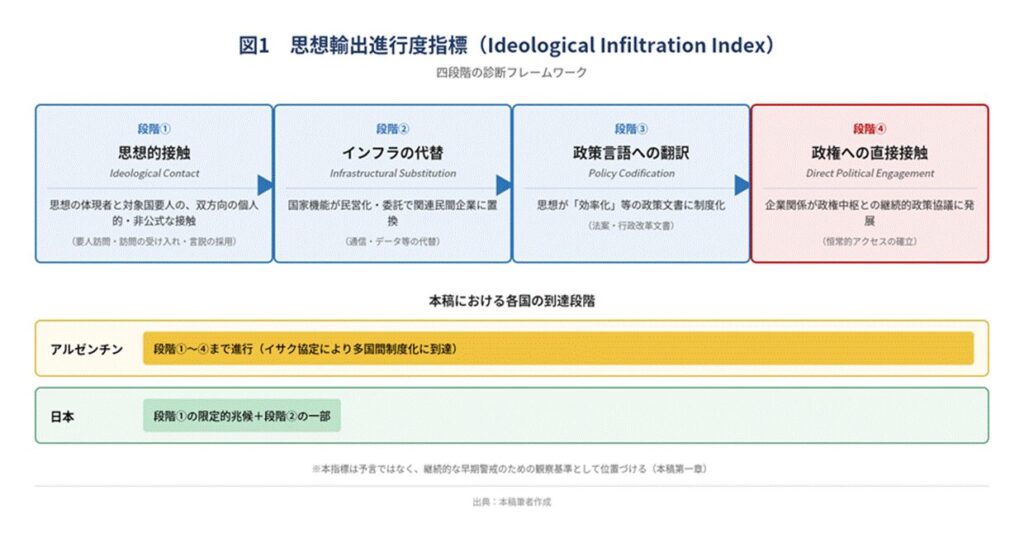
図1 思想輸出進行度指標の四段階フローと、本稿における各国の到達段階(出典:本稿筆者作成)
第二章 思想の解剖——リバタリアニズムからダーク・エンライトメントへ
2-1 出発点:ティールの2009年エッセイ
※以下は確認済みの事実である。
2009年、ピーター・ティールはCato Unboundに「The Education of a Libertarian」と題するエッセイを寄稿し、その中で「私はもはや自由と民主主義が両立するとは考えていない」と明確に述べた。[1]これは、単純なリバタリアニズム(個人の自由の最大化)の枠を超え、民主主義そのものを自由の障害として位置づける思想的転換点であった。
2-2 体系化:カーティス・ヤーヴィンと新反動主義
「ダーク・エンライトメント」または「新反動主義(neoreaction)」と呼ばれる思想運動は、2000年代半ばにオンライン空間で生まれた、反民主主義・反平等主義・反進歩主義の思想潮流である。[2]ソフトウェア技術者カーティス・ヤーヴィンは、2007年から2014年まで「Unqualified Reservations」というブログを「メンシウス・モールドバグ」というペンネームで執筆し、米国の民主主義を「失敗した実験」と位置づけ、企業の統治構造に類似した「責任ある君主制」への置き換えを主張した。[3]ヤーヴィンとニック・ランドは、ティールの「自由と民主主義はもはや両立しない」というエッセイから着想を得たことが、複数の学術的分析で指摘されている。[2]
2-3 政治権力への翻訳:ヴァンスという回路——その強さに関する留保
※以下は確認済みの事実である。
J.D.ヴァンス米副大統領は、ティールの元被後見人である。ヴァンスは2021年のポッドキャストでヤーヴィンの名を挙げ、「行政国家の官僚を全員解雇し、我々の人間に置き換えるべきだ」とトランプへの助言として語った。The New Republic等の複数メディアは、ヤーヴィンの思想に影響を受けた人物の筆頭としてティールとヴァンスを挙げている。[4]
しかし、この連鎖の強さについては、当事者自身による重要な留保がある。 ヤーヴィン本人は2025年、New York Timesの取材に対し、ヴァンスとの関係は「明確に誇張されている(definitely overstated)」と語った。ヤーヴィンを直接研究するジャーナリストのジョシュア・テイトも、「ヤーヴィンはDOGEの、ましてやトランプ政権の大理論家ではない。彼が実際の具体的な影響力を持っているとは思わない」と評価している。同様に、ティール自身も2023年、The Atlanticの取材に対し、ヤーヴィンの考えが「機能する」とは思わないが、彼を「興味深く、力強い」歴史家だと感じていると述べており、無条件の支持者ではない。
本稿はこの留保を踏まえ、ティール・ヤーヴィン・ヴァンスの関係を、単純な「師弟関係の連鎖」として描くことを避ける。 実態は、Tlon社への出資という資金的な結びつきと、思想の部分的・選択的な共有が混在する、より複雑な構造である。本稿が論じる「思想の輸出」は、特定個人間の直接的な思想伝達ではなく、Founders Fundという資本ネットワークを介した、より緩やかな思想的近接性として理解すべきである。
2-4 統治文書化:Project 2025
※以下は確認済みの事実である。
ヘリテージ財団が主導した「Project 2025」(2023年4月発表、表題「Mandate for Leadership: The Conservative Promise」)は、米国連邦政府を再編し、行政権力を右派政策のために集中させることを目的とした包括的な政策文書である。その哲学的展望と政策提言の両方において、ヤーヴィンの新反動主義的ビジョンと著しい思想的並行性を持つことが、複数の分析で指摘されている——シンクタンクの政策言語で包装されてはいるが。[5]
この思想的並行性には、ヴァンス個人の影響関係よりも検証可能な、具体的な実務上の接続が存在する。 ラス・ヴォート(Russell Vought)は、第一次トランプ政権で行政管理予算局長を務めた人物であり、Project 2025の中心的な起草者である。ヴォートが主宰するシンクタンク「Center for Renewing America(CRA)」は、Project 2025の多くの政策と、政権発足直後に署名可能な大統領令の草案を作成した。ヴォートが「腐敗した官僚機構」との対決を掲げる姿勢は、ヤーヴィンが「カテドラル(既得権益化した制度的権力複合体)」の解体と呼ぶ主張と、内容的に一致している。なお、政府効率化部門(DOGE)の若手スタッフの中には、ティールのもとで働いた経験を持つ者や、新反動主義的な見解を公に表明した者が複数含まれていることが、政治研究機関の分析で指摘されている。
思想がブログから政策文書に翻訳された時点で、その思想は「輸出可能な形式」を獲得した、と本稿は位置づける。ブログの個人的な思想表明と、政策文書という統治のための実践的言語は、伝播のしやすさにおいて根本的に異なる。Project 2025は、ダーク・エンライトメントという過激な思想を、「行政改革」という、国際的にも受け入れられやすい言語に変換した実例であり、その制度化の経路は、ヴァンス個人への影響という不確かな線よりも、ヴォート・CRAという組織的な実務の線において、より明確に観察できる。
第三章 思想の最初の実践——ニュージーランドという先行事例
ダーク・エンライトメントが米国内で政策文書へと制度化される以前、ティール個人の思想は、すでに一つの国家との関係において、20年近く先行する形で実践されていた。本章は、この先行事例を確認することで、本稿が提示する四段階指標が、アルゼンチン・日本に限らず、より長期的な反復構造を持つことを示す。
3-1 「私の未来観に最も一致する国」——市民権という最小単位の接触
※以下は確認済みの事実である。
ティールは2011年6月、ニュージーランド内務大臣ネイサン・ガイが「例外的事情」条項を適用したことにより、市民権を取得した。通常、永住権保持者が市民権を申請するには5年間で1,350日の滞在が必要だが、ティールは5年間で4回の訪問、合計わずか12日間の滞在だった。この事実は2017年、ニュージーランド・ヘラルド紙の調査報道により公になった。ティールは申請書に「私の未来観に、ニュージーランドほど一致する国はない」と記している。[6]
これは、本稿の指標における段階①(思想的接触)が、実質的な居住や制度的関与を伴わずに、市民権という法的地位そのものとして成立しうることを示す、最も純粋な事例である。 思想的接触は、対面での会談や訪問の回数だけで測られるものではなく、「特定の国家を、自身の理想に最も近い場所として選定し、その国家から法的な地位を得る」という形でも成立する。
3-2 情報・防衛機関との接続——段階②への接近
※以下は確認済みの事実である。
ティールの中核事業であるPalantirは、ニュージーランド国防軍、保安情報局(SIS)、政府通信保安局(GCSB)と、長期にわたる関係を持っていたことが、ニュージーランド・ヘラルド紙の調査報道により明らかになっている。[6]これは、個人への市民権付与という段階①の接触が、その後、当該国家の情報・防衛機関とPalantirとの関係という、段階②的な構造に接続していく経路を示す、先行事例として位置づけられる。
3-3 国境の外側に統治単位を作るという、一貫した実践
※以下は確認済みの事実である。
ティールは、シーステッディング研究所(公海上に自治コミュニティを建設する構想)の初期支援者であり、その後関心をチャーターシティ(陸上での自治都市)に移した。彼はPronomos Capitalという、空き地に実験的な半自治都市を設立することを目指す投資ファンドの主要出資者であり、同ファンドが支援するプロジェクトにはホンジュラスの「Próspera」が含まれる。関連企業のPraxisは新しい都市国家の設立を目指し、グリーンランドを候補地の一つとして検討した。2025年、デンマーク政府がPalantirを自国の軍・警察・情報機関に統合する動きに対し、反対派が提起した論拠の一つは、Praxisプロジェクト(ティールがPronomos経由で支援)がグリーンランドの主権にとって脅威であるというものだった。[7]
これらの事実を統合すると、ティールの思想(国家の民主的統制への懐疑、国境に縛られない移動の自由としての理想)は、2009年のエッセイで初めて言語化されたのではなく、それ以前から、複数の国家・地域を舞台に、一貫した実践として積み重ねられてきたことが分かる。 ニュージーランドはその最初の、最も成熟した実例であり、アルゼンチンはその約15年後における、より包括的な実装と位置づけられる。
第四章 制度化されたネットワーク——Dialog
4-1 Dialogの実在と構造
※以下は確認済みの事実である。
「Dialog」は2006年、ピーター・ティールとシリコンバレーのエンジェル投資家オーレン・ホフマンによって共同設立された、招待制かつ非公開の組織である。20年間メンバーシップを公開してこなかったが、2026年、スイスのハクティビストmaia arson crimewがdialog.orgのソースコードに埋め込まれた公開ディレクトリを発見し、WIREDが内容を独自に検証・報道した。[8]
4-2 参加者構成の分析
流出した2026年8月のリトリート(アイルランド・ダブリン近郊で開催予定)の登録者リストには222名が記載されており、NATO欧州連合軍最高司令官兼米欧州軍司令官(2021年から出席)、米財務長官、上院議員(テッド・クルーズ等)、Palantir共同創業者ジョー・ロンズデール等が含まれていることが、WIREDの検証で確認されている。[9]また、別途流出した113名の関係者ディレクトリには、イーロン・マスク、上院議員コリー・ブッカー、スタンフォード大学学長、作家エズラ・クラインらが含まれていたことが、複数の報道機関の検証で確認されている。セッション議題には「第三次世界大戦をナビゲートする(Navigating WWIII)」「カルトを作る(Build-a-Cult)」が含まれていた。
本稿は、この構成を「カルト」と評価することを避ける。セッション名に皮肉めいた表現が含まれていたとしても、それ自体を組織の本質と断定することは、検証可能な事実を超えた解釈になる。本稿が重視するのは、民間×軍事×政治が同一の非公開空間で、継続的に交わっているという、客観的に確認できる構造である。
4-3 Dialogの機能仮説
※以下は現時点での作業仮説であり、今後の実証を要する。
Dialogが具体的な政策決定を行う場であるという直接的な証拠は、現時点の公開情報からは確認されていない。しかし、本稿はDialogを、思想が国境を越える際の人的ネットワークの基盤として機能している可能性がある組織として位置づける。これは仮説であり、断定ではない。
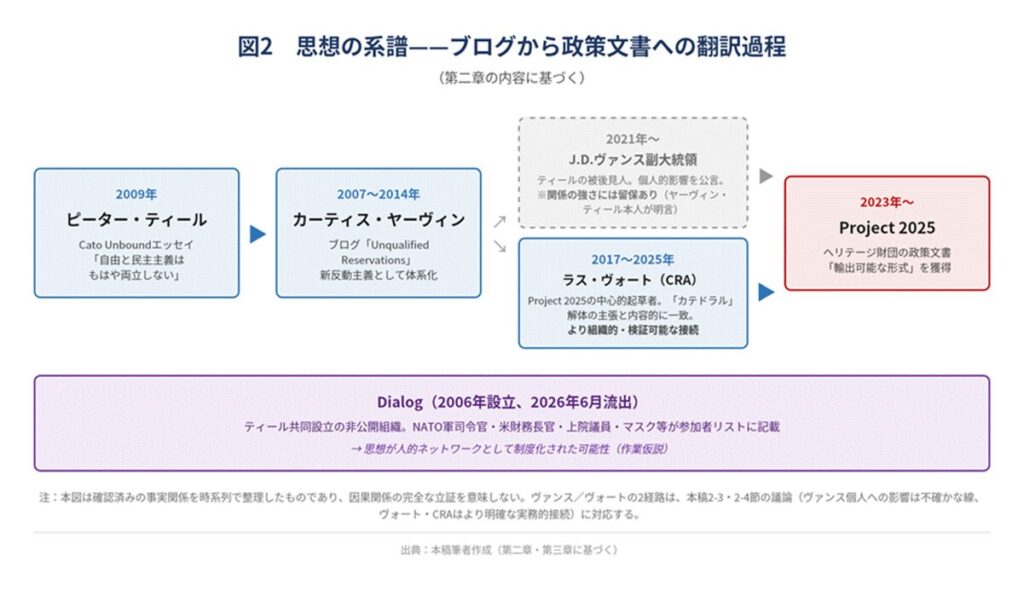
図2 思想の系譜——ブログから政策文書への翻訳過程(出典:本稿筆者作成)
第五章 指標の適用①:アルゼンチン——三段階まで進行した事例
5-1 なぜアルゼンチンが選ばれたか
※以下は現時点での作業仮説であり、今後の実証を要する。
本稿は、アルゼンチンが「地理的偶然」によって選ばれたのではなく、既存の政治的条件が、思想浸透の障壁を最も低くしていたという仮説を提示する。具体的には、(1)数十年にわたる経済危機とハイパーインフレーションによる「国家不信」という既存の政治的土壌、(2)IMFによる構造改革要求という「国家縮小」への国際的な政治的合意の存在、(3)ミレイ個人とティールの間の思想的共鳴、という三つの条件が重なっていた。
5-2 段階①:思想的接触
※以下は確認済みの事実である。
ピーター・ティールは、同じリバタリアンであるアルゼンチン大統領ハビエル・ミレイと、2024年1月のカーサ・ロサーダ(大統領府)での会談を皮切りに、複数回の接触を重ねている。2024年5月にはロサンゼルスのミルケン研究所フォーラムで、2026年4月23日には再びカーサ・ロサーダで会談した。[10]ミレイは2026年4月の会談後、「素晴らしい会談だった」と述べ、ティールについて「彼は私と同じく、哲学的にアナルコ・キャピタリスト(無政府資本主義者)だ」と語った。両者は資産課税・文化戦争・自由主義の将来等について議論したと報じられている。ミレイは選挙戦から就任後にかけて、「国家は敵だ」という言葉を一貫して使用し、行政機関解体のパフォーマンス(チェーンソーを使った演説)を繰り返した。
※以下は確認済みの事実である。
ここでも、本稿が設計した否定基準の適用が重要になる。 ミレイ自身は2026年4月の会談について、具体的な投資機会は話し合わなかったと述べ、会話は両者が共有する政治的理念をどう維持するかに集中したと説明している。一方、野党議員のフアン・マリーノはこの訪問について外務省に説明を要求し、Palantirの監視・防衛技術の導入や購入が議題になったかを問うた。本稿執筆時点で、この問いに対する政府の公式回答は確認できていない。
5-3 段階②:インフラの代替
イーロン・マスクは、ミレイが2023年の選挙で勝利した直後、「アルゼンチンに繁栄が訪れる」とXに投稿した。[11]なお、Starlinkは2021年12月にアルゼンチン国家通信委員会(ENACOM)から運営許可を得ており、ミレイ政権の発足によって新たに参入したわけではない。しかし、Starlinkはミレイが演説で名前を挙げた数少ない民間企業であり、2024年3月の商用サービス開始は、既存の許可企業がミレイ政権下の規制緩和路線の象徴として政治的に利用された事例として理解すべきである。
※以下は確認済みの事実である。
より直接的に段階②の判定基準に該当する事例は、国家情報インフラそのものに見られる。 2025年12月31日、議会休会中にミレイ政権はDNU(緊急大統領令)941号を公布し、国家情報法を改正した。この大統領令は、ANSES(社会保障庁)・AFIP(税務庁)・RENAPER(国民身元登録庁)・保健医療システムを含む15以上の国家機関に対し、裁判所命令なし、市民への通知なしに、個人データを国家情報庁(SIDE)と共有することを義務付けるものであった。[12]
5-4 段階③:政策言語への翻訳
2026年4月、ピーター・ティールはブエノスアイレスを訪問し、大統領およびSIDE長官と会談した。アルゼンチンの法律専門家団体(AGC)は、公開された契約は存在しないが、DNU941/2025がPalantirの事業モデル——大規模データ統合、AIによる予測分析、標的決定の自動化——とほぼ完全に整合する規制環境を作り出していると指摘している。[13]
この指摘は本稿の理論にとって重要である。 段階②・③の進行は、必ずしも公開された契約という形を取るとは限らない。規制環境そのものが、特定の民間アクターの事業モデルに「鍵と鍵穴のように」適合するよう設計されることによっても、同様の効果が生まれうる。
※以下は確認済みの事実である。
2026年5月22日、ミレイ政権は「Gemelo Digital Social(デジタルツイン社会版)」の運用を開始したと発表した。国家機関に分散する情報を統合し、社会政策を設計・予測するAIプラットフォームであり、この発表はX上の広報動画によるもので、法的根拠となる法律・公開された入札・データ保護プロトコルへの言及は、広報動画および本稿が確認できた公開情報の範囲では見当たらなかった(広報動画以外の公式な手続き文書が別途存在する可能性は否定できない)。発表は、ティールのアルゼンチン滞在と同時期に行われた。[14]
5-5 段階④への接近:イサク協定
※以下は確認済みの事実である。
2026年4月19日、ミレイ大統領とイスラエルのネタニヤフ首相は、エルサレムで「イサク協定」を正式に発表した。米国・イスラエル・ラテンアメリカの三者間における貿易・技術・安全保障の協力を定めるこの枠組みは、安全保障協力と人工知能に関する覚書を含む。[15]これは、アルゼンチンの構造変容が、二国間の個人的関係を超えて、多国間の制度的枠組みへと拡大していることを示す。
※以下は現時点での作業仮説であり、今後の実証を要する。
イサク協定そのものは国家間の外交条約であり、ティールの思想ネットワークとの直接的な接続を示す一次資料は存在しない。しかし、本稿がこの協定を段階④の指標として扱う理由は、協定が成立した土壌にある。ミレイ政権がこれまで積み重ねてきたDNU941・Gemelo Digital SocialというPalantir型の規制環境整備(段階②・③)が、同政権の「国家機能の対外的な開放」という統治姿勢を既成事実化しており、イサク協定はその同じ姿勢が安全保障・AI領域においても多国間化した結果として位置づけられる。すなわち、本稿はイサク協定そのものをティール思想圏の産物と主張するのではなく、同一の政治的土壌から生まれた並行的な制度化として、段階④への接近の補強的指標として扱う。
5-6 評価
アルゼンチンは、本稿の指標において、段階①から③までが明確に進行し、段階④(政権への直接的・継続的な政策協議)に至っている事例(注:このうち段階④への接続の一部はイサク協定を指標とし、5-5節で述べた作業仮説に基づく)として評価できる。これは、本稿が論じる「思想輸出進行度」が最も進んだ、現時点で唯一の観察可能な完成形である。
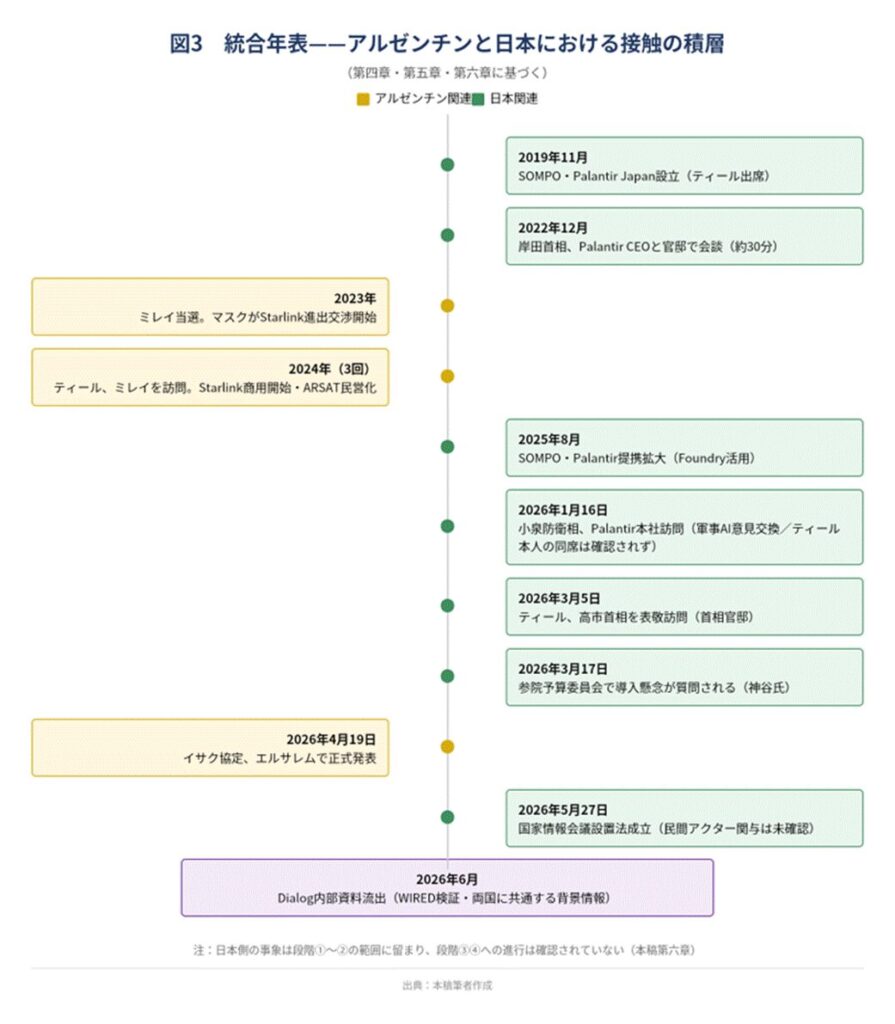
図3 統合年表——アルゼンチンと日本における接触の積層(出典:本稿筆者作成)
第六章 指標の適用②:日本——初期段階の兆候
6-1 なぜ日本は「アルゼンチン型」では実装されないか
※以下は確認済みの事実である。
日本には、アルゼンチンのような「国家解体」への政治的合意は存在しない。IMF構造改革のような外部からの圧力もなく、政治文化として国家機構への根本的な不信が広がっているわけでもない。この点を明示することは、本稿の分析が「日本もアルゼンチンと同じ道を辿る」という単純な予言ではないことを保証する上で、不可欠である。
6-2 段階①:思想的接触
2026年3月5日、ピーター・ティールは首相官邸で高市早苗首相を表敬訪問した。これは、2019年以前にも何度かビジネス目的や講演関係で来日していたティールにとって、政府関係者との初めての正式な接触であった。[16]会談は約25分間行われ、首相の訪米に向けて、小型モジュール炉などの日米の科学技術の展望について意見交換が行われたと報じられている。
この事実だけでは、段階①の「思想的共鳴」の有無を判定することはできない。会談内容として報じられているのは科学技術協力であり、ミレイのケースのような、明確な思想的言説の採用は、現時点では確認されていない。第一章で示した段階①の否定基準——「接触の主題が技術協力・商業案件に限定され、国家統治のあり方に関する言説が確認されない場合」——に、この事例は該当する。したがって、日本のケースは、段階①の最も初期的な兆候(接触の発生)に該当するに過ぎず、否定基準に照らせば、思想的共鳴の段階には至っていないと判定される。
※以下は確認済みの事実である。
この会談は、すでに日本の国会において公の政治的論点となっている。高市首相は3月17日の参院予算委員会で、参政党・神谷宗幣代表からの質問に対し、「(パランティアの)同社のサービスを利用するような話は全くしていない」と明確に答弁した。首相はティールについて、「バンス副大統領と仲がいい」「トランプ政権を作った立役者の一人である」という紹介を受けていたことも明らかにした。これは、Palantir導入への懸念がすでに日本の公開の政治的議論の対象になっていることを示す、重要な事実である。
※以下は確認済みの事実である。
この接触は、ティールから日本側への一方向だけではない。2026年1月16日(現地時間)、訪米中の小泉進次郎防衛大臣は、ワシントンD.C.のパランティア・テクノロジーズ本社を訪問し、同社幹部と安全保障分野におけるAIの活用状況について意見交換を行った。出迎えたのは同社の防衛部門長であり元米下院議員のマイク・ギャラガー氏であったことが、小泉氏自身のSNS投稿および防衛省の公式発表で確認されている。[33]
本稿が第一章で示した段階①の判定基準を、思想の体現者による訪問だけでなく、対象国側からの訪問も含む双方向の接触として定義し直すならば、この訪問も段階①の追加的な指標として位置づけられる。ただし、ここで起きたのは「日本の防衛大臣が、ティールが共同創業した企業の本社を訪問した」という事実であり、「日本の防衛大臣とティールが会談した」という事実ではない。ティール本人が同席したという記録は、防衛省の公式発表・共同通信の報道・小泉氏自身のSNS投稿のいずれにも見当たらず、この区別を曖昧にすることは、本稿が重視する反証可能性の原則に反する。
6-3 段階②:インフラの代替——当初評価よりも深い相互依存
※以下は確認済みの事実である。
2019年11月18日、SOMPOホールディングスとPalantir Technologiesは、データ解析プラットフォーム事業を展開する合弁会社「Palantir Technologies Japan株式会社」を共同設立することに合意した。資本金約108億円を両社が50%ずつ出資し、会見にはティール自身に加え、SOMPO側の櫻田謙悟グループCEO、楢﨑浩一グループCDOが出席した。会見後の質疑応答では、SOMPOが保有するリアルデータに対する個人情報の扱いへの懸念について、ティールは「哲学的な原則としてプライバシーを尊重する」と述べた。[17]
この関係は、本稿が当初想定していたより深い。 2020年、SOMPOはPalantir本体に対して5億ドル(約540億円)を出資しており、これは業務提携を超えた資本関係である。Palantir側も2023年にSOMPOとのパートナーシップを拡大し、2025年8月には「2回目の拡大」として複数年契約を発表した。[18]2025年8月時点で、SOMPOグループ・損害保険ジャパン・SOMPOケア・富士通を含む日本国内の利用従業員数は約8,000人規模に達している。
したがって、SOMPOの事例は、単なる「一企業の業務委託」ではなく、出資・経営参画・大規模な業務統合が複合した、段階②としては相応に進行した事例として再評価すべきである。ただし、アルゼンチンの事例(DNU941・Gemelo Digital Social)が国家機関間のデータ共有を法的に義務化する大統領令という、国家機能そのものの代替であるのに対し、SOMPOの事例はあくまで民間企業の自発的な経営判断であり、政府の権限を用いた強制を伴わない。この違いは重要である。第一章で示した段階②の否定基準のうち「契約解除・他社への切替が実務的に可能である場合」という条件についても、SOMPOがPalantirとの関係を一方的に解消できるかは、巨額の資本関係を踏まえると、形式的な代替可能性以上に複雑である可能性がある。本稿はこの点を、断定せず、今後の検証課題として明示する。
※以下は確認済みの事実である。
SOMPOに続き、日本の他の主要企業もPalantirとの関係を深めている。 富士通は2020年からPalantirと協業を開始し、2023年12月にグローバルパートナーシップを締結、2025年8月19日には生成AI基盤Palantir AIPに関するライセンス契約を締結した(2029年度末までに1億ドル規模の売上を目標とする)。さらに、富士通は防衛装備庁防衛イノベーション科学技術研究所から「防衛用マルチAIエージェントによるAI幕僚能力獲得の研究」を委託研究として受注している。[19]なお、この防衛装備庁の委託研究とPalantir AIPのライセンス契約は、現時点で公開されている情報の範囲では別個の契約であり、両者の間に技術的な連関があることを示す一次資料は確認されていない。住友商事も2026年3月19日、グループ会社を通じてPalantir Technologies JapanとAIPのライセンス契約を締結し、エネルギー関連(油井管ビジネス)のサプライチェーン管理への導入を進めている。[20]
※以下は、本稿執筆時点で独立した一次資料による確認ができていない情報である。
複数のウェブメディアが、日本の防衛省がPalantirの「Gotham」を「災害情報の統合分析」という名目で導入できないか検討しているという、ほぼ同一内容の記述を行っている。[21] しかし、これらの記述をたどっても、防衛省の公式発表・予算文書、または主要全国紙による独自の調査報道には行き着かなかった。複数の媒体が同一の文言を反復しているという事実は、独立した複数の確認を意味しない。むしろ、単一の未検証情報がウェブメディア間で反復されている可能性(いわゆる「シタジェネシス」)を否定できない。 本稿はこの情報を、段階③の確定的な事例としては扱わず、今後の検証を要する観察対象として記録するに留める。
6-4 段階③:政策言語への翻訳(現時点では未確認)
2026年、高市政権の下で「国家情報局」の創設が進められている。国家情報会議設置法は2026年5月27日、参院本会議で自民党・日本維新の会・国民民主党などの賛成により成立し、政府は同年夏にも国家情報局を発足させる予定である。[22]高市首相は会見で、自身が自民党総裁選挙で繰り返し公約してきた政策であると述べ、この法律を「第一歩」と位置づけ、今後スパイ防止法の制定や対外情報機関の設置を検討する考えを示した。一部野党からはプライバシー侵害への懸念が指摘された。この構想は、高市内閣発足(2025年10月)以前から首相自身が公約として掲げてきたものであり、第一章で示した段階③の否定基準——「政策・法案の立案過程が、特定の思想潮流とは独立した、国内の既存の政治的合意に基づいて説明できる場合」——に明確に該当する。特定の民間アクターや思想ネットワークの関与を示す一次資料は、現時点では一切確認されていない。
報道によれば、国家情報局の主導権を巡って、公安調査庁・警察庁・外務省・防衛省が互いに中核を担おうと活発に動いているという、国内省庁間の権限争いという、本稿の理論枠組みとは別の力学が働いていることが指摘されている。[23]
※以下は現時点での作業仮説であり、今後の実証を要する。
国家情報局のシステム構築を将来どの企業が担うかは、現時点では未公表である。本稿が提示する指標を踏まえれば、今後の調達・人事に関する公開情報を注視することが、早期警戒の具体的な実践となる。しかし、現時点でこれを段階③に該当すると判定する根拠はない。
6-5 二つの経路の比較表
| 要素 | アルゼンチン | 日本 |
| 段階①(思想的接触) | 確認済み(3回訪問、思想的共鳴の言説) | 接触は確認済み(ティール表敬訪問1回+小泉防衛相のパランティア本社訪問1回)、思想的共鳴は未確認 |
| 段階②(インフラの代替) | 確認済み(国営通信の民営化+Starlink進出) | 限定的(一企業の業務委託、国家機能の代替ではない) |
| 段階③(政策言語への翻訳) | 確認済み(デジタルツイン計画) | 未確認(国家情報局構想に民間アクターの関与は確認されず) |
| 段階④(政権への直接接触) | 確認済み(継続的な政策協議+イサク協定※後者は作業仮説) | 未確認(一回の表敬訪問のみ) |
| 総合評価 | 進行事例(段階③〜④) | 初期兆候(段階①の一部、段階②の限定例) |
6-6 評価
日本は、本稿の指標において、段階①の限定的な兆候と、段階②の極めて限定的な事例(一企業の業務委託)が観察されるに過ぎない。 これは「危機が進行している」と断定する根拠にはならないが、早期警戒の対象として、継続的に監視すべき焦点であることを示している。
第七章 脅威が現れる三つの層
これまでの分析を踏まえ、思想輸出が技術的に実装される三つの層を整理する。これらの三層は、第一章のフレームワークにおける段階②(インフラの代替)が、対象とする領域別に取りうる具体的な発現形態として理解できる。 通信・データ・軍事AIという異なる領域であっても、国家が担っていた機能が特定の民間アクター群に置き換わるという構造は共通しており、本章はその構造が領域ごとにどのような形を取るかを示す。
7-1 代替層:宇宙インフラ
通信インフラの代替は、海底ケーブルという物理層だけでなく、衛星通信という代替層にも及ぶ。NATOは、海底ケーブルに障害が発生した場合に高優先度データを衛星に迂回させる「Project HEIST」を2024年に発表したが、ロシアが水中と宇宙の両ドメインで同時にエスカレーションを図るリスクが指摘されており、この戦略が「キャッチ22」(どちらを選んでも袋小路)に陥る可能性が懸念されている。
7-2 個人データ層:保険・金融インフラ
SOMPO・Palantirの事例が示す通り、個人データ層への浸透は、政治的合意を必要としない、最も目立たない経路である。さらにSOMPOのケースは、業務委託に加えて出資という資本関係を伴っており、企業レベルの依存が、単純な契約解除では清算できない深度に達しうることを示す。これは段階②の「インフラの代替」が、国家機能の代替よりも先に、かつより複雑な形で、企業レベルで進行しうることを示している。
7-3 軍事AI層:同盟の非対称化
日本・韓国・オーストラリアは、すでにPalantirと軍事・安全保障分野での契約関係にある。この依存が深まれば、条約上の同盟義務とは別の次元で、行動制約が生まれる可能性がある——本稿はこれを「技術的拘束による同盟の非対称化」と呼ぶ。
第八章 日本の構造的盲点——なぜ見えにくいのか
8-1 文化的要因と思想用語の認知における内外差
※以下は確認済みの事実である。
「ダーク・エンライトメント」「新反動主義」という用語自体は、日本語圏において完全に無名というわけではない。日本語版ウィキペディアに独立した項目「暗黒啓蒙」が存在し[24]、木澤佐登志による解説書『ニック・ランドと新反動主義 現代世界を覆う〈ダーク〉な思想』(星海社新書、2019年)が刊行されているほか[25]、note等の個人ブログでも複数の紹介記事が確認できる。
しかし、本稿の調査範囲では、これらの言及はいずれも思想史・サブカルチャー的な文脈(哲学書、個人の論考)に留まっており、日本の主要紙の政治・安全保障面や、防衛省・外務省関連のシンクタンクの分析において、この思想とPalantirの日本展開・国家情報局構想を結びつけた言及は確認できなかった。 本稿はウェブ検索による限定的な調査に基づくものであり、この結論は本稿執筆時点での確認結果であって、将来にわたる断定ではない。
※以下は現時点での作業仮説であり、今後の実証を要する。
和・集団・合意を重視する日本の政治文化は、ダーク・エンライトメントのような、明示的に反民主主義的な思想言語とは、根本的な不親和性を持つ。この文化的距離が、逆説的に「思想的免疫の欠如」を生む可能性がある。親和性のない思想は、脅威として認識されにくく、その思想的動因を持つアクターとの交渉において、判断を誤るリスクがある。
すなわち、日本における「盲点」は、思想そのものの紹介が欠落していることではなく、思想史的な知識と、安全保障政策の現場における警戒との間に、橋が架かっていないことにあると考えられる。 この橋渡しの欠落こそが、本稿が早期警戒モデルの構築を提言する理由である。
8-2 制度の実効性という、もう一つの構造的脆弱性——放送法外資規制の事例
※以下は確認済みの事実である。
本稿が論じる「思想ネットワークに連なる特定アクターへの依存」とは異質だが、関連する構造的脆弱性が、日本の制度運用そのものにも見られる。放送法・電波法は、言論報道機関への外国資本支配を防ぐため、地上波・衛星放送事業者の外国人議決権比率を20%未満とするよう定めている。しかし2021年、フジ・メディアホールディングスが2012年9月から約2年間にわたり、この上限を超えていたことが判明した。[26]東北新社も同年、別の外資規制違反が発覚し、衛星放送事業の一部認定取り消しとなった。
重要なのは、フジの違反が判明した後も、認定取り消しという制度上の罰則が実際には適用されなかった点である。 これは「規制は存在するが、実効性を欠く」という、本稿が繰り返し指摘してきた構造的傾向——制度の形式と、その執行力の間に生じる落差——の、情報・メディア領域における具体的な実例である。総務省は2022年、外資比率の定期報告義務化等を盛り込んだ法改正を行ったが、これは事後報告の強化に留まり、即時の罰則を強化するものではなかった。
この事例は、技術主権的アクターの議論とは別の文脈に属するが、本稿の核心的な問い——『制度はあるが、機能しているか』——を、日本国内の既存の事例で補強する。 本稿が調査した範囲は、情報・データ・通信領域に集中しており、交通・水道・エネルギー等、他の重要インフラ領域における同様の構造的脆弱性の有無は、本稿の対象外として今後の検証課題とする。
第九章 自律性の二類型——インドとフランスという二つの先例
技術主権的アクターへの依存を避けるための「自律性」には、本稿の調査によって、二つの全く異なる形があることが判明した。
9-1 インド型:孤立による脆弱性の放置
※以下は確認済みの事実である。
インドは、自国製プラットフォーム(UPI等の決済システム等)へのこだわりが強い国家として知られる。しかし、2022年4月、米サイバーセキュリティ企業Recorded Future(脅威研究部門Insikt Group)は、中国国家の関与が疑われるハッカー集団(同社が「TAG-38」と命名)が、インド・ラダック国境地帯にある7つの州負荷分散センター(SLDC、電力系統制御・配電の実務を担う重要施設)への侵入を継続的に行っていたことを公表した。インド政府のシン電力相は、中国側ハッカーによる2回の試みがあったが「成功しなかった」と公式に説明した。[27]Recorded Futureは、これが経済的利益を目的とした通常のスパイ活動とは異なり、将来の有事における能力構築や事前配置を意図したものと分析している。これは特定の自前主義的な国家であっても、外部からの組織的なサイバー攻撃を免れないことを示す事例である。さらに2026年の脅威レポートによれば、クラウド環境における全検知の62%が誤設定に起因しており、[28]自前主義へのこだわりが、必ずしも運用面の安全性向上に直結していない実態が示されている。
インドの事例が示すのは、「自国で作れば安全」という前提が成立しないという事実である。 自前主義は、国際的な脅威情報共有からの孤立を伴う場合、運用面の脆弱性を放置する結果につながりうる。
※以下は確認済みの事実である。
インドの自前主義は、2026年に別の方向からも試されている。2026年6月、米国政府の輸出管理指令を受け、Anthropicは最上位モデル(Fable 5・Mythos 5)への米国外からの全アクセスを遮断した。これにより、インドの開発者・企業(業務にClaudeを組み込んでいたタタ・コンサルタンシー・サービシズ(TCS)の大規模研修パートナーシップ等を含む)が、契約直後にアクセスを失う事態が発生した。[34] 元Infosys CFOのモハンダス・パイ氏は、年間5,000億ルピー規模の「ソブリンAIファンド」創設をモディ首相に要求し、Zoho共同創業者のスリダール・ヴェンブ氏は「技術は主権の究極の武器になった」と述べている。[35]
これは、本稿が示した「自前主義は運用面の脆弱性を放置する」という論旨とは別方向の事例であり、注意深く位置づける必要がある。TAG-38の事例は「自前で作っても安全とは限らない」ことを示すが、Anthropicの事例は逆に「外国製の先端技術に依存すれば、地政学的判断一つでアクセスを失う」ことを示しており、自前主義を後押しする方向に働く。すなわち、自前主義には運用面の脆弱性という代償があり、依存には地政学的なアクセス遮断という代償がある。本稿が提示する「情報と権限の制度的分離」という第三の道は、この両方の代償を同時に回避しようとする試みである。
9-2 フランス型:制度分離による両立、ただし運用面の課題も残る
※以下は確認済みの事実である。
フランスは、2026-2030年の国家サイバーセキュリティ戦略において、EUとの協力を「主権のための戦い」と位置づけ、CSIRTネットワーク等を通じた欧州レベルでの脅威情報共有を重視している。[29]同時に、2021年に開始された「クラウド・オ・サントル(Cloud au Centre)」ドクトリンの下、国家行政機関・公益団体が機密データ(法律上保護される秘密、国家の本質的機能に必要なデータ)を扱う際は、非EU当局による不正アクセスを実効的に防止する措置を実装したクラウドサービスを選択しなければならず、これは実務上、ANSSI(フランス国家サイバーセキュリティ庁)が発行する「SecNumCloud」資格(2017年策定、現行版3.2は約1,200項目の要件を含む)を保有する事業者の利用を意味する。これは米国CLOUD法・FISA等の域外干渉を防ぐための、厳格な主権要件である。[30]2026年時点でSecNumCloud資格を保有する事業者は9社、審査中の事業者は12社に留まり、市場規模はフランス国内で約1,800万ユーロと、欧州主権クラウド市場全体(約124億ユーロ)の中ではなお小さい。
ただし、フランスの運用実態は、明暗両面を持つことを正確に記述しなければならない。2024年第1四半期、フランスの公的雇用サービス機関France Travailは、ソーシャルエンジニアリング(CAP EMPLOI職員の認証情報を欺いて奪取する手法)により、約4300万人分の個人情報(社会保障番号・氏名・生年月日・メールアドレス・電話番号等)が漏洩する、フランス公共部門史上最大のデータ侵害を受けた。フランスの個人情報保護機関CNILは2026年1月29日、調査の結果、認証プロセスの不備や異常検知ログの不足等、「基本的なセキュリティ原則の無視」があったと断定し、500万ユーロの制裁金を科した。[31]これは、制度分離型のモデルであっても、運用面の失敗(特に技術的脆弱性ではなく、人的・組織的な管理体制の不備)を完全には防げないことを示す事実である。
一方、同年に開催されたパリ夏季オリンピックにおいては、二件のランサムウェア攻撃が検知されたが、ANSSIは情報システムの分割(セグメンテーション)と迅速な対応により、これらが重要システムの混乱や大会運営への干渉には至らなかったと評価している。両事例を対比すると、フランスの強みは「攻撃を完全に防ぐ能力」ではなく「重大インフラと一般システムを分離し、被害の伝播を限定する設計」にあることが分かる。
9-3 二類型の本質的な違い
インド型は「依存の単純な裏返し」である。 外国民間企業を排除すること自体を目的化し、国際的な脅威情報の共有という協力的側面まで縮小させてしまう。結果として、運用面での脆弱性が放置される。
フランス型は「情報と権限の制度的分離」である。 脅威情報の共有では国際協力に積極的に参加しながら、基幹データに最終的にアクセスできる権限は、明確な制度的基準(SecNumCloud等)によって、国家の手の中に保持する。
※以下は現時点での作業仮説であり、今後の実証を要する。
ただし、フランスのモデルも完全ではない。シンクタンクCigrefがAsterès社に委託した調査(2025年4月)によれば、欧州企業のクラウド・ソフトウェア支出の83%が米企業(主にAmazon Web Services、Google、Microsoft Azure)に向けられ、その価値の80%が米国内で創出されており、これは年間約264億ユーロ(欧州連合のGDPの約1.5%に相当)が米国経済に流出している計算になる。[32]これは、SecNumCloudのような厳格な主権要件を持つフランスであっても、実際の市場構造においては、なお深い対米依存が残っていることを示す。制度分離モデルは「完成された自律性」を意味するわけではない。本稿は、フランスを「模範」としてではなく、日本が参照しうる、現実的な方向性の一例として位置づける。
9-4 二類型を超える第三のリスク:基盤モデル依存というサプライチェーンの死角
※以下は確認済みの事実である。
9-1・9-2が示した二つの失敗モード——孤立による脆弱性の放置、依存による経済的浸食——に加えて、2026年にはこのいずれとも異なる第三の失敗モードを示す事例が現れた。9-1で述べた通り、2026年6月、米国政府の輸出管理指令により、Anthropicは最上位モデル(Fable 5・Mythos 5)への米国外からの全アクセスを遮断し、インドを含む非米国の利用者がアクセスを失った。これは、自前主義の失敗でも、制度分離の不備でもなく、外国製AIサービスへの依存が、提供国側の一方的な政策判断によって遮断されるという、独立した第三の失敗モードである。
さらに重要な点として、この層は本稿が第六章で論じたPalantir依存の議論と直接接続する。PalantirのAIプラットフォーム(AIP)は、自社開発モデルに限らず、Anthropic・OpenAI・Google等、複数の外部基盤モデルを選択的に組み込む「マルチモデル」設計を採用している。[36] 実際に2026年2月、米国防総省はAnthropicとの契約交渉が決裂したことを受け、同社を「サプライチェーンリスク」に指定し、Anthropicと取引する全ての防衛関連業者に取引停止を要求する事態が発生した(なお、この措置は2026年3月、連邦地裁により「報復的かつ違憲」として差し止められている。これは輸出管理を根拠とするFable 5・Mythos 5の対外遮断とは法的根拠が異なり、当該裁判の対象外である)。[37]
この一連の経緯が示すのは、Palantirという一企業との関係を日本がいかに慎重に管理しても、その先にある基盤モデル提供企業の地政学的立場までは、契約上の統制が及ばないという、依存構造の「入れ子」である。
※以下は推察であり、今後の実証を要する。
日本国内のPalantir関連システム(SOMPO・富士通等)が現時点でどの基盤モデルを採用しているかは、公開情報からは確認できない。しかし、AIPがマルチモデル設計である以上、将来的にいずれの基盤モデルを採用したとしても、その提供企業の本国(主に米国)の政策判断によって、日本側の意図とは無関係にアクセスの可否が変化する可能性は、構造的に常に存在する。 本稿が示す二類型(孤立型・制度分離型)は、いずれもこの第三のリスクには直接対応していない。
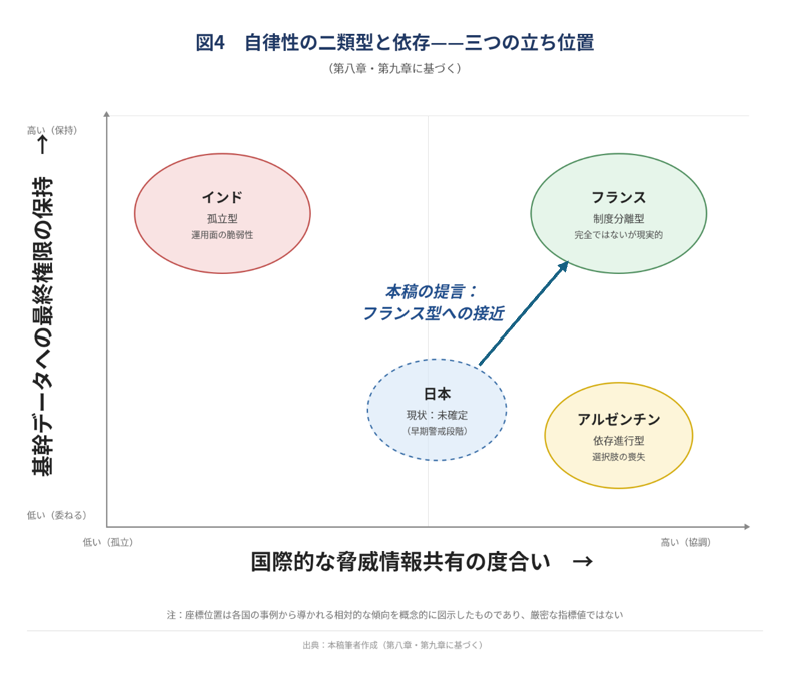
図4 自律性の二類型と依存——三つの立ち位置、および日本への提言(出典:本稿筆者作成)
第十章 政策的含意
提言① 思想輸出進行度指標の制度的運用
本稿が提示した四段階指標を、外務省・防衛省・経済産業省等が共同で運用する、継続的な早期警戒モニタリングの基準として制度化することを提言する。これにより、「依存が深まった後に気づく」のではなく、進行段階を事前に把握し、対応の時間的余裕を確保することが可能になる。
提言② 情報と権限の制度的分離(フランス型モデルの応用)
脅威情報の共有協定(FBI・NSA・CISA等との協力)と、基幹システムの構築・運用委託契約は、異なる承認プロセス・異なる監視体制を適用するべきである。「情報を集めること」と「権限を委ねること」を、制度上明確に区別する基準を確立することが、日本にとって最も現実的な方針である。
提言③ 経済安全保障推進法の概念拡張
特定重要技術の概念を、軍事AI・データ統合プラットフォームに拡張し、外国民間企業の参入に対する「地政学的自律性影響評価」の制度化を検討すべきである。
提言④ 外交・防衛における思想的リテラシーの制度化
技術依存のリスク評価は、法制度や技術基準だけでは不十分である。交渉相手の思想的動因を読み解く能力を、外交官・防衛官僚・政治家の教育に組み込む必要がある。日本の政治文化は、ダーク・エンライトメントのような攻撃的思想言語との親和性が低く、それゆえ思想的動因を持つアクターの意図を過小評価しやすい構造的傾向がある。この「文化的盲点」を自覚し、思想的リテラシーを安全保障教育の正式な柱として位置づけることが急務である。
提言⑤ AIシステムの基盤モデル依存の可視化
政府・公的機関が導入するAIシステム(Palantir AIP等のマルチモデル型プラットフォームを含む)について、その基盤として実際に使用されるAIモデルの提供企業・提供国を特定し、当該モデルが提供国側の地政学的判断(輸出管理・防衛調達規則の変更等)によってアクセスを遮断されるリスクを、システム選定・継続運用の評価項目に明記すべきである。 ベンダー(Palantir等)との関係管理だけでは、その先にある基盤モデル層の依存リスクは捉えられない(第九章9-4参照)。
結論
本稿は、米国シリコンバレーで体系化された反民主主義的統治思想が、国境を越えてどの国家を選び、どの順序で浸透するかを、四段階の診断フレームワークを用いて実証的に追跡した。
アルゼンチンは、この指標において、思想的接触からインフラの代替、政策言語への翻訳、そして政権への継続的な政策協議という、四段階のほぼ全てが進行した、現時点で唯一の完成形に近い事例である(このうち政権への政策協議の一部はイサク協定を指標とし、これは作業仮説に基づく)。日本は、思想的接触の初期段階と、一企業レベルでの限定的なインフラ代替が観察されるに過ぎず、危機が進行しているとは言えない。しかし、これは「安全である」ことを意味するのではなく、早期警戒によって対応の選択肢が残されている段階にあることを意味する。
本稿が最終的に提示する方針は、依存でも孤立でもない。インドが示した「孤立による脆弱性の放置」と、アルゼンチンが示した「依存による選択肢の喪失」——この二つの失敗の間にある、フランスが示す「情報と権限の制度的分離」という第三の道を、日本は意識的に設計すべきである。情報を集めながら、支配されない。 これが、本稿が提示する、日本のサイバー安全保障における最も現実的な戦略的方針である。
最後に、本稿のタイトルにある「輸出」という語の限界について明記しておく。本稿が示した事実の多くは、ティール側の能動的な働きかけよりも、受容国側の構造的条件(国家への不信、効率化への要求)が先に存在し、そこに思想が「接木」されるという、受動的な構造に帰着する。したがって「輸出」とは、特定のアクターが他国を計画的に標的にしていることを実証する語ではなく、観察された浸透パターンを指す比喩として用いていることを、ここに明記する。
後記:継続的監視の必要性
本稿が提示した思想輸出進行度指標は、固定された判定ではなく、継続的な観察を前提とした分析ツールである。日本における段階②・③の進行の有無——特に、国家情報局のシステム構築を担う主体、および高市政権とティール周辺の接触が一回限りの儀礼か、継続的な政策協議に発展するか——は、本稿執筆時点では未確定であり、今後の公開情報を注視することが、早期警戒の具体的な実践となる。
特に、富士通が防衛装備庁の委託研究(防衛用マルチAIエージェント研究)と、Palantir AIPのライセンス契約という、防衛・商用の両分野でPalantirとの関係を別個に深めている現状(両者の間に技術的な連関を示す一次資料はない)を踏まえると、富士通が将来的に国家情報局のシステム構築に関与する可能性は、本稿が今後注視すべき具体的な観察対象の一つである。ただし、本稿執筆時点でこれを示す一次資料は存在せず、断定はできない。
参考資料
[1] Thiel, P. (2009). The Education of a Libertarian. Cato Unbound. https://www.cato-unbound.org/2009/04/13/peter-thiel/education-libertarian/
[2] Wikipedia, “Dark Enlightenment.” https://en.wikipedia.org/wiki/Dark_Enlightenment / Miranda, A. (2025). “Understanding Neoreaction: A Focus on Curtis Yarvin.” illiberalism.org.
[3] Wikipedia, “Curtis Yarvin.” https://en.wikipedia.org/wiki/Curtis_Yarvin
[4] The New Republic (2024年). “Where J.D. Vance Gets His Weird, Terrifying Techno-Authoritarian Ideas.” https://newrepublic.com/article/183971/jd-vance-weird-terrifying-techno-authoritarian-ideas / Newsweek (2025年1月18日). “Who is Curtis Yarvin? Conservative linked to JD Vance wants ‘monarchy’.”
[5] The Guardian (2024年12月21日). Wilson, Jason. “He’s anti-democracy and pro-Trump: the obscure ‘dark enlightenment’ blogger influencing the next US administration.” / Political Research Associates (2025年6月13日). “Tech Capitalism and the Neoreactionary Movement Behind DOGE.” https://politicalresearch.org/2025/06/13/tech-capitalism-and-neoreactionary-movement-behind-doge / The Nation (2024年12月18日). “A Guide to Some of the Key Movers and Influencers in Trump’s Orbit.”
[6] New Zealand Herald (2017年1月25日). “Controversial billionaire Peter Thiel made a Kiwi after two-week holiday.” https://www.nzherald.co.nz/business/controversial-billionaire-peter-thiel-made-a-kiwi-after-two-week-holiday/H7ZMW57ILS4VX3TTY3LBRGFHRA/ / RNZ (2017年6月30日). “Govt digs in over Thiel citizenship decision.” https://www.rnz.co.nz/news/political/334161/govt-digs-in-over-thiel-citizenship-decision
[7] Wikipedia, “Peter Thiel.” https://en.wikipedia.org/wiki/Peter_Thiel (Pronomos Capital、Praxis、デンマークでのPalantir統合に対するグリーンランド主権論争について)
[8] WIRED (2026年6月20日). “Leak Exposes Members of Peter Thiel’s Secretive ‘Dialog‘ Society.” https://www.wired.com/story/leak-exposes-members-of-peter-thiels-secretive-dialog-society/
[9] 同上.
[10] MercoPress (2026年4月23日). “Tech magnate Peter Thiel meets Milei after a week of private contacts with the Argentine government.” https://en.mercopress.com/2026/04/23/tech-magnate-peter-thiel-meets-milei-after-a-week-of-private-contacts-with-the-argentine-government / Buenos Aires Times (2026年4月24日). “Milei discusses taxes, culture war, politics in ‘wonderful’ meeting with Thiel.” / Buenos Aires Herald (2026年4月23日). “Peter Thiel meets with Javier Milei in Buenos Aires.”
[11] Reuters (2023年11月). Milei election victory and Musk reaction coverage. / ENACOM Resolución 1291/2020(Starlinkアルゼンチン運営許可、2021年12月発効).
[12] Amnistía Internacional Argentina (2026年5月). “Caso Palantir en Argentina.” / DNU 941/2025(2025年12月31日公布、国家情報法改正).
[13] Informáticos.ar (2026年4月23日). “Palantir: una amenaza para la democracia.” https://informaticos.ar/palantir-una-amenaza-para-la-democracia/
[14] Radio Gráfica (2026年5月28日). “Milei lanza en Argentina un sistema de inteligencia artificial bajo la sombra de Palantir.”
[15] DLA Piper (2026). The Isaac Accords: Argentina’s New Strategic Framework with Israel. / The Jerusalem Post (2026). / AP News (2025).
[16] 首相官邸. ティール氏来日・表敬訪問報道(2026年3月5日).
[17] SOMPOホールディングス公式発表 (2019年11月18日). https://www.sompo-hd.com/~/media/hd/files/news/2019/20191118_1.pdf / 日経クロステック (2019年11月18日). 「世界の課題解決に挑む、SOMPOHDがデータ解析の米パランティアと新会社設立へ」
[18] 西村あさひ法律事務所 (2020). “SOMPOホールディングス株式会社:Palantir Technologies Inc.への出資” / CX研究所 (2026). 「パランティアとは?事業内容・株価・日本進出を解説」.
[19] 日本経済新聞 (2025年8月19日). 「富士通、米パランティアとAI契約」 / 富士通公式発表 (2023年12月5日、2025年8月19日). グローバルパートナーシップ・ライセンス契約締結について / 防衛装備庁防衛イノベーション科学技術研究所、富士通への委託研究(防衛用マルチAIエージェント研究)関連発表.
[20] 住友商事公式発表 (2026年3月19日). Ascend SCを通じたPalantir Technologies Japanとのライセンス契約締結について.
[21] 日本語版ウィキペディア「パランティア・テクノロジーズ」https://ja.wikipedia.org/wiki/パランティア・テクノロジーズ / JBpress (2026年3月). 「データ解析企業・パランティアの実態」 / 現代ビジネス (2026年3月). 「高市総理が急接近したピーター・ティール」 (注:いずれも同一内容の記述であり、防衛省の公式発表・主要全国紙による独立した確認は本稿執筆時点で得られていない).
[22] 首相官邸 (2026年5月27日). 「国家情報会議設置法の成立についての会見」https://www.kantei.go.jp/jp/105/statement/2026/0527kaiken.html / 内閣官房 (2026). 「国家情報会議設置法案概要」https://www.cas.go.jp/jp/houan/260313/gaiyou.pdf / 参議院議案情報 https://www.sangiin.go.jp/japanese/joho1/kousei/gian/221/meisai/m221080221024.htm
[23] sbbit.jp (2026). 「いよいよ創設間近の『国家情報局』、日本版『CIA』でも『FBI』でもないと言えるワケ」.
[24] 日本語版ウィキペディア「暗黒啓蒙」. https://ja.wikipedia.org/wiki/暗黒啓蒙
[25] 木澤佐登志 (2019年). 『ニック・ランドと新反動主義 現代世界を覆う〈ダーク〉な思想』星海社新書.
[26] 総務省 (2021). フジ・メディアホールディングス外資規制違反に関する報道発表 / 国会図書館調査資料. 東北新社の外資規制違反と衛星放送認定取り消し(2021年).
[27] The Record from Recorded Future News (2022年4月6日). “Suspected China-backed hackers target 7 Indian electricity grid centers.” / The Diplomat (2022年4月8日). “Chinese Hackers Reportedly Target India’s Power Grid.”
[28] eventussecurity.com (2026). “Top 15 Recent Cyber Attacks in India 2026.”
[29] SGDSN (2026). “National Cybersecurity Strategy 2026–2030.” https://www.sgdsn.gouv.fr/files/files/National%20cybersecurity%20strategy_ENG.pdf
[30] Chambers and Partners (2026). “Cybersecurity 2026 – France.” / Legiscope (2026). “Certification SecNumCloud ANSSI : Guide Complet 2026.”
[31] CNIL (2026年1月29日). “Data breach: FRANCE TRAVAIL fined €5 million.” https://www.cnil.fr/en/data-breach-5million-fine-france-travail / Infosecurity Magazine (2026年1月29日). “France Fines National Employment Agency €5m Over 2024 Data Breach.”
[32] Asterès / Cigref (2025年4月25日). “Technological Dependence on American Software and Cloud Services: An Assessment of the Economic Consequences in Europe.” https://www.cigref.fr/wp/wp-content/uploads/2025/05/TECHNOLOGICAL-DEPENDENCE-ON-AMERICAN-SOFTWARE-AND-CLOUD-SERVICES-AN-ASSESSMENT-OF-THE-ECONOMIC-CONSEQUENCES.pdf (Cigref・Numeum委託調査)
[33] 防衛省 (2026年1月16日). 「小泉防衛大臣の米国訪問」https://www.mod.go.jp/j/approach/anpo/2026/0112a_usa-j.html / 共同通信 (2026年1月17日). 「小泉防衛相、最先端技術を視察」 / 小泉進次郎 X(旧Twitter)投稿 (2026年1月17日).
[34] Anthropic公式発表 (2026年6月12日). “Statement on the US government directive to suspend access to Fable 5 and Mythos 5.” https://www.anthropic.com/news/fable-mythos-access / CNBC (2026年6月12日). “Anthropic disables access to Fable 5 and Mythos 5 to comply with government directive.” / Al Jazeera (2026年6月14日). “US asks Anthropic to block global access to top AI models: Why it matters.”(Reuters報道を引用)
[35] The Next Web (2026年6月). “Anthropic’s model shutdown just handed India’s sovereign AI movement its strongest argument yet.”
[36] Palantir Technologies. “AIP Model Catalog.” https://www.palantir.com/docs/foundry/model-catalog/overview / Palantir Technologies, AWS, Anthropic 共同発表 (2024年11月). “Anthropic and Palantir Partner to Bring Claude AI Models to AWS for U.S. Government Intelligence and Defense Operations.”
[37] CBS News (2026年2月27日). “Hegseth declares Anthropic a supply chain risk, restricting military contractors from doing business with AI giant.” / CNN Business (2026年3月26日). “Judge blocks Pentagon’s effort to ‘punish’ Anthropic by labeling it a supply chain risk.” / Mayer Brown (2026年3月). “Anthropic Supply Chain Risk Designation Takes Effect — Latest Developments and Next Steps for Government Contractors.”
用語集
リバタリアニズム(Libertarianism)
個人の自由・私的財産権・市場経済を最大限尊重し、国家による介入・規制を最小化すべきとする政治思想。本稿が論じるダーク・エンライトメントは、このリバタリアニズムの一部の論者が、「国家を縮小する」という主張から、さらに進んで「民主主義そのものが自由の障害である」という結論に至った、より過激な分岐として位置づけられる。ピーター・ティールの2009年エッセイは、この分岐点を象徴する文書である。
ダーク・エンライトメント(新反動主義/Dark Enlightenment, NRx)
2000年代半ばにオンライン空間で生まれた、反民主主義・反平等主義・反進歩主義の思想運動。カーティス・ヤーヴィンが体系化し、ニック・ランドが拡張した。民主主義を「非効率な制度」として退け、企業統治に類似した権威主義的体制への置き換えを志向する。
思想輸出進行度指標(Ideological Infiltration Index)
本稿が提唱する、思想が国境を越えて国家に浸透する過程を四段階(思想的接触・インフラの代替・政策言語への翻訳・政権への直接接触)に分解した診断フレームワーク。
シーステッディング/チャーターシティ(Seasteading / Charter Cities)
既存の国家の主権が及ばない場所(公海上、または法的に特別な地位を持つ陸上の区域)に、独自の統治ルールを持つ自治コミュニティを建設するという構想。ティールはシーステッディング研究所の初期支援者であり、その後Pronomos Capital等を通じてチャーターシティ(ホンジュラスのPrósperaなど)への投資を継続している。本稿第三章で論じるニュージーランドの事例は、この構想の実現以前における、既存国家の枠内での実践的先行例として位置づけられる。
Dialog
2006年、ピーター・ティールが共同設立した招待制・非公開の組織。2026年6月、内部資料の流出によりWIREDが実態を検証・報道した。[8]
技術主権的アクター(Techno-Sovereign Actor)
国家でも通常の多国籍企業でもなく、軍事AI・宇宙・国家データ統合・通信インフラ・戦略資源という複数の安全保障関連領域を横断的に掌握する民間アクター群。
自律性の二類型(孤立型/制度分離型)
技術主権的アクターへの依存を避けるための自律性には、国際的な脅威情報共有から孤立し運用面の脆弱性を放置する「孤立型」(インドの事例)と、脅威情報共有では国際協力を維持しながら基幹データへの権限を制度的に分離する「制度分離型」(フランスの事例)という、二つの異なる形がある。
Project 2025
米ヘリテージ財団が主導した政策文書(2023年4月発表)。新反動主義的なビジョンと、シンクタンクの言語で包装された思想的並行性を持つとされる。中心的な起草者はラス・ヴォート。
ラス・ヴォート(Russell Vought)
第一次トランプ政権で行政管理予算局長を務めた人物。Project 2025の中心的な起草者であり、自身が主宰するシンクタンク「Center for Renewing America(CRA)」を通じて、政権発足直後に署名可能な大統領令の草案を作成した。「腐敗した官僚機構」との対決を掲げる姿勢は、ヤーヴィンが「カテドラル」の解体と呼ぶ主張と内容的に一致するとされる。
© 2026 一般財団法人 日本危機管理研究所 無断転載を禁じます
筆者:舩山美保 一般財団法人 日本危機管理研究所 理事
国際標準化、技術インテリジェンス、知的財産分析、地政学・危機管理を専門とする戦略アナリスト。キヤノン株式会社において国際標準・新技術分野の特許調査および戦略分析業務に従事。ISO/IEC JTC 1/SC 28(オフィス機器)副国際幹事として、国際規格策定および多国間交渉の調整を担い、国際標準化活動への貢献によりITSCJ国際標準化貢献賞を3回受賞。現在、中東アジア情報戦略研究所フェロー。公益社団法人 日本外国特派員協会(FCCJ)プロフェッショナル・アソシエイト会員。上智大学国際政治学科卒業。青山学院大学大学院修了(国際政治経済学・哲学・心理学)。
研究領域:言語・行動パターンの体系的分析手法を応用した意思決定構造・行動構造の解析を専門とする。とりわけPSYOP(心理作戦)および情報戦の分析、ならびに危機管理政策の視点からセキュリティインテリジェンスの研究・分析を行っている。国際政治学・心理学・哲学にまたがる学際的バックグラウンドを基盤に、国家・非国家アクターによる認知領域への介入メカニズムの解明に取り組む。
English Translation
The Ideological Infiltration Index
Which Nations Does the Dark Enlightenment Choose, and in What Order Does It Spread?
Published: June 28, 2026
Publisher: Japan Institute of Crisis Management
A leaked invitation-only network linking NATO’s top commander, a U.S. Treasury Secretary, and Peter Thiel. A four-stage diagnostic framework traces how an anti-democratic ideology moves from Silicon Valley to Buenos Aires — with early signs now emerging in Japan.
Table of Contents
A Note on the Scope and Method of This Paper
Novelty and Aims of This Paper
Introduction: Framing the Question
Chapter One — The Ideological Infiltration Index: A Four-Stage Diagnostic Framework
Stage ①: Ideological Contact
Stage ②: Infrastructural Substitution
Stage ③: Policy Codification
Stage ④: Direct Political Engagement
Operational Policy of the Framework
Chapter Two — Anatomy of an Ideology: From Libertarianism to the Dark Enlightenment
2-1 Point of Origin: Thiel’s 2009 Essay
2-2 Systematization: Curtis Yarvin and Neoreaction
2-3 Translation into Political Power: The Vance Channel — A Reservation About Its Strength
2-4 Codification into Governance: Project 2025
Chapter Three — The Ideology’s First Practice: New Zealand as a Precedent
3-1 “No Country Aligns More with My View of the Future”: Citizenship as the Smallest Unit of Contact
3-2 Connections to Intelligence and Defense Agencies: An Approach Toward Stage ②
3-3 A Consistent Practice of Building Governing Units Outside National Borders
Chapter Four — An Institutionalized Network: Dialog
4-1 The Existence and Structure of Dialog
4-2 An Analysis of Participant Composition
4-3 A Working Hypothesis on Dialog’s Function
Chapter Five — Applying the Index (I): Argentina, a Case That Has Progressed Through Three Stages
5-1 Why Argentina Was Chosen
5-2 Stage ①: Ideological Contact
5-3 Stage ②: Infrastructural Substitution
5-4 Stage ③: Policy Codification
5-5 Approaching Stage ④: The Isaac Accords
5-6 Assessment
Chapter Six — Applying the Index (II): Japan, Early-Stage Signs
6-1 Why Japan Will Not Follow the “Argentine Pattern”
6-2 Stage ①: Ideological Contact
6-3 Stage ②: Infrastructural Substitution — A Deeper Mutual Dependence Than Initially Assessed
6-4 Stage ③: Policy Codification (Currently Unconfirmed)
6-5 A Comparison Table of the Two Paths
6-6 Assessment
Chapter Seven — Three Layers Where the Threat Appears
7-1 The Substitution Layer: Space Infrastructure
7-2 The Personal-Data Layer: Insurance and Financial Infrastructure
7-3 The Military-AI Layer: The Asymmetric Erosion of Alliances
Chapter Eight — Japan’s Structural Blind Spot: Why It Is Hard to See
8-1 Cultural Factors and the Gap Between Domestic and Foreign Awareness of Ideological Terminology
8-2 A Second Structural Vulnerability — the Effectiveness of Institutions: The Case of Broadcasting Foreign-Ownership Restrictions
Chapter Nine — Two Types of Autonomy: India and France as Two Precedents
9-1 The Indian Type: Leaving Operational Vulnerability Unaddressed Through Isolation
9-2 The French Type: Reconciling the Two Through Institutional Separation, Though Operational Challenges Remain
9-3 The Essential Difference Between the Two Types
9-4 A Third Risk Beyond the Two Types: The Supply-Chain Blind Spot of Foundation-Model Dependence
Chapter Ten — Policy Implications
Recommendation ① Institutionalizing the Operation of the Ideological Infiltration Index
Recommendation ② Institutional Separation of Information from Authority (Applying the French Model)
Recommendation ③ Expanding the Concept Underlying the Economic Security Promotion Act
Recommendation ④ Institutionalizing Ideological Literacy in Diplomacy and Defense
Recommendation ⑤ Making Visible the Foundation-Model Dependence Within AI Systems
Afterword: The Need for Continued Monitoring
A Note on the Scope and Method of This Paper
This paper is a risk analysis that draws a clear line between inference and fact. Throughout the text, statements of established fact are marked “Note: The following is an established fact,” while present-stage inferences or hypotheses are marked “Note: The following is a working hypothesis at the time of writing and requires further verification.” Statements without such a marker are facts that are clear from context or are widely known information.
Novelty and Aims of This Paper
● Analysis of the anti-democratic, anti-egalitarian governing ideology known as the “Dark Enlightenment” (neoreaction) has, to date, been confined to the context of U.S. domestic politics (the theorist Curtis Yarvin, Vice President Vance, the Trump administration, Project 2025). Critical commentary already exists pointing to an ideological affinity between the Dark Enlightenment and the Milei government in Argentina, and the international spread of China-style digital authoritarianism has likewise been addressed by existing analytical frameworks such as that of CNAS. The novelty of this paper is limited to the following: it structures this U.S.-originated anti-democratic governing ideology into an observable four-stage diagnostic index, and applies that index to Japan — a target country that has not previously been discussed in this context.
● Analysis of ideology within the United States, analysis of political upheaval in South America, and analysis of technology-company partnerships in Japan have, until now, existed as separate bodies of literature and reporting. This paper connects them as different expressions of a single underlying ideology and integrates them within one theoretical framework.
● As its own original contribution, this paper proposes the “Ideological Infiltration Index,” a four-stage diagnostic framework. This moves beyond the simple binary of “dependence versus autonomy” by decomposing autonomy itself into an “isolation type” and an “institutional-separation type,” thereby building an analytical tool that judges the progress of ideological infiltration against observable criteria.
● By using this index to position Argentina’s advanced case and Japan’s early-stage signs accurately — without either exaggeration or understatement — this paper presents a verifiable early-warning model.
Keywords
● Libertarianism and the Dark Enlightenment (neoreaction)
● The Ideological Infiltration Index
● The dual structure of technocracy and state dismantlement
● Dialog (the institutionalization of an ideological network)
● The Techno-Sovereign Actor
● Two types of autonomy (isolation type / institutional-separation type)
● Japan’s cultural blind spot in cyber security
Executive Summary
In plain terms: The idea that “the state is inefficient and should be reduced” and the movement to “expand private infrastructure that uses data and AI to replace state functions” appear contradictory, but are in fact a paired structure. Wherever democratic control by the state withdraws, something inevitably moves in. When that “something” is a specific group of unaccountable private actors, the state retains its formal independence while steadily losing its substantive freedom to choose. This paper shows, on the basis of verifiable facts, that this structure was born in the United States, has been implemented in South America, and has begun to show signs of emerging in Japan as well.
● An ideology systematized in U.S. Silicon Valley, known as the “Dark Enlightenment,” rejects democracy as an inefficient system and seeks to replace it with governance by data, AI, and algorithms. This is no longer mere blog commentary: it has directly influenced the thinking of a figure within the U.S. administration (Vice President Vance) and has been translated into a policy document (Project 2025).
● The private, invitation-only organization “Dialog,” co-founded by Peter Thiel — an embodiment of this ideology — had its internal records leaked in June 2026, and its substance was verified by news organizations. A NATO supreme commander, the U.S. Treasury Secretary, and 222 individuals including several U.S. senators have been confirmed as included on its participant list.
● In Argentina, this ideology is being concretely implemented, starting from an ideological resonance with the Milei government and proceeding through the privatization of state telecommunications infrastructure, the entry of a foreign private company (Starlink), and a plan to consolidate citizen data.
● The same pattern’s early signs have begun to be observed in Japan as well, evidenced by the deepening partnership between a major private insurer and Palantir, and by the fact of a courtesy visit by Thiel to Japan’s prime minister.
● This paper presents an “Ideological Infiltration Index” that decomposes this process of infiltration into four stages, and evaluates Argentina and Japan according to their respective stage of progress, without exaggeration.
● In conclusion, the policy Japan should pursue is neither dependence on techno-sovereign actors nor international isolation through self-reliance. A French-style “institutional-separation model” — which maintains international sharing of threat information while never ceding ultimate authority over core infrastructure — is the most realistic guide for Japan.
Introduction: Framing the Question
In June 2026, the internal records of “Dialog” — a private organization co-founded in 2006 by the American investor Peter Thiel — were leaked and verified and reported by WIRED.[8] The leaked participant list included the Supreme Allied Commander Europe of NATO, the U.S. Treasury Secretary, several U.S. senators, and major figures of the “PayPal Mafia,” including Elon Musk.
This news demonstrated, more directly than ever before, a structure in which the private sector, the military, and politics intersect within a single non-public space. But this discovery alone cannot answer one crucial question. Does this ideological network remain confined within the United States, or does it cross borders and spread to other nations? And if it does spread, which nations are chosen, and in what sequence does the process proceed?
The answer to this question is already partially observable. The anti-democratic governing ideology born in the United States — known as the “Dark Enlightenment” or “neoreaction” — has, since 2023, accumulated verifiable ideological and practical contacts with Javier Milei’s government in Argentina. At the same time, in Japan, contact with companies and individuals connected to the same ideological sphere has been progressing in stages since 2019.
Two important gaps exist in the existing scholarship. First, analysis of the Dark Enlightenment has been almost entirely confined to the context of U.S. domestic politics (Yarvin, Vance, Project 2025), and no empirical analysis exists that traces how this ideology spreads across national borders. Second, analysis of South America’s political upheaval and analysis of Japan’s technology-company partnerships have existed as separate bodies of literature, with no analysis connecting the two as a single ideological phenomenon.
This paper aims to fill these two gaps. To do so, it constructs its own original diagnostic framework — the Ideological Infiltration Index — and analyzes Argentina and Japan on that basis. The working hypothesis of this paper is as follows.
Ideology selects nations in which the conditions are ripe, and is implemented by grafting itself onto a political consensus the nation already holds (distrust of the state, demand for efficiency). This implementation is not coercive; it is an observable process that proceeds through multiple stages.
Chapter One — The Ideological Infiltration Index: A Four-Stage Diagnostic Framework
This chapter presents the central contribution of this paper: a diagnostic framework that decomposes the process by which ideology infiltrates a nation into four observable stages.
Stage ①: Ideological Contact
Definition: The stage at which an embodiment of the ideology (a person or organization) builds a personal, informal relationship with a political leader or business figure of the target nation. The ideology has not yet appeared in institutions or policy.
Criteria:
● The frequency and form of bidirectional contact (visiting, or being visited) between the embodiment of the ideology, or its affiliated organization, and the political leaders or business figures of the target nation
● The use, by the target nation’s leadership, of the ideology’s terminology or logic (e.g., adoption of statements such as “the state is inefficient” or “the private sector is faster”)
● A record of participation by figures connected to the target nation in a non-public network
Disqualifying criteria (conditions under which this stage should not be deemed to apply):
● Where the subject matter of the contact is, so far as can be confirmed, limited to technical cooperation or commercial dealings, and no statement concerning the nature of state governance is found at all
● Where the meeting was conducted within the bounds of formal diplomatic protocol, and no statement from the target nation’s leadership expressing ideological sympathy or resonance has been recorded
● Where the contact was a single occurrence, and it is clear that it took place as part of the routine business of the embodiment’s affiliated company rather than as a personal act of the embodiment of the ideology
Operational note: satisfying any single criterion alone does not warrant a finding of Stage ①. A finding of Stage ① requires that multiple criteria be satisfied simultaneously, and that none of the disqualifying criteria above apply. A single visit, in itself, is a routine occurrence between many major powers, and applying any one criterion in isolation has no discriminating power.
Stage ②: Infrastructural Substitution
Definition: The stage at which a function previously carried out by the state (telecommunications, data management, intelligence-gathering) is replaced — through privatization, deregulation, or outsourcing — by a private company connected to the ideological network.
Criteria:
● Whether the privatization of state infrastructure and the market entry of a specific private company are proceeding concurrently in time
● Whether, after the substitution, technical substitutability (the ease of switching to another provider) remains, or has been lost
Disqualifying criteria (conditions under which this stage should not be deemed to apply):
● Where the contract was awarded through a competitive bidding process among multiple candidate companies, and no preferential treatment toward a specific company can be confirmed — an ordinary commercial procurement process does not, in itself, constitute infrastructural substitution
● Where the subject of the contract is not a state function (sovereignty over communications, intelligence-gathering, management of core data, etc.) but is limited to the internal operational efficiency of a single private company (e.g., partial renewal of an internal system)
● Where it can be confirmed that termination of the contract, or switching to another provider, is practically feasible under both the contract’s terms and the relevant technology — the formal existence of substitutability should not be read, on its own, as evidence of irreplaceability
Stage ③: Policy Codification
Definition: The stage at which the ideology, through think tanks or government documents, is translated into policy language that appears politically neutral — “efficiency,” “administrative reform,” “national strength” — and institutionalization proceeds.
Criteria:
● The degree to which concepts of ideological origin are reflected in official government documents or draft legislation
● Whether there is a documented record of individuals or organizations connected to the ideological network being involved in the drafting process of the relevant policy
Disqualifying criteria (conditions under which this stage should not be deemed to apply):
● Where the drafting process of the policy or legislation can be explained on the basis of an existing domestic political consensus independent of any particular ideological current (cross-party agreement, a long-standing matter within the bureaucracy, etc.)
● Where, even though words such as “efficiency” or “administrative reform” are used, their substance does not match the concrete institutional design advocated by the embodiment of the ideology (authoritarian governance, centralized data control, etc.) — superficial similarity of language is not evidence of ideological influence
● Where no involvement whatsoever of individuals or organizations connected to the ideological network can be confirmed in any public record (note that this paper currently applies this disqualifying criterion to Japan’s proposed National Intelligence Agency)
Stage ④: Direct Political Engagement
Definition: The stage at which a corporate-level relationship develops into direct dialogue and policy consultation with the core of the government itself. From this point on, the ideological network has standing access to the state’s own decision-making process.
Criteria:
● What is discussed, and at what frequency, in meetings between the embodiment of the ideology and the government’s top leadership
● Whether the meetings are a one-off act of courtesy, or have developed into a framework of continuing policy consultation
Disqualifying criteria (conditions under which this stage should not be deemed to apply):
● Where the meeting was a single occurrence, and no record of continuing contact can be confirmed over a subsequent period (this paper uses twelve months as a benchmark)
● Where the government side has clearly denied or limited the content of the meeting in a public forum (e.g., parliamentary testimony), and no subsequent evidence emerges of that company’s or ideology’s influence on policy decisions — this is treated as positive grounds for a finding against Stage ④
● Where the contact has taken place in parallel with multiple competing companies or holders of multiple ideological positions, and no single actor has obtained exclusive access
Operational Policy of the Framework
Note: The following is an established fact.
These four stages do not necessarily proceed in a single linear sequence. Nor does a nation’s reaching Stage ④ mean that “infiltration is complete”; rather, it is a warning indicator showing that the range of options available to the state’s decision-making is, in an observable way, beginning to narrow.
This paper secures falsifiability by presenting, for every stage, both a set of criteria and a paired set of disqualifying criteria. The mere fact that “contact occurred” is not, by itself, evidence of any stage. A finding that a given stage has been reached is made only when the criteria are satisfied and none of the disqualifying criteria apply. For example, the SOMPO–Palantir partnership discussed in Chapter Six of this paper was initially assessed as remaining within the bounds of a single company’s outsourcing arrangement; later verification, however, revealed that the relationship involved an equity stake, leading this paper to revise that assessment — this is not a mechanical finding of “Stage ② because a contract exists.”
Note: The following is a working hypothesis at the time of writing and requires further verification.
This paper uses this index to evaluate both Argentina and Japan, but does not claim that the two nations will necessarily follow the same path. The speed and sequence of progression may differ according to each nation’s political and cultural conditions. With this in mind, the index should be understood not as a “prophecy” but as an “observational benchmark for early warning.”
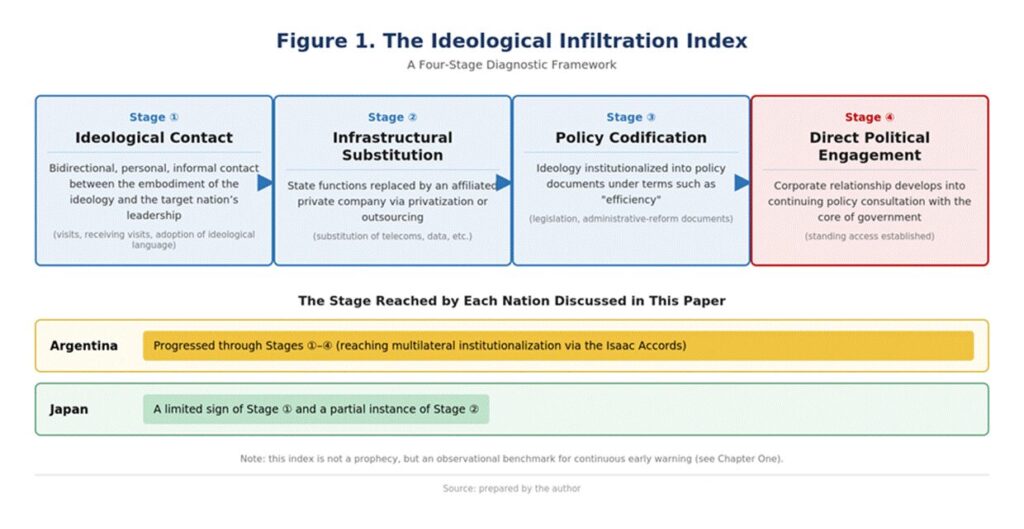
Figure 1. The four-stage flow of the Ideological Infiltration Index, and the stage reached by each nation discussed in this paper (Source: prepared by the author)
Chapter Two — Anatomy of an Ideology: From Libertarianism to the Dark Enlightenment
2-1 Point of Origin: Thiel’s 2009 Essay
Note: The following is an established fact.
In 2009, Peter Thiel contributed an essay titled “The Education of a Libertarian” to Cato Unbound, in which he stated plainly that he “no longer believe[d] that freedom and democracy are compatible.”[1] This marked an ideological turning point that went beyond simple libertarianism (the maximization of individual freedom) and positioned democracy itself as an obstacle to freedom.
2-2 Systematization: Curtis Yarvin and Neoreaction
The intellectual movement known as the “Dark Enlightenment,” or “neoreaction,” is an anti-democratic, anti-egalitarian, anti-progressive current of thought that emerged online in the mid-2000s.[2] The software engineer Curtis Yarvin wrote a blog titled “Unqualified Reservations” from 2007 to 2014 under the pen name “Mencius Moldbug,” positioning American democracy as a “failed experiment” and arguing for its replacement with a “responsible monarchy” resembling corporate governance structures.[3] Multiple academic analyses note that Yarvin and Nick Land drew inspiration from Thiel’s essay declaring that “freedom and democracy are no longer compatible.”[2]
2-3 Translation into Political Power: The Vance Channel — A Reservation About Its Strength
Note: The following is an established fact.
U.S. Vice President J.D. Vance is a former protégé of Thiel’s. In a 2021 podcast appearance, Vance cited Yarvin by name and, as advice to Trump, stated that the administration should “fire every single mid-level bureaucrat in the administrative state and replace them with our people.” The New Republic and other outlets have named Thiel and Vance as the foremost figures influenced by Yarvin’s thought.[4]
However, important reservations have been voiced by the parties themselves regarding the strength of this chain of influence. Yarvin himself told The New York Times in 2025 that his relationship with Vance has been “definitely overstated.” Joshua Tait, a journalist who studies Yarvin directly, likewise assesses that “Yarvin is not the grand theorist of DOGE, much less of the Trump administration. I don’t think he has actual, concrete influence.” Similarly, Thiel himself told The Atlantic in 2023 that, while he does not think Yarvin’s ideas would “work,” he finds him an “interesting” and “powerful” historian — hardly the language of an unconditional supporter.
In light of this reservation, this paper avoids depicting the relationship among Thiel, Yarvin, and Vance as a simple “chain of mentorship.” The reality is a more complex structure in which a financial tie — an investment in Yarvin’s company, Tlon — coexists with a partial and selective sharing of ideas. The “export of ideology” discussed in this paper should be understood not as direct ideological transmission between specific individuals, but as a looser ideological proximity mediated through a capital network, namely Founders Fund.
2-4 Codification into Governance: Project 2025
Note: The following is an established fact.
“Project 2025” (released in April 2023 under the title “Mandate for Leadership: The Conservative Promise”), led by the Heritage Foundation, is a comprehensive policy document aimed at reorganizing the U.S. federal government and concentrating executive power in the service of right-wing policy. Multiple analyses note that, in both its philosophical outlook and its policy prescriptions, it bears a striking ideological parallel to Yarvin’s neoreactionary vision — albeit packaged in the language of think-tank policy.[5]
This ideological parallel has a concrete, practical connection that is more verifiable than Vance’s personal influence. Russell Vought, who served as Director of the Office of Management and Budget in the first Trump administration, is the central drafter of Project 2025. The Center for Renewing America (CRA), the think tank Vought leads, produced many of Project 2025’s policies as well as draft executive orders ready for signature immediately upon the administration taking office. Vought’s posture of confrontation with a “corrupt bureaucracy” is substantively consistent with what Yarvin calls the dismantling of “the Cathedral” — the entrenched institutional power complex. Political-research organizations have also noted that several junior staff members of the Department of Government Efficiency (DOGE) have prior experience working under Thiel, or have publicly expressed neoreactionary views.
Once an idea is translated from a blog into a policy document, this paper regards it as having acquired an “exportable form.” A personal expression of belief on a blog and the practical language of governance found in a policy document differ fundamentally in how readily they can spread. Project 2025 is an example of the Dark Enlightenment — an extremist ideology — being converted into the internationally palatable language of “administrative reform,” and its path of institutionalization can be observed more clearly through the organizational, practical channel of Vought and the CRA than through the uncertain line of Vance’s personal influence.
Chapter Three — The Ideology’s First Practice: New Zealand as a Precedent
Before the Dark Enlightenment was institutionalized into a policy document within the United States, Thiel’s personal ideology had already been put into practice, in relation to a single nation, nearly two decades earlier. This chapter confirms this precedent in order to show that the four-stage index proposed in this paper reflects a longer-running, recurring structure that is not confined to Argentina and Japan.
3-1 “No Country Aligns More with My View of the Future”: Citizenship as the Smallest Unit of Contact
Note: The following is an established fact.
In June 2011, Thiel acquired New Zealand citizenship after the country’s Internal Affairs Minister, Nathan Guy, applied an “exceptional circumstances” provision. Ordinarily, a permanent resident applying for citizenship must reside in the country for 1,350 days over five years; Thiel had made only four visits over five years, totaling a mere 12 days of residence. This fact became public in 2017 through investigative reporting by the New Zealand Herald. On his application, Thiel wrote that “no other country aligns more with my view of the future than New Zealand.”[6]
This is the purest example showing that Stage ① (ideological contact) in this paper’s index can be constituted by the legal status of citizenship itself, without substantive residence or institutional involvement. Ideological contact is not measured solely by the number of in-person meetings or visits; it can also take the form of “selecting a particular nation as the place most closely aligned with one’s own ideals, and obtaining legal status from that nation.”
3-2 Connections to Intelligence and Defense Agencies: An Approach Toward Stage ②
Note: The following is an established fact.
Investigative reporting by the New Zealand Herald has revealed that Palantir, Thiel’s core business, held a long-standing relationship with the New Zealand Defence Force, the Security Intelligence Service (SIS), and the Government Communications Security Bureau (GCSB).[6] This serves as a precedent illustrating a pathway by which Stage ① contact — the granting of citizenship to an individual — subsequently connects to a Stage ②-type structure: a relationship between Palantir and the nation’s intelligence and defense agencies.
3-3 A Consistent Practice of Building Governing Units Outside National Borders
Note: The following is an established fact.
Thiel was an early backer of the Seasteading Institute (a concept for building autonomous communities on the high seas), and later turned his interest to charter cities (autonomous cities on land). He is a leading investor in Pronomos Capital, an investment fund aimed at establishing experimental, semi-autonomous cities on undeveloped land; projects backed by the fund include “Próspera” in Honduras. Praxis, a related company, has sought to establish a new city-state and considered Greenland as one candidate site. In 2025, when the Danish government moved to integrate Palantir into its own military, police, and intelligence agencies, one argument raised by opponents was that the Praxis project (which Thiel backs via Pronomos) posed a threat to Greenland’s sovereignty.[7]
Taken together, these facts show that Thiel’s ideology — skepticism of democratic control by the state, and an ideal of freedom of movement unbound by national borders — was not first put into words in his 2009 essay, but had already been accumulating, even before that, as a consistent practice across multiple nations and regions. New Zealand stands as its first and most mature example, with Argentina, roughly fifteen years later, representing a more comprehensive implementation.
Chapter Four — An Institutionalized Network: Dialog
4-1 The Existence and Structure of Dialog
Note: The following is an established fact.
“Dialog” is a private, invitation-only organization co-founded in 2006 by Peter Thiel and Silicon Valley angel investor Auren Hoffman. It kept its membership undisclosed for twenty years until, in 2026, the Swiss hacktivist maia arson crimew discovered a public directory embedded in the source code of dialog.org, after which WIRED independently verified and reported its contents.[8]
4-2 An Analysis of Participant Composition
WIRED’s verification confirmed that the registrant list for a leaked retreat scheduled for August 2026 (to be held near Dublin, Ireland) named 222 individuals, including NATO’s Supreme Allied Commander Europe and Commander of U.S. European Command (attending since 2021), the U.S. Treasury Secretary, several senators (including Ted Cruz), and Palantir co-founder Joe Lonsdale.[9] A separately leaked directory of 113 affiliated individuals was confirmed by multiple news organizations to include Elon Musk, Senator Cory Booker, a Stanford University president, and the writer Ezra Klein. Session topics on the agenda included “Navigating WWIII” and “Build-a-Cult.”
This paper avoids characterizing this gathering as a “cult.” Even if some session titles contained ironic language, treating that language as proof of the organization’s true nature would be an interpretation that exceeds verifiable fact. What this paper emphasizes is the objectively confirmable structure: that the private sector, the military, and politics are intersecting continuously within one and the same non-public space.
4-3 A Working Hypothesis on Dialog’s Function
Note: The following is a working hypothesis at the time of writing and requires further verification.
No direct evidence currently available in the public record confirms that Dialog is a venue where concrete policy decisions are made. However, this paper positions Dialog as an organization that may function as a human-network foundation for ideology as it crosses national borders. This is a hypothesis, not a settled conclusion.
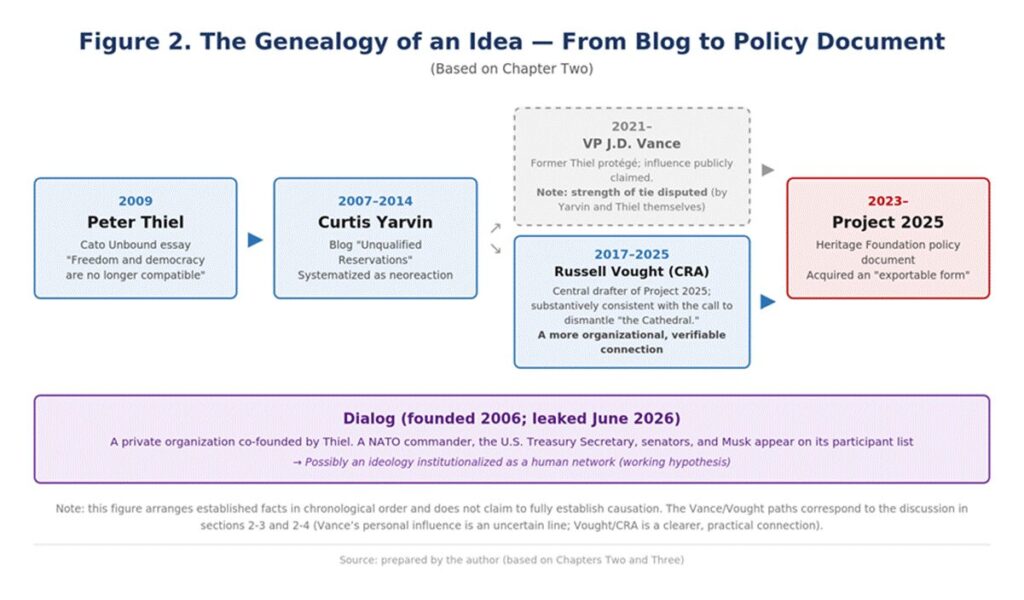
Figure 2. The genealogy of an idea — the process of translation from blog to policy document (Source: prepared by the author)
Chapter Five — Applying the Index (I): Argentina, a Case That Has Progressed Through Three Stages
5-1 Why Argentina Was Chosen
Note: The following is a working hypothesis at the time of writing and requires further verification.
This paper proposes the hypothesis that Argentina was not selected by “geographic coincidence,” but because its existing political conditions had lowered the barriers to ideological infiltration more than almost any other nation. Specifically, three conditions converged: (1) an existing political climate of “distrust of the state” produced by decades of economic crisis and hyperinflation; (2) an existing international political consensus favoring “shrinking the state,” arising from IMF demands for structural reform; and (3) a personal ideological resonance between Milei and Thiel.
5-2 Stage ①: Ideological Contact
Note: The following is an established fact.
Peter Thiel, himself a fellow libertarian, has had repeated contact with Argentine President Javier Milei, beginning with a meeting at the Casa Rosada (presidential palace) in January 2024. They met again at the Milken Institute forum in Los Angeles in May 2024, and once more at the Casa Rosada on April 23, 2026.[10] After their April 2026 meeting, Milei called it “a wonderful meeting” and said of Thiel, “He is, like me, philosophically an anarcho-capitalist.” The two are reported to have discussed wealth taxation, the culture war, and the future of liberalism. From his campaign through his time in office, Milei has consistently used the phrase “the state is the enemy,” and has repeatedly staged a performance of dismantling government agencies, including a campaign speech in which he wielded a chainsaw.
Note: The following is an established fact.
Here, too, the application of this paper’s disqualifying criteria becomes important. Milei himself has stated that no specific investment opportunities were discussed in the April 2026 meeting, explaining that the conversation centered on how the two might sustain the political philosophy they share. Opposition legislator Juan Marino, however, demanded an explanation from the Foreign Ministry over the visit, asking whether the introduction or purchase of Palantir’s surveillance and defense technologies had been on the agenda. As of this writing, no official government response to that question has been confirmed.
5-3 Stage ②: Infrastructural Substitution
Immediately after Milei’s 2023 election victory, Elon Musk posted on X that “prosperity is coming to Argentina.”[11] It should be noted that Starlink had already obtained an operating license from Argentina’s national telecommunications regulator (ENACOM) in December 2021, and did not newly enter the market with the launch of the Milei government. Nonetheless, Starlink is one of the few private companies Milei has named in his speeches, and the launch of its commercial service in March 2024 should be understood as a case in which an already-licensed company was politically deployed as a symbol of the Milei government’s deregulatory agenda.
Note: The following is an established fact.
A more direct instance meeting the criteria for Stage ② can be found in the state’s intelligence infrastructure itself. On December 31, 2025, while Congress was in recess, the Milei government issued Emergency Decree (DNU) 941, amending the National Intelligence Law. This decree obligated more than fifteen state agencies — including ANSES (Social Security Administration), AFIP (the tax authority), RENAPER (the national identity registry), and the public health system — to share personal data with the State Intelligence Secretariat (SIDE) without a court order and without notifying citizens.[12]
5-4 Stage ③: Policy Codification
In April 2026, Peter Thiel visited Buenos Aires and met with the President and the head of SIDE. The Argentine legal-professionals association (AGC) has noted that, while no public contract exists, DNU 941/2025 has created a regulatory environment that aligns almost perfectly with Palantir’s business model — large-scale data integration, AI-driven predictive analysis, and automated targeting decisions.[13]
This observation matters for the theory of this paper. The progression of Stages ② and ③ need not take the form of a public contract. The same effect can arise when the regulatory environment itself is designed to fit a particular private actor’s business model “like a key fits a lock.”
Note: The following is an established fact.
On May 22, 2026, the Milei government announced the launch of “Gemelo Digital Social” (Social Digital Twin), an AI platform that consolidates information dispersed across state agencies in order to design and forecast social policy. The announcement took the form of a promotional video on X, and no reference to a legal basis, a public tender, or data-protection protocols could be found within either the promotional video or the public information this paper was able to confirm (the possibility that some other official procedural document exists separately from the promotional video cannot be ruled out). The announcement coincided with Thiel’s presence in Argentina.[14]
5-5 Approaching Stage ④: The Isaac Accords
Note: The following is an established fact.
On April 19, 2026, President Milei and Israeli Prime Minister Netanyahu formally announced the “Isaac Accords” in Jerusalem. This trilateral framework among the United States, Israel, and Latin America governs cooperation on trade, technology, and security, and includes a memorandum on security cooperation and artificial intelligence.[15] This shows that Argentina’s structural transformation has expanded beyond a bilateral personal relationship into a multilateral institutional framework.
Note: The following is a working hypothesis at the time of writing and requires further verification.
The Isaac Accords are themselves a diplomatic treaty between states, and no primary source shows any direct connection to Thiel’s ideological network. The reason this paper nonetheless treats the Accords as an indicator of Stage ④ lies in the soil from which they grew. The Palantir-style regulatory groundwork the Milei government has steadily built — DNU 941 and Gemelo Digital Social (Stages ② and ③) — has already established, as a fait accompli, a governing posture of “opening state functions outward,” and the Isaac Accords can be positioned as the result of that same posture becoming multilateral in the security and AI domain as well. In other words, this paper does not claim that the Isaac Accords are themselves a product of Thiel’s ideological sphere; rather, it treats them as a parallel institutionalization arising from the same political soil — a corroborating indicator of an approach toward Stage ④.
5-6 Assessment
Argentina can be assessed, under this paper’s index, as a case in which Stages ① through ③ have clearly progressed, and which has reached Stage ④ — direct, continuing policy consultation with the government (note that part of this connection to Stage ④ uses the Isaac Accords as its indicator, which rests on the working hypothesis discussed in section 5-5). This is, at present, the only observable case in which the “ideological infiltration” discussed in this paper has progressed to its most advanced, near-complete form.
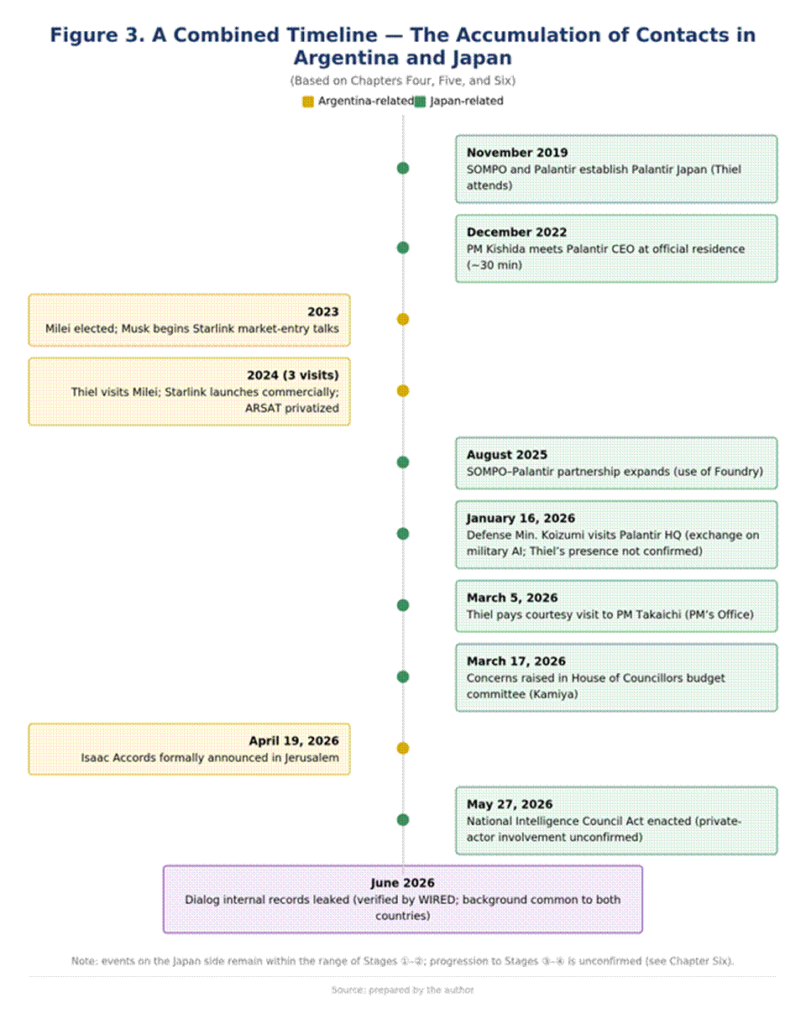
Figure 3. A combined timeline — the accumulation of contacts in Argentina and Japan (Source: prepared by the author)
Chapter Six — Applying the Index (II): Japan, Early-Stage Signs
6-1 Why Japan Will Not Follow the “Argentine Pattern”
Note: The following is an established fact.
Japan has no political consensus, of the kind seen in Argentina, favoring the “dismantling of the state.” There is no external pressure comparable to IMF-mandated structural reform, nor is there a broadly shared political culture of fundamental distrust toward state institutions. Stating this clearly is essential to ensuring that the analysis in this paper is not a simple prophecy that “Japan, too, will follow Argentina’s path.”
6-2 Stage ①: Ideological Contact
On March 5, 2026, Peter Thiel paid a courtesy visit to Prime Minister Sanae Takaichi at the Prime Minister’s Office. For Thiel, who had previously visited Japan several times for business or speaking engagements before 2019, this was his first formal contact with a government official.[16] The meeting reportedly lasted about 25 minutes, and is reported to have involved an exchange of views on Japan-U.S. scientific and technological prospects, including small modular reactors, ahead of the Prime Minister’s planned visit to Washington.
This fact alone cannot determine whether the “ideological resonance” required for Stage ① is present. The reported content of the meeting was scientific and technological cooperation, and no clear adoption of ideological language — of the kind seen in Milei’s case — has so far been confirmed. This case falls within the disqualifying criterion for Stage ① set out in Chapter One: “the subject matter of the contact is limited to technical cooperation or commercial dealings, and no statement concerning the nature of state governance is found.” The Japanese case therefore amounts to no more than the most preliminary sign of Stage ① — the mere occurrence of contact — and, measured against the disqualifying criteria, should be judged not yet to have reached the stage of ideological resonance.
Note: The following is an established fact.
This meeting has already become an open political issue within Japan’s Diet. At a House of Councillors budget committee session on March 17, Prime Minister Takaichi, responding to a question from Sohei Kamiya, leader of the Sanseito party, stated clearly that “there was no discussion whatsoever of using [Palantir’s] services.” The Prime Minister also revealed that she had been briefed on Thiel as someone who “is on good terms with Vice President Vance” and “was one of the architects of the Trump administration.” This is an important fact, showing that concern over the possible adoption of Palantir is already a subject of open political debate in Japan.
Note: The following is an established fact.
This contact has not run only in one direction, from Thiel toward Japan. On January 16, 2026 (local time), Defense Minister Shinjiro Koizumi, while visiting the United States, toured Palantir Technologies’ Washington, D.C. headquarters and exchanged views with company executives on the use of AI in the security field. It has been confirmed, both through Minister Koizumi’s own social-media posts and through an official announcement by the Ministry of Defense, that he was received by the company’s head of defense — a former U.S. congressman — Mike Gallagher.[33]
If the criteria for Stage ① set out in Chapter One of this paper are redefined to include not only visits by an embodiment of the ideology, but also bidirectional contact that includes visits from the target nation, then this visit, too, can be regarded as an additional indicator for Stage ①. It must be stressed, however, that what occurred here was the fact that “Japan’s defense minister visited the headquarters of a company Thiel co-founded,” not the fact that “Japan’s defense minister met with Thiel.” No record of Thiel himself having been present can be found in the Ministry of Defense’s official announcement, in Kyodo News’ reporting, or in Minister Koizumi’s own social-media post, and blurring this distinction would run contrary to the principle of falsifiability that this paper holds central.
6-3 Stage ②: Infrastructural Substitution — A Deeper Mutual Dependence Than Initially Assessed
Note: The following is an established fact.
On November 18, 2019, SOMPO Holdings and Palantir Technologies agreed to jointly establish a venture, Palantir Technologies Japan, to operate a data-analytics platform business. The two companies each contributed roughly half of approximately ¥10.8 billion in capital. The press conference was attended by Thiel himself, along with SOMPO Group CEO Kengo Sakurada and Group CDO Koichi Narasaki. In the question-and-answer session that followed, Thiel addressed concerns about the handling of personal information drawn from SOMPO’s real-world data, stating that he “respect[s] privacy as a philosophical principle.”[17]
This relationship runs deeper than this paper initially assumed. In 2020, SOMPO invested $500 million (roughly ¥54 billion) directly in Palantir itself — an equity relationship that goes beyond a mere business partnership. Palantir, for its part, expanded its partnership with SOMPO in 2023, and in August 2025 announced a multi-year contract as a “second expansion.”[18] As of August 2025, the number of users within SOMPO Group, Sompo Japan Insurance, SOMPO Care, and Fujitsu in Japan had reached approximately 8,000.
The SOMPO case should therefore be reassessed not as a simple case of “outsourcing by a single company,” but as a case that has progressed substantially within Stage ②, combining equity investment, management participation, and large-scale operational integration. It is nonetheless important to note a difference: whereas Argentina’s case (DNU 941 and Gemelo Digital Social) involves a presidential decree that legally mandates data-sharing among state agencies — a substitution of state function itself — the SOMPO case remains a voluntary management decision by a private company, without the exercise of state coercive power. Regarding the disqualifying criterion for Stage ② set out in Chapter One — “where termination of the contract, or switching to another provider, is confirmed to be practically feasible” — whether SOMPO could unilaterally dissolve its relationship with Palantir, given the scale of the capital relationship involved, may in practice be more complex than the formal existence of substitutability would suggest. This paper does not reach a firm conclusion on this point and flags it as a matter for future verification.
Note: The following is an established fact.
Following SOMPO, other major Japanese companies have also deepened their relationship with Palantir. Fujitsu began collaborating with Palantir in 2020, signed a global partnership in December 2023, and on August 19, 2025, signed a license agreement for the generative-AI platform Palantir AIP (targeting roughly $100 million in revenue by the end of fiscal year 2029). Fujitsu has further been awarded a commissioned research contract from the Acquisition, Technology & Logistics Agency’s Defense Innovation Science and Technology Institute, titled “Research on Acquiring AI Staff Capability through Defense Multi-Agent AI.”[19] It should be noted that, so far as is publicly known at this time, this commissioned defense research and the Palantir AIP license agreement are separate contracts, and no primary source confirms any technical connection between the two. Sumitomo Corporation, too, signed a license agreement for AIP with Palantir Technologies Japan through a group company on March 19, 2026, and is proceeding to introduce it into supply-chain management for its energy-related (oil-pipe) business.[20]
Note: The following is information that could not be confirmed by an independent primary source at the time of this paper’s writing.
A number of web-based media outlets have published essentially identical claims that Japan’s Ministry of Defense is considering introducing Palantir’s “Gotham” platform under the guise of “integrated analysis of disaster-related information.”[21] Tracing these claims, however, did not lead to any official statement or budget document from the Ministry of Defense, nor to any independent investigative reporting by a major national newspaper. The fact that multiple outlets repeat the same wording does not constitute multiple independent confirmations; rather, the possibility cannot be ruled out that a single, unverified claim is simply being repeated across web media (so-called “citogenesis”). This paper does not treat this information as a confirmed instance of Stage ③, and records it only as an observation that warrants further verification.
6-4 Stage ③: Policy Codification (Currently Unconfirmed)
In 2026, under the Takaichi government, the creation of a “National Intelligence Agency” is moving forward. The National Intelligence Council Establishment Act passed the House of Councillors plenary session on May 27, 2026, with support from the Liberal Democratic Party, the Japan Innovation Party, and the Democratic Party for the People, and the government plans to launch the agency as early as the summer of that year.[22] At a press conference, Prime Minister Takaichi stated that this had been a policy she had repeatedly pledged during her party’s presidential election, calling the law “a first step,” and indicating that she would consider, going forward, enacting an anti-espionage law and establishing a foreign-intelligence service. Some opposition parties raised concerns about privacy infringement. This initiative had already been a campaign pledge by the Prime Minister herself before the Takaichi cabinet took office (October 2025), and falls clearly within the disqualifying criterion for Stage ③ set out in Chapter One: “where the drafting process of the policy or legislation can be explained on the basis of an existing domestic political consensus independent of any particular ideological current.” No primary source whatsoever currently confirms the involvement of any specific private actor or ideological network.
According to reporting, a dynamic separate from the theoretical framework of this paper — a domestic turf war among ministries — is at play, with the Public Security Intelligence Agency, the National Police Agency, the Ministry of Foreign Affairs, and the Ministry of Defense all actively maneuvering to take the leading role in the new agency.[23]
Note: The following is a working hypothesis at the time of writing and requires further verification.
Which company will, in the future, be responsible for building the National Intelligence Agency’s systems remains undisclosed at this time. In keeping with the index this paper proposes, monitoring future public information on procurement and personnel constitutes the concrete practice of early warning. However, there is currently no basis for finding that this meets the criteria for Stage ③.
6-5 A Comparison Table of the Two Paths
| Element | Argentina | Japan |
| Stage ① (Ideological Contact) | Confirmed (3 visits, statements of ideological resonance) | Contact confirmed (1 courtesy visit by Thiel + 1 visit to Palantir HQ by Defense Minister Koizumi); ideological resonance unconfirmed |
| Stage ② (Infrastructural Substitution) | Confirmed (privatization of state telecoms + Starlink entry) | Limited (outsourcing by a single company; not a substitution of state function) |
| Stage ③ (Policy Codification) | Confirmed (Digital Twin plan) | Unconfirmed (no confirmed involvement of a private actor in the National Intelligence Agency concept) |
| Stage ④ (Direct Political Engagement) | Confirmed (continuing policy consultation + the Isaac Accords; the latter rests on a working hypothesis) | Unconfirmed (a single courtesy visit only) |
| Overall Assessment | An advanced case (Stages ③–④) | An early-stage sign (part of Stage ①; a limited instance of Stage ②) |
6-6 Assessment
Under this paper’s index, Japan shows only a limited sign of Stage ① and an extremely limited instance of Stage ② (outsourcing by a single company). This is not grounds for concluding that “a crisis is underway,” but it does indicate a focal point that warrants continued monitoring as a matter of early warning.
Chapter Seven — Three Layers Where the Threat Appears
Building on the analysis so far, this chapter organizes the three layers in which the export of ideology is technically implemented. These three layers can be understood as the concrete forms that Stage ② (infrastructural substitution) in the Chapter One framework takes within each different domain. Across the differing domains of telecommunications, data, and military AI, the underlying structure is common: state functions are being replaced by a specific group of private actors. This chapter shows the shape that structure takes within each domain.
7-1 The Substitution Layer: Space Infrastructure
The substitution of communications infrastructure extends not only to the physical layer of undersea cables, but also to the substitute layer of satellite communications. NATO announced “Project HEIST” in 2024, which would reroute high-priority data to satellites in the event of an undersea-cable failure; however, concerns have been raised that Russia could simultaneously escalate in both the undersea and space domains, leaving this strategy vulnerable to a “Catch-22” — a bind in which either choice leads to a dead end.
7-2 The Personal-Data Layer: Insurance and Financial Infrastructure
As the SOMPO–Palantir case shows, infiltration of the personal-data layer is the least conspicuous pathway, requiring no political consensus. The SOMPO case, moreover, involves not merely outsourcing but an equity relationship, showing that corporate-level dependence can reach a depth that cannot be unwound by a simple contract termination. This shows that Stage ② — “infrastructural substitution” — can proceed at the corporate level, ahead of, and in a more complex form than, the substitution of state functions themselves.
7-3 The Military-AI Layer: The Asymmetric Erosion of Alliances
Japan, South Korea, and Australia already have contractual relationships with Palantir in the military and security domain. Should this dependence deepen, constraints on action may arise on a dimension separate from treaty-based alliance obligations — a phenomenon this paper terms “the asymmetric erosion of alliances through technical constraint.”
Chapter Eight — Japan’s Structural Blind Spot: Why It Is Hard to See
8-1 Cultural Factors and the Gap Between Domestic and Foreign Awareness of Ideological Terminology
Note: The following is an established fact.
The terms “Dark Enlightenment” and “neoreaction” are not entirely unknown within the Japanese-language sphere. An independent entry, “Ankoku Keimo” (Dark Enlightenment), exists on Japanese Wikipedia,[24] Satoshi Kizawa has published an explanatory book, Nick Land and Neoreaction: The Dark Ideas Covering the Contemporary World (Seikaisha Shinsho, 2019),[25] and several introductory articles can be found on individual blogs such as note.
Within the scope of this paper’s research, however, all of these references remain confined to an intellectual-historical or subcultural context (philosophical works, individual commentary). No reference connecting this ideology to Palantir’s expansion in Japan, or to the National Intelligence Agency concept, could be found in the political or security sections of Japan’s major newspapers, or in the analyses of think tanks affiliated with the Ministry of Defense or the Ministry of Foreign Affairs. This paper’s conclusion is based on a limited web-search investigation, and reflects findings as of the time of writing rather than a permanent judgment.
Note: The following is a working hypothesis at the time of writing and requires further verification.
Japan’s political culture, which places weight on harmony, the collective, and consensus, has a fundamental incompatibility with an explicitly anti-democratic ideological language such as the Dark Enlightenment. This cultural distance may, paradoxically, produce a “lack of ideological immunity.” An ideology with which one has no affinity is less easily recognized as a threat, creating a risk of misjudgment in dealings with an actor driven by that ideological motive.
In other words, the “blind spot” in Japan does not lie in any absence of introduction to the ideology itself, but in the lack of a bridge between intellectual-historical knowledge and vigilance in the practice of security policy. It is precisely this missing bridge that motivates this paper’s proposal to build an early-warning model.
8-2 A Second Structural Vulnerability — the Effectiveness of Institutions: The Case of Broadcasting Foreign-Ownership Restrictions
Note: The following is an established fact.
Distinct from, but related to, the dependence on a specific actor connected to an ideological network that this paper discusses, a structural vulnerability can also be found in the operation of Japan’s own institutions. The Broadcast Act and the Radio Act require terrestrial and satellite broadcasters to keep foreign voting rights below 20%, in order to prevent foreign capital from controlling the press. In 2021, however, it came to light that Fuji Media Holdings had exceeded this ceiling for roughly two years, from September 2012.[26] Tohokushinsha was likewise found that same year to have violated the foreign-ownership restriction in a separate case, resulting in the partial revocation of its satellite-broadcasting authorization.
What matters is that even after Fuji’s violation came to light, the institutional penalty of license revocation was never actually applied. This is a concrete example, within the information and media domain, of a structural pattern this paper has repeatedly noted: a gap between the formal existence of regulation and its actual enforcement. In 2022, the Ministry of Internal Affairs and Communications revised the relevant law to require periodic reporting of foreign-ownership ratios, but this strengthened only after-the-fact reporting, not the immediate application of penalties.
This case belongs to a different context from the discussion of techno-sovereign actors, but it reinforces, through an existing domestic Japanese example, the central question of this paper: “Does the institution exist, and does it actually function?” The scope of this paper’s investigation has been concentrated in the domains of information, data, and telecommunications; whether similar structural vulnerabilities exist in other critical-infrastructure domains — transportation, water, energy, and so on — lies outside the scope of this paper and is left as a matter for future verification.
Chapter Nine — Two Types of Autonomy: India and France as Two Precedents
This paper’s research has found that “autonomy” — the avoidance of dependence on a techno-sovereign actor — can take two entirely different forms.
9-1 The Indian Type: Leaving Operational Vulnerability Unaddressed Through Isolation
Note: The following is an established fact.
India is known as a nation with a strong commitment to domestically developed platforms (such as the UPI payment system). In April 2022, however, the U.S. cybersecurity firm Recorded Future (through its Insikt Group threat-research unit) disclosed that a hacking group suspected of links to the Chinese state — which the firm designated “TAG-38” — had been conducting sustained intrusions into seven State Load Despatch Centres (SLDCs, critical facilities responsible for power-grid control and distribution) in the Ladakh border region of India. India’s power minister, R.K. Singh, officially stated that there had been two attempts by Chinese hackers, but that they had “not succeeded.”[27] Recorded Future assessed that this was not ordinary espionage aimed at economic gain, but was instead intended to build capability and pre-position for a future contingency. This is a case showing that even a strongly self-reliant nation cannot escape an organized cyberattack from abroad. Furthermore, according to a 2026 threat report, 62% of all detections within cloud environments were attributable to misconfiguration,[28] showing that a commitment to self-reliance does not necessarily translate directly into improved operational security.
What India’s case shows is that the premise “if we build it ourselves, it is safe” does not hold. Where self-reliance entails isolation from the international sharing of threat information, it can leave operational vulnerabilities unaddressed.
Note: The following is an established fact.
India’s self-reliance was tested again in 2026, from a different direction. In June 2026, following an export-control directive from the U.S. government, Anthropic cut off all access to its top-tier models (Fable 5 and Mythos 5) from outside the United States. As a result, Indian developers and enterprises — including those involved in a large-scale training partnership with Tata Consultancy Services (TCS), which had integrated Claude into its operations — lost access immediately after signing their agreements.[34] Mohandas Pai, former CFO of Infosys, called on Prime Minister Modi to create an annual “sovereign AI fund” worth roughly ₹500 billion, and Zoho co-founder Sridhar Vembu stated that “technology has become the ultimate weapon of sovereignty.”[35]
This is a case running in a different direction from this paper’s argument that “self-reliance leaves operational vulnerability unaddressed,” and must be carefully positioned. The TAG-38 case shows that “building it yourself does not guarantee safety”; the Anthropic case, conversely, shows that “depending on advanced foreign technology can mean losing access at the stroke of a single geopolitical decision” — a fact that works in favor of self-reliance. In other words, self-reliance carries the cost of operational vulnerability, while dependence carries the cost of geopolitical access denial. The “third path” this paper proposes — institutional separation of information from authority — is an attempt to avoid both costs simultaneously.
9-2 The French Type: Reconciling the Two Through Institutional Separation, Though Operational Challenges Remain
Note: The following is an established fact.
In its 2026–2030 National Cybersecurity Strategy, France frames cooperation with the EU as a “fight for sovereignty,” and places weight on threat-information sharing at the European level through mechanisms such as the CSIRT network.[29] At the same time, under the “Cloud au Centre” doctrine launched in 2021, when state administrative bodies and public-interest organizations handle sensitive data — legally protected secrets, or data necessary to the essential functions of the state — they must choose a cloud service that has implemented measures effectively preventing unauthorized access by non-EU authorities. In practice, this means using a provider that holds the “SecNumCloud” certification (established in 2017; the current version, 3.2, includes roughly 1,200 requirements) issued by ANSSI, France’s national cybersecurity agency. This constitutes a strict sovereignty requirement intended to prevent extraterritorial interference under instruments such as the U.S. CLOUD Act and FISA.[30] As of 2026, only nine providers hold SecNumCloud certification, with twelve more under review; the market remains small, at roughly €18 million within France, against a wider European sovereign-cloud market of approximately €12.4 billion.
It must, however, be stated accurately that France’s operational record has both a bright and a dark side. In the first quarter of 2024, France Travail, the country’s public employment-services agency, suffered the largest data breach in the history of the French public sector, through a social-engineering technique that deceived CAP EMPLOI staff into surrendering their credentials, exposing the personal data — social-security numbers, names, dates of birth, email addresses, and phone numbers — of roughly 43 million people. France’s data-protection authority, CNIL, concluded on January 29, 2026, following its investigation, that there had been a “disregard for basic security principles,” citing deficiencies in authentication processes and a lack of anomaly-detection logging, and imposed a fine of €5 million.[31] This is a fact showing that even an institutional-separation model cannot fully prevent operational failure — particularly failures of human and organizational management, as opposed to technical vulnerability.
By contrast, at the Paris Summer Olympics held the same year, two ransomware attacks were detected, but ANSSI assessed that, through the segmentation of information systems and a rapid response, these did not disrupt critical systems or interfere with the operation of the Games. Comparing the two cases shows that France’s strength lies not in “an ability to prevent attacks entirely,” but in “a design that separates critical infrastructure from general systems and limits the spread of any damage.”
9-3 The Essential Difference Between the Two Types
The Indian type is “simply the inverse of dependence.” It turns the exclusion of foreign private companies into an end in itself, and in doing so shrinks even the cooperative dimension of international threat-information sharing. The result is that operational vulnerability is left unaddressed.
The French type is “the institutional separation of information from authority.” It participates actively in international cooperation on threat-information sharing, while keeping ultimate authority over access to core data in the hands of the state, governed by clear institutional standards such as SecNumCloud.
Note: The following is a working hypothesis at the time of writing and requires further verification.
The French model, too, is not complete. According to an April 2025 study commissioned by the think tank Cigref from the firm Asterès, 83% of European corporate spending on cloud and software goes to U.S. companies (chiefly Amazon Web Services, Google, and Microsoft Azure), and 80% of the resulting value is generated within the United States — amounting to an estimated €26.4 billion flowing annually into the U.S. economy (equivalent to roughly 1.5% of the EU’s GDP).[32] This shows that, even in France, with its strict sovereignty requirements such as SecNumCloud, a deep dependence on the United States remains within the actual structure of the market. An institutional-separation model does not amount to “complete autonomy.” This paper positions France not as a “model to be emulated,” but as one realistic direction Japan may draw upon.
9-4 A Third Risk Beyond the Two Types: The Supply-Chain Blind Spot of Foundation-Model Dependence
Note: The following is an established fact.
In addition to the two failure modes shown in sections 9-1 and 9-2 — leaving vulnerability unaddressed through isolation, and economic erosion through dependence — a case emerged in 2026 illustrating a third failure mode, distinct from either. As described in section 9-1, in June 2026 a U.S. government export-control directive caused Anthropic to cut off all access to its top-tier models (Fable 5 and Mythos 5) from outside the United States, and users in non-U.S. countries, including India, lost access. This is neither a failure of self-reliance nor a deficiency of institutional separation; it is an independent, third failure mode, in which dependence on a foreign AI service is severed by a unilateral policy decision on the part of the providing country.
More importantly, this layer connects directly to this paper’s discussion, in Chapter Six, of dependence on Palantir. Palantir’s AI Platform (AIP) is not limited to in-house models; it adopts a “multi-model” design that selectively incorporates multiple external foundation models, including those of Anthropic, OpenAI, and Google.[36] Indeed, in February 2026, after contract negotiations between Anthropic and the U.S. Department of Defense broke down, the Department designated the company a “supply chain risk,” demanding that every defense-related contractor doing business with Anthropic cease that business (it should be noted that this measure was halted in March 2026 by a federal court, which found it “retaliatory and unconstitutional”; this rests on a different legal basis than the export-control suspension of Fable 5 and Mythos 5 for foreign users, and falls outside the scope of that ruling).[37]
What this sequence of events reveals is a “nested” structure of dependence: however carefully Japan manages its relationship with a single company, Palantir, that management cannot reach the geopolitical position of the foundation-model providers that lie beneath it.
Note: The following is an inference and requires further verification.
It cannot be confirmed from public information which foundation models Japan’s Palantir-related systems (at SOMPO, Fujitsu, and elsewhere) currently use. However, given that AIP is a multi-model design, the structural possibility always exists that, whichever foundation model is eventually adopted, access could change — independent of Japan’s own intentions — according to a policy decision made in that provider’s home country (chiefly the United States). Neither of the two types this paper presents (the isolation type and the institutional-separation type) directly addresses this third risk.
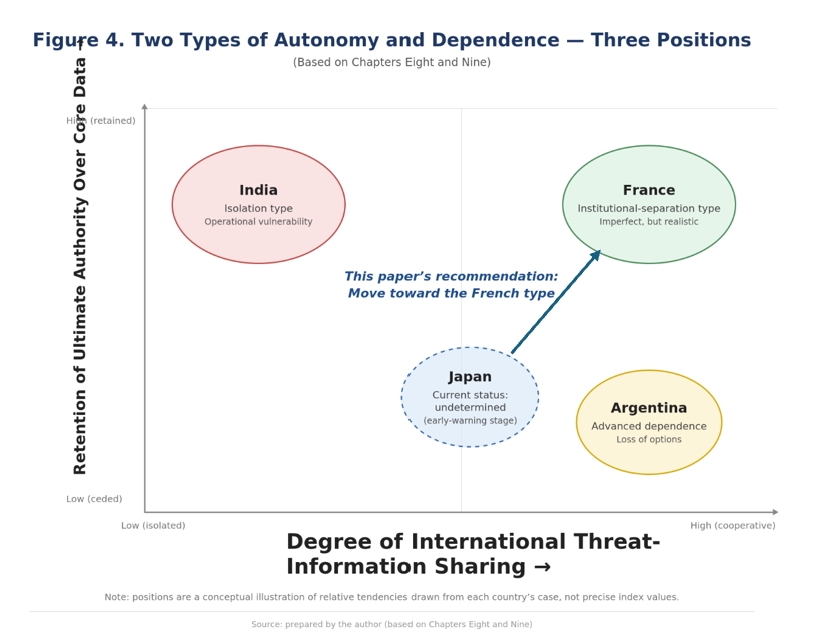
Figure 4. Two types of autonomy and dependence — three positions, and a proposal for Japan (Source: prepared by the author)
Chapter Ten — Policy Implications
Recommendation ① Institutionalizing the Operation of the Ideological Infiltration Index
This paper recommends institutionalizing the four-stage index it presents as a benchmark for continuous early-warning monitoring, to be jointly operated by the Ministry of Foreign Affairs, the Ministry of Defense, the Ministry of Economy, Trade and Industry, and other relevant bodies. This would make it possible to grasp the stage of progression in advance — rather than “noticing only after dependence has deepened” — and to secure the time needed to respond.
Recommendation ② Institutional Separation of Information from Authority (Applying the French Model)
Threat-information-sharing agreements (cooperation with bodies such as the FBI, NSA, and CISA) should be subject to a different approval process and a different oversight regime than contracts for building or operating core systems. Establishing a clear institutional standard that distinguishes “gathering information” from “ceding authority” is the most realistic policy for Japan.
Recommendation ③ Expanding the Concept Underlying the Economic Security Promotion Act
The concept of “specified critical technologies” should be expanded to cover military-AI and data-integration platforms, and Japan should consider institutionalizing a “geopolitical autonomy impact assessment” applicable to the entry of foreign private companies.
Recommendation ④ Institutionalizing Ideological Literacy in Diplomacy and Defense
Assessing the risk of technological dependence cannot rely on legal and technical standards alone. The ability to read the ideological motives of a counterpart must be built into the training of diplomats, defense officials, and politicians. Japan’s political culture has a low affinity with aggressive ideological language such as the Dark Enlightenment, and consequently has a structural tendency to underestimate the intentions of an actor driven by such ideological motives. Recognizing this “cultural blind spot,” and establishing ideological literacy as a formal pillar of security education, is an urgent priority.
Recommendation ⑤ Making Visible the Foundation-Model Dependence Within AI Systems
For any AI system the government or a public institution introduces — including multi-model platforms such as Palantir AIP — the providing company and providing country of the foundation model actually used as its base should be identified, and the risk that access to that model could be cut off by a geopolitical decision on the part of the providing country (a change in export controls, defense-procurement regulations, etc.) should be explicitly written into the evaluation criteria used in selecting and continuing to operate such systems. Managing the relationship with the vendor (Palantir, etc.) alone cannot capture the dependence risk that lies in the foundation-model layer beneath it (see section 9-4).
Conclusion
This paper has empirically traced, using a four-stage diagnostic framework, which nations an anti-democratic governing ideology — systematized in U.S. Silicon Valley — selects as it crosses national borders, and in what order it spreads within them.
Under this index, Argentina is, at present, the only case in which nearly all four stages — from ideological contact, through infrastructural substitution and policy codification, to continuing policy consultation with the government — have progressed, making it the closest thing to a complete realization of the process (part of its connection to continuing policy consultation rests on the Isaac Accords as an indicator, which is itself a working hypothesis). Japan shows only the early stage of ideological contact and a limited instance of infrastructural substitution at the level of a single company; it cannot be said that a crisis is under way. This does not mean, however, that Japan is “safe” — it means that Japan remains at a stage where early warning still leaves room for a range of responses.
The policy this paper ultimately proposes is neither dependence nor isolation. Between the two failure modes shown by India — leaving vulnerability unaddressed through isolation — and by Argentina — the loss of options through dependence — lies a third path, demonstrated by France: the institutional separation of information from authority. Japan should consciously design itself along this path. Gather information, without being controlled. This is the most realistic strategic policy this paper proposes for Japan’s cyber security.
Finally, a note on the limits of the word “export,” as used in this paper’s title. Many of the facts this paper has presented come down to a passive structure, in which a structural condition already present in the receiving nation — distrust of the state, demand for efficiency — precedes any active effort by Thiel’s side, and ideology is then “grafted” onto it. “Export,” accordingly, is not a term that demonstrates that a particular actor has deliberately targeted other nations; it is recorded here as a metaphor referring to an observed pattern of infiltration.
Afterword: The Need for Continued Monitoring
The Ideological Infiltration Index this paper presents is not a fixed verdict, but an analytical tool premised on continued observation. Whether Stages ② and ③ progress within Japan — in particular, which entity will be responsible for building the National Intelligence Agency’s systems, and whether contact between the Takaichi government and Thiel’s circle develops from a one-off courtesy visit into continuing policy consultation — remains undetermined as of this writing. Continuing to monitor public information going forward is the concrete practice of early warning.
In particular, given that Fujitsu is separately deepening its relationship with Palantir in both the defense and commercial domains — through its commissioned research for the Acquisition, Technology & Logistics Agency (defense multi-agent AI research) and its Palantir AIP license agreement (with no primary source showing any technical connection between the two) — the possibility that Fujitsu could, in the future, become involved in building the National Intelligence Agency’s systems is one concrete object this paper believes warrants continued attention. However, no primary source confirms this at the time of writing, and no firm conclusion can be drawn.
References
[1] Thiel, P. (2009). The Education of a Libertarian. Cato Unbound. https://www.cato-unbound.org/2009/04/13/peter-thiel/education-libertarian/
[2] Wikipedia, “Dark Enlightenment.” https://en.wikipedia.org/wiki/Dark_Enlightenment / Miranda, A. (2025). “Understanding Neoreaction: A Focus on Curtis Yarvin.” illiberalism.org.
[3] Wikipedia, “Curtis Yarvin.” https://en.wikipedia.org/wiki/Curtis_Yarvin
[4] The New Republic (2024). “Where J.D. Vance Gets His Weird, Terrifying Techno-Authoritarian Ideas.” https://newrepublic.com/article/183971/jd-vance-weird-terrifying-techno-authoritarian-ideas / Newsweek (January 18, 2025). “Who is Curtis Yarvin? Conservative linked to JD Vance wants ‘monarchy’.”
[5] The Guardian (December 21, 2024). Wilson, Jason. “He’s anti-democracy and pro-Trump: the obscure ‘dark enlightenment’ blogger influencing the next US administration.” / Political Research Associates (June 13, 2025). “Tech Capitalism and the Neoreactionary Movement Behind DOGE.” https://politicalresearch.org/2025/06/13/tech-capitalism-and-neoreactionary-movement-behind-doge / The Nation (December 18, 2024). “A Guide to Some of the Key Movers and Influencers in Trump’s Orbit.”
[6] New Zealand Herald (January 25, 2017). “Controversial billionaire Peter Thiel made a Kiwi after two-week holiday.” https://www.nzherald.co.nz/business/controversial-billionaire-peter-thiel-made-a-kiwi-after-two-week-holiday/H7ZMW57ILS4VX3TTY3LBRGFHRA/ / RNZ (June 30, 2017). “Govt digs in over Thiel citizenship decision.” https://www.rnz.co.nz/news/political/334161/govt-digs-in-over-thiel-citizenship-decision
[7] Wikipedia, “Peter Thiel.” https://en.wikipedia.org/wiki/Peter_Thiel (regarding Pronomos Capital, Praxis, and the Greenland sovereignty dispute over the integration of Palantir in Denmark)
[8] WIRED (June 20, 2026). “Leak Exposes Members of Peter Thiel’s Secretive ‘Dialog’ Society.” https://www.wired.com/story/leak-exposes-members-of-peter-thiels-secretive-dialog-society/
[9] Ibid.
[10] MercoPress (April 23, 2026). “Tech magnate Peter Thiel meets Milei after a week of private contacts with the Argentine government.” https://en.mercopress.com/2026/04/23/tech-magnate-peter-thiel-meets-milei-after-a-week-of-private-contacts-with-the-argentine-government / Buenos Aires Times (April 24, 2026). “Milei discusses taxes, culture war, politics in ‘wonderful’ meeting with Thiel.” / Buenos Aires Herald (April 23, 2026). “Peter Thiel meets with Javier Milei in Buenos Aires.”
[11] Reuters (November 2023). Milei election victory and Musk reaction coverage. / ENACOM Resolución 1291/2020 (Starlink’s operating license in Argentina, effective December 2021).
[12] Amnistía Internacional Argentina (May 2026). “Caso Palantir en Argentina.” / DNU 941/2025 (issued December 31, 2025, amending the National Intelligence Law).
[13] Informáticos.ar (April 23, 2026). “Palantir: una amenaza para la democracia.” https://informaticos.ar/palantir-una-amenaza-para-la-democracia/
[14] Radio Gráfica (May 28, 2026). “Milei lanza en Argentina un sistema de inteligencia artificial bajo la sombra de Palantir.”
[15] DLA Piper (2026). The Isaac Accords: Argentina’s New Strategic Framework with Israel. / The Jerusalem Post (2026). / AP News (2025).
[16] Prime Minister’s Office of Japan. Reporting on Thiel’s visit to Japan and courtesy call (March 5, 2026).
[17] SOMPO Holdings, official announcement (November 18, 2019). https://www.sompo-hd.com/~/media/hd/files/news/2019/20191118_1.pdf / Nikkei Cross Tech (November 18, 2019). “Tackling the World’s Challenges: SOMPO Holdings to Establish New Company with U.S.-Based Palantir for Data Analytics.”
[18] Nishimura & Asahi (2020). “SOMPO Holdings, Inc.: Investment in Palantir Technologies Inc.” / CX Research Institute (2026). “What Is Palantir? Explaining Its Business, Stock Price, and Entry into Japan.”
[19] Nikkei (August 19, 2025). “Fujitsu Signs AI Contract with U.S.-Based Palantir.” / Fujitsu, official announcements (December 5, 2023; August 19, 2025). On the conclusion of the global partnership and license agreement / Acquisition, Technology & Logistics Agency, Defense Innovation Science and Technology Institute, announcement regarding commissioned research with Fujitsu (defense multi-agent AI research).
[20] Sumitomo Corporation, official announcement (March 19, 2026). On the conclusion of a license agreement with Palantir Technologies Japan through Ascend SC.
[21] Japanese-language Wikipedia, “Palantir Technologies.” https://ja.wikipedia.org/wiki/パランティア・テクノロジーズ / JBpress (March 2026). “The Reality of the Data-Analytics Company Palantir.” / Gendai Business (March 2026). “Peter Thiel, to Whom Prime Minister Takaichi Has Suddenly Grown Close” (note: both carry essentially identical claims, and no independent confirmation from an official Ministry of Defense statement or a major national newspaper had been obtained at the time of this paper’s writing).
[22] Prime Minister’s Office of Japan (May 27, 2026). Press conference on the enactment of the National Intelligence Council Establishment Act. https://www.kantei.go.jp/jp/105/statement/2026/0527kaiken.html / Cabinet Secretariat (2026). Outline of the National Intelligence Council Establishment Bill. https://www.cas.go.jp/jp/houan/260313/gaiyou.pdf / House of Councillors, bill information. https://www.sangiin.go.jp/japanese/joho1/kousei/gian/221/meisai/m221080221024.htm
[23] sbbit.jp (2026). “The Soon-to-Be-Established ‘National Intelligence Agency’: Why It Is Neither a Japanese ‘CIA’ Nor an ‘FBI’.”
[24] Japanese-language Wikipedia, “Ankoku Keimo” (Dark Enlightenment). https://ja.wikipedia.org/wiki/暗黒啓蒙
[25] Satoshi Kizawa (2019). Nick Land and Neoreaction: The Dark Ideas Covering the Contemporary World. Seikaisha Shinsho.
[26] Ministry of Internal Affairs and Communications (2021). Press release regarding Fuji Media Holdings’ violation of the foreign-ownership restriction / National Diet Library research material. The foreign-ownership violation by Tohokushinsha and the revocation of its satellite-broadcasting authorization (2021).
[27] The Record from Recorded Future News (April 6, 2022). “Suspected China-backed hackers target 7 Indian electricity grid centers.” / The Diplomat (April 8, 2022). “Chinese Hackers Reportedly Target India’s Power Grid.”
[28] eventussecurity.com (2026). “Top 15 Recent Cyber Attacks in India 2026.”
[29] SGDSN (2026). “National Cybersecurity Strategy 2026–2030.” https://www.sgdsn.gouv.fr/files/files/National%20cybersecurity%20strategy_ENG.pdf
[30] Chambers and Partners (2026). “Cybersecurity 2026 – France.” / Legiscope (2026). “Certification SecNumCloud ANSSI: Guide Complet 2026.”
[31] CNIL (January 29, 2026). “Data breach: FRANCE TRAVAIL fined €5 million.” https://www.cnil.fr/en/data-breach-5million-fine-france-travail / Infosecurity Magazine (January 29, 2026). “France Fines National Employment Agency €5m Over 2024 Data Breach.”
[32] Asterès / Cigref (April 25, 2025). “Technological Dependence on American Software and Cloud Services: An Assessment of the Economic Consequences in Europe.” https://www.cigref.fr/wp/wp-content/uploads/2025/05/TECHNOLOGICAL-DEPENDENCE-ON-AMERICAN-SOFTWARE-AND-CLOUD-SERVICES-AN-ASSESSMENT-OF-THE-ECONOMIC-CONSEQUENCES.pdf (study commissioned by Cigref and Numeum)
[33] Ministry of Defense of Japan (January 16, 2026). “Defense Minister Koizumi’s Visit to the United States.” https://www.mod.go.jp/j/approach/anpo/2026/0112a_usa-j.html / Kyodo News (January 17, 2026). “Defense Minister Koizumi Inspects Cutting-Edge Technology.” / Shinjiro Koizumi, post on X (formerly Twitter) (January 17, 2026).
[34] Anthropic, official statement (June 12, 2026). “Statement on the US government directive to suspend access to Fable 5 and Mythos 5.” https://www.anthropic.com/news/fable-mythos-access / CNBC (June 12, 2026). “Anthropic disables access to Fable 5 and Mythos 5 to comply with government directive.” / Al Jazeera (June 14, 2026). “US asks Anthropic to block global access to top AI models: Why it matters” (citing Reuters reporting).
[35] The Next Web (June 2026). “Anthropic’s model shutdown just handed India’s sovereign AI movement its strongest argument yet.”
[36] Palantir Technologies. “AIP Model Catalog.” https://www.palantir.com/docs/foundry/model-catalog/overview / Palantir Technologies, AWS, and Anthropic, joint announcement (November 2024). “Anthropic and Palantir Partner to Bring Claude AI Models to AWS for U.S. Government Intelligence and Defense Operations.”
[37] CBS News (February 27, 2026). “Hegseth declares Anthropic a supply chain risk, restricting military contractors from doing business with AI giant.” / CNN Business (March 26, 2026). “Judge blocks Pentagon’s effort to ‘punish’ Anthropic by labeling it a supply chain risk.” / Mayer Brown (March 2026). “Anthropic Supply Chain Risk Designation Takes Effect — Latest Developments and Next Steps for Government Contractors.”
Glossary
Libertarianism
A political philosophy that places the highest priority on individual freedom, private property rights, and the market economy, and holds that state intervention and regulation should be minimized. The Dark Enlightenment discussed in this paper is positioned as a more extreme offshoot, in which some proponents of libertarianism moved beyond the claim that “the state should be reduced” to the further conclusion that “democracy itself is an obstacle to freedom.” Peter Thiel’s 2009 essay is a document that symbolizes this branching point.
The Dark Enlightenment (Neoreaction, NRx)
An anti-democratic, anti-egalitarian, anti-progressive intellectual movement that emerged online in the mid-2000s. Systematized by Curtis Yarvin and extended by Nick Land. It rejects democracy as an “inefficient institution” and seeks to replace it with an authoritarian governance structure resembling corporate governance.
The Ideological Infiltration Index
A diagnostic framework proposed by this paper that decomposes the process by which an ideology crosses national borders and infiltrates a nation into four stages: ideological contact, infrastructural substitution, policy codification, and direct political engagement.
Seasteading / Charter Cities
A concept for building an autonomous community, governed by its own rules, in a place beyond the reach of any existing state’s sovereignty — whether on the high seas or in a land area holding special legal status. Thiel was an early backer of the Seasteading Institute, and has since continued to invest in charter cities (such as Próspera in Honduras) through vehicles including Pronomos Capital. The New Zealand case discussed in Chapter Three of this paper is positioned as a practical precedent that occurred within the framework of an existing state, prior to the realization of this concept.
Dialog
A private, invitation-only organization co-founded by Peter Thiel in 2006. In June 2026, WIRED verified and reported on its substance following the leak of its internal records.[8]
The Techno-Sovereign Actor
A group of private actors that is neither a state nor an ordinary multinational corporation, but which holds cross-cutting control over multiple security-related domains — military AI, space, the integration of state data, telecommunications infrastructure, and strategic resources.
Two Types of Autonomy (Isolation Type / Institutional-Separation Type)
Autonomy aimed at avoiding dependence on a techno-sovereign actor takes two distinct forms: an “isolation type” (exemplified by India), which isolates itself from international threat-information sharing and leaves operational vulnerability unaddressed, and an “institutional-separation type” (exemplified by France), which maintains international cooperation on threat-information sharing while institutionally separating authority over core data.
Project 2025
A policy document led by the U.S. Heritage Foundation (released April 2023). It is said to bear an ideological parallel to a neoreactionary vision, packaged in the language of a think tank. Its central drafter was Russell Vought.
Russell Vought
A figure who served as Director of the Office of Management and Budget in the first Trump administration. The central drafter of Project 2025, who, through the think tank he leads, the Center for Renewing America (CRA), produced draft executive orders ready for signature immediately upon the administration taking office. His posture of confrontation with a “corrupt bureaucracy” is said to be substantively consistent with what Yarvin calls the dismantling of “the Cathedral.”
© 2026 Institute for Japan Institute of Crisis Management. All rights reserved.
Author: Miho Funayama
Miho Funayama is a strategic analyst specializing in international standardization, technology intelligence, intellectual property analysis, and geopolitical and crisis risk management. She holds a degree in International Politics from Sophia University and completed graduate studies in International Political Economy, Philosophy, and Psychology at Aoyama Gakuin University. She previously led patent research and strategic analysis on international standards and emerging technologies at Canon Inc., where she served as Deputy International Secretary of ISO/IEC JTC 1/SC 28 and received the ITSCJ Award for Contribution to International Standardization three times. She is currently a Director and Chief Researcher at the Japan Institute for Crisis Management Research, a Fellow at the Institute of Middle East–Asia Information Strategy, and a Professional Associate Member of the Foreign Correspondents’ Club of Japan.
Her research focuses on the intersection of cybersecurity, geopolitical risk, and information warfare, examining decision-making structures and psychological operations through an interdisciplinary lens spanning international politics, philosophy, and psychology.