
— Examining the two pathways opened by the Statistical Exception — the National Intelligence Agency and critical infrastructure operators — through overseas precedents and the “Ideological Infiltration Index” as an auxiliary lens
* The “Ideological Infiltration Index” is a hypothetical analytical framework proposed by our institute. (Original source: “Palantir and Japan: Signs of Dark Enlightenment Infiltration,” Japan Institute for Crisis Management, https://inst-ds.org/cyber-security/1745/) Further detail is provided in the closing note and in Chapter 6.
Published: July 14, 2026
Publisher: Japan Institute for Crisis Management
Table of Contents
On This Article’s Scope and Notes
Chapter 1: The Statistical Exception — Birth of a “Tool for Legal Justification”
1-0 Background — What Is the Act on the Protection of Personal Information?
1-1 What Changed
1-2 Why This Could Become a “Tool”
1-3 The Reach of the “Tool”
Chapter 2: Pathway 1 — How Might the National Intelligence Agency Use the Statistical Exception?
2-1 Establishment of the National Intelligence Council Act
2-2 MP Daimon’s Questions and the Government’s Response
2-3 Precedent: Argentina’s Decree DNU 941
2-4 Assessment
Chapter 3: Pathway 2 — How Might Critical Infrastructure Operators Use the Statistical Exception?
3-1 Precedents at SOMPO and Fujitsu
3-2 Precedent: The UK NHS’s “Section 254 Direction”
3-3 Assessment
Chapter 4: Not Yet Too Late — Contrasting Cases from Germany, France, and Spain
4-1 Why These Are “Contrasting Cases”
4-2 Germany
4-3 France
4-4 Spain
4-5 A Common Pattern
4-6 An Admission of Being “Unguarded”
Chapter 5: Policy Recommendations
5-1 A Check on Pathway 1
5-2 A Check on Pathway 2
5-3 An Independent Oversight Body
5-4 Disclosure of Foundation-Model Providers
5-5 Security Clearance
5-6 Criteria for “Stopping Before Completion”
Chapter 6: Surveying the Whole Picture
On This Article’s Scope and Notes
This article is a risk analysis that clearly distinguishes speculation from fact. Where a claim has been confirmed against a primary source, it is marked “confirmed fact” or similar; where speculation or hypothesis is involved, it is marked “speculation” or “hypothesis.” The article avoids categorical assertions and cites sources for any claim that is not already widely shared or well established.
Why This Article Is New
● No study we could locate has examined the Statistical Purposes Exception in the amended Act on the Protection of Personal Information (enacted July 10, 2026) through the single, narrow question of whether it could become a legally sanctioned “tool” for the National Intelligence Agency or critical infrastructure operators to justify providing data to techno-sovereign actors — rather than asking what the exception achieves in the abstract.
● To test this, we integrate three distinct kinds of evidence into a single line of inquiry (could the Statistical Exception become a tool for legalized data provision?): (1) primary-source, time-stamped Diet testimony from the ruling party’s AI policy chief and the Ministry of Defense; (2) our institute’s Ideological Infiltration Index; and (3) the latest policy responses to Palantir in the UK, Germany, France, and Spain (April–July 2026).
● In particular, we treat the UK NHS precedent — “non-consensual data access achieved through an undisclosed administrative directive under existing law” — as the most concrete available model for the path Japan’s Statistical Exception could follow.
Keywords
Statistical Purposes Exception (the “AI Exception”) / Sensitive Personal Information / National Intelligence Council Establishment Act / techno-sovereign actor / Palantir Technologies / Ideological Infiltration Index (a hypothetical analytical framework proposed by our institute) / data sovereignty / pathway to legal justification
Timeline
The events covered in this article are concentrated in a span of barely seven months, from the end of December 2025 to July 10, 2026. The timeline below lays out that sequence.
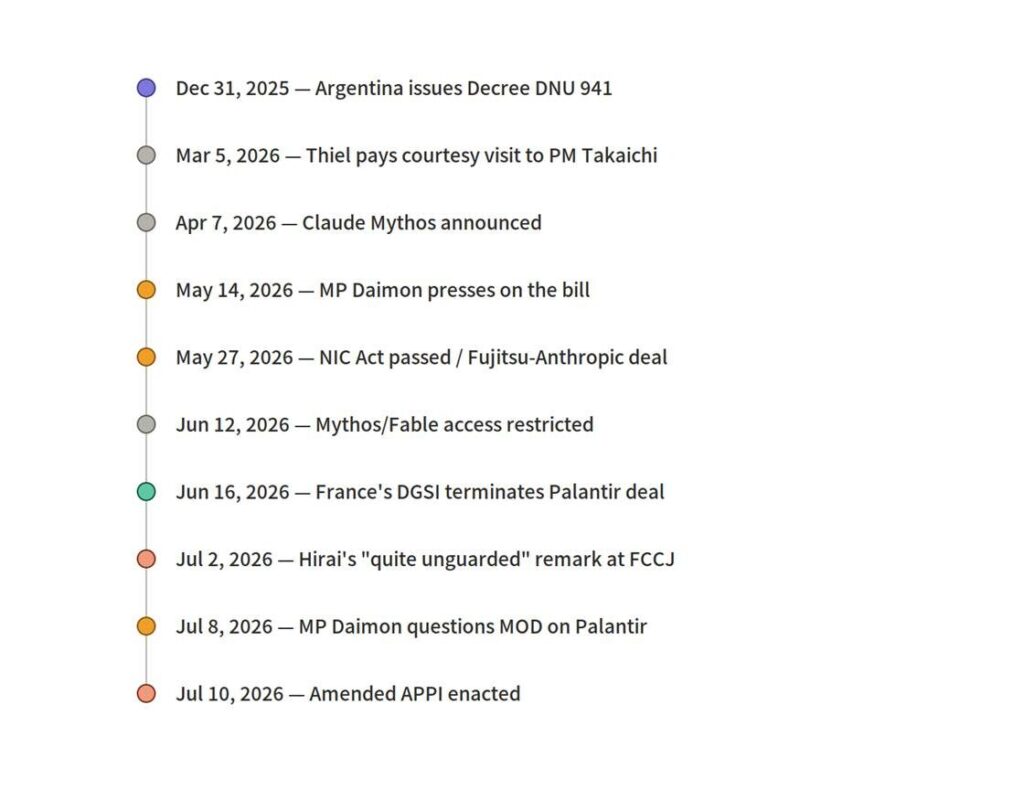
Figure: Timeline of related events, December 2025 – July 2026
Executive Summary
● On July 10, 2026, Japan’s amended Act on the Protection of Personal Information (APPI) was enacted. It introduces a new “Statistical Exception,” under which personal data — including Sensitive Personal Information — can be provided to third parties without the data subject’s consent, so long as the purpose is AI development. No obligation to anonymize the data, and no provision for group litigation, was included.
● The central question of this article is whether this Statistical Exception could, in the future, be used as a legally sanctioned “tool” by two distinct actors — (1) the National Intelligence Agency and (2) critical infrastructure operators — to justify providing data to techno-sovereign actors such as Palantir.
● Pathway 1 (National Intelligence Agency): At a House of Councillors Cabinet Committee session (May 21, 2026), MP Daimon Mikishi had government witness Oka Motohiko — a Cabinet Councillor in the Cabinet Intelligence and Research Office — confirm that data requests made under Article 7 of the National Intelligence Council Establishment Act bill would fall under the “cases based on laws and regulations” exception in the APPI. Government witness Ogawa Kuniko, a councillor at the Personal Information Protection Commission secretariat, also explained the possibility that data obtained via the Statistical Exception could reach the Council or the Agency. Chief Cabinet Secretary Kihara Minoru indicated that operations would be kept within a limited scope. The most advanced precedent for this pathway is Argentina’s presidential Decree DNU 941, which obliges state agencies to share personal data with intelligence services.
● Pathway 2 (critical infrastructure operators): SOMPO and Fujitsu have already deepened their relationships with Palantir and Anthropic, and the legal barrier to this pathway could fall once the Statistical Exception takes effect. The most advanced precedent for this pathway is the UK NHS’s “Section 254 Direction” — a mechanism that achieved non-consensual access to patient data through an undisclosed administrative application of existing law.
● In Diet testimony on July 8, 2026, Ministry of Defense councillor Yoshino stated that a decision to adopt Palantir had not been made, and stressed that Japan’s own decision-making authority and data sovereignty must be preserved. As things stand, Japan sits, on both pathways, at a stage “prior to legal completion.”
● Germany, France, and Spain have each moved, through political decisions, to sever reliance on Palantir in the defense or intelligence domain (France’s move remains at the announcement stage, and Palantir itself disputes it, maintaining the contract is still valid), offering a contrasting case: “even a relationship that has deepened can still be stopped, so long as it has not yet reached legal completion.”
● Measured against the Ideological Infiltration Index — a hypothetical analytical framework — Palantir’s infiltration into Japan is said to remain at an early stage. This cannot be treated as settled fact, but if the framework is accepted, it implies that Japan still has time to design institutional safeguards against both pathways.
Chapter 1: The Statistical Exception — Birth of a “Tool for Legal Justification”
1-0 Background — What Is the Act on the Protection of Personal Information?
The Act on the Protection of Personal Information (APPI), enacted in 2003, sets the rules that govern how businesses handle personal information. It is administered by the Personal Information Protection Commission (PPC), an independent administrative commission empowered to issue recommendations and orders against violations. The Act’s basic principle is that personal data may not be provided to third parties without the data subject’s consent, with exceptions — such as “cases based on laws and regulations” — narrowly enumerated. The Act is revised every few years, and the 2026 amendment is its latest iteration.
1-1 What Changed
On July 10, 2026, the House of Councillors passed the amended APPI by a majority that included the Liberal Democratic Party, Japan Innovation Party, Democratic Party for the People, and Team Mirai. The Constitutional Democratic Party, Komeito, Sanseito, the Japanese Communist Party, Reiwa Shinsengumi, Okinawa Kazekai, and the Social Democratic Party opposed it.
The centerpiece of the amendment is the “Statistical Purposes Exception” (hereafter, the Statistical Exception), which waives the requirement of consent for providing personal data to third parties, so long as the purpose is limited to AI model training or the compilation of statistics. Under current law, businesses and hospitals holding personal data are, in principle, obliged to obtain consent before releasing it externally; the new exception allows this step to be skipped, provided the stated purpose is AI development or statistical compilation. Sensitive Personal Information — such as medical history, criminal record, or belief and creed — also falls within the scope of this exception.
The government has explained the rationale for this deregulation as bolstering Japan’s domestic AI development capacity, which is said to be lagging behind the United States and China.
1-2 Why This Could Become a “Tool” — Two Gaps
The Statistical Exception does include an obligation to maintain security-management measures, and a mechanism whereby the terms agreed between provider and recipient are disclosed in advance so that third parties can verify them. This should be stated fairly.
However, from the standpoint of this article’s central question — whether the exception could function as a tool for justifying data provision to techno-sovereign actors — two gaps are decisive.
First, there is no requirement that the providing entity anonymize names or other identifying details. This means that data supplied under the Statistical Exception could reach the recipient in a form still close to identifiable raw data.
Second, the mechanism of group litigation — which would let consumer organizations seek injunctions on behalf of affected individuals — was not included in this amendment. A transparency mechanism through advance disclosure exists, but no means of externally and forcibly verifying whether it actually functions has been provided.
The National Federation of Health Insurance Societies (Zenkoku Hoken-i Dantai Rengokai) warned that, once AI development is cited as the purpose, medical institutions could provide Sensitive Personal Information such as patients’ medical histories to companies without consent, risking the leakage of individually identifiable information; it labeled the amendment a “bill for the worse” and called for it to be scrapped.
1-3 The Reach of the “Tool” — Who Might Use It, and For What
The wording of the Statistical Exception itself does not presuppose any particular actor or recipient. It is precisely this generality that widens the reach of the tool. In principle, both of the following actors could receive data under this exception:
● The state (intelligence bodies such as the National Intelligence Agency) — a pathway by which the government itself uses the Statistical Exception as the legal basis for cross-ministry data aggregation
● Critical infrastructure operators — a pathway by which private companies, citing AI development as their purpose, use the exception to justify providing data to techno-sovereign actors (foreign platform companies such as Palantir)
This article examines the concerns already raised in Japan, along with primary sources and overseas precedents, for each of these two pathways in Chapters 2 and 3.
Chapter 2: Pathway 1 — How Might the National Intelligence Agency Use the Statistical Exception?
2-1 Establishment of the National Intelligence Council Act
Around the same time as the amended APPI, the National Intelligence Council Establishment Act — which strengthens the government’s intelligence function — was passed by the House of Councillors on May 27, 2026. The government intends to launch the National Intelligence Agency in the summer of that year.
2-2 MP Daimon’s Questions and the Government’s Response — The Statistical Exception Meets the National Intelligence Council
At a House of Councillors Cabinet Committee session on May 21, 2026 (the 221st Diet session, meeting No. 9), MP Daimon Mikishi pressed government witness Oka Motohiko, a Cabinet Councillor in the Cabinet Intelligence and Research Office, on Article 7 of the National Intelligence Council Establishment Act bill — the provision allowing the Council or the Agency to request documents and information, including personal information, from ministries and agencies. Building on the fact that Article 69 of the APPI prohibits, in principle, using or providing personal information for purposes other than that for which it was collected, while carving out an exception for “cases based on laws and regulations,” Oka answered clearly: “Provision of documents under Article 7 of the National Intelligence Council Establishment Act corresponds precisely to a case based on laws and regulations, as that term is used in the Personal Information Protection Act.” (Diet record, statement No. 92.)
MP Daimon went on to note that the amended APPI — then still under deliberation in the House of Representatives — would introduce a Statistical Exception allowing personal information collected for statistical purposes to be provided to third parties without consent, and asked whether such data could be provided to the National Intelligence Council or Agency upon request. Government witness Ogawa Kuniko, a councillor at the Personal Information Protection Commission secretariat, explained that the amendment would create a new exception permitting third-party provision, without consent, by businesses whose sole purpose is AI development or statistical compilation, and that under current law, Article 69, paragraph 2, item 4 already permits administrative agencies to provide data outside its original purpose when the sole purpose is statistical compilation (statement No. 94).
MP Daimon then pressed further, using the example of a statistical survey of companies trading with a particular foreign country, asking whether personal information collected for statistical purposes might be aggregated by the National Intelligence Council or Agency without the knowledge or consent of the individuals concerned. Oka responded that even under current law there are precedents for personal information being provided to other ministries without consent, which is precisely why the current Article 69 is structured as it is (statements 95 and 96).
Finally, against a backdrop of distrust over the possibility that the National Intelligence Agency’s operations would be centered on the Public Security Police, MP Daimon conveyed his concerns to Chief Cabinet Secretary Kihara Minoru. Kihara stated, “Cases in which the National Intelligence Council or Agency receive personal information would be limited to what is necessary in connection with fulfilling their duties — for example, the prevention of terrorism,” and said that it was “hard to imagine,” and unnecessary, for the Council or Agency to collect, aggregate, or analyze the personal information of an unspecified large number of people beyond their assigned duties (statements 97 and 98).
Separately, it has also been reported that the government is coordinating to consolidate the reporting window for personal-data breaches at the National Cyber Office (NCO) (Nikkei Cross Tech, January 14, 2026). It should be noted that this is a coordination effort aimed at streamlining the reporting system, independent of the debate over the Statistical Exception or data sovereignty.
2-3 Precedent: Argentina’s Decree DNU 941
In considering how far this pathway could actually progress, Argentina’s case offers the most concrete point of reference.
On December 31, 2025, Argentina’s Milei government issued presidential Decree (DNU) No. 941 during a legislative recess, amending the national intelligence law. The decree obliges more than fifteen state agencies — including ANSES (Social Security Administration), AFIP (Federal Tax Administration), RENAPER (National Registry of Persons), and the health-care system — to share personal data with the state intelligence agency (SIDE), without a court order and without notifying citizens.
The configuration that concerns MP Daimon — a combination of cross-ministry data-collection authority and an exception permitting provision outside the original purpose — has, in Argentina, been completed in precisely this form, as a matter of law. The decisive difference from Japan’s current situation is that in Argentina this pathway has already been realized with binding legal force, in the form of a presidential decree, whereas in Japan concerns over this pathway remain at the stage of being pressed in the Diet, with the government taking the position of denying them.
2-4 Assessment
Taken together, Pathway 1 (the National Intelligence Agency’s invocation of the Statistical Exception) is, in Japan, a theoretical concern pursued in the Diet, but not one confirmed as a legally realized fact. Argentina’s case shows that this concern is not an idle fancy but a real possibility that other countries have, in fact, turned into law — and functions as a concrete cautionary example.
Chapter 3: Pathway 2 — How Might Critical Infrastructure Operators Use the Statistical Exception?
The relationships among SOMPO, Fujitsu, Palantir, and Anthropic are difficult to grasp from text alone. The figure below organizes the contractual and partnership relationships among these companies.
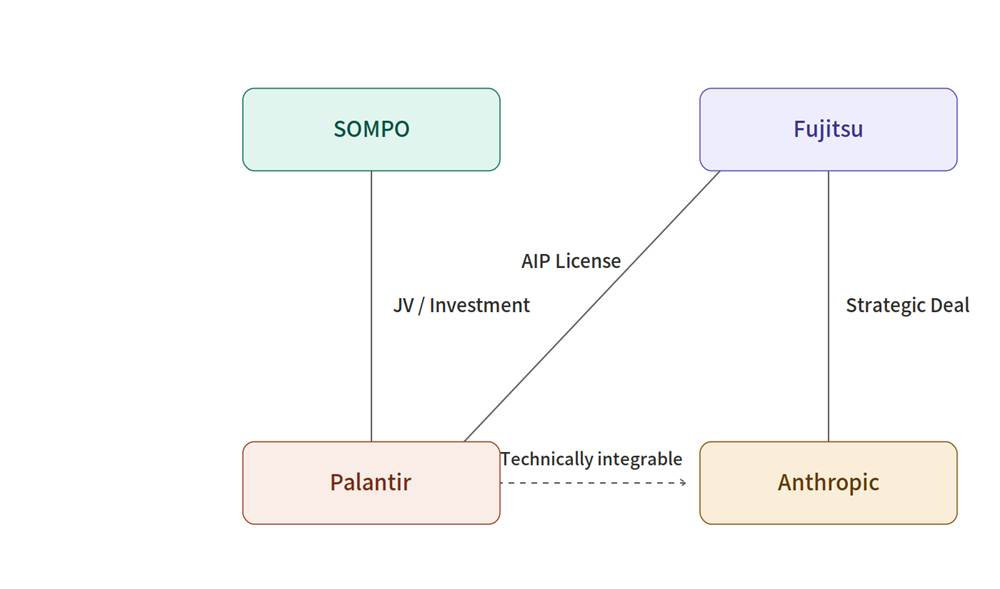
Figure: Relationships among SOMPO, Fujitsu, Palantir, and Anthropic
3-1 Precedents at SOMPO and Fujitsu — The State of Data Aggregation Already Underway
Pathway 2 is one in which a private critical infrastructure operator, rather than the state, uses the Statistical Exception as grounds for justifying data provision to a techno-sovereign actor. To assess how realistic this pathway is, we first confirm the facts already unfolding within Japan.
In 2019, SOMPO Holdings established a joint venture with Palantir Technologies, and in 2020 invested $500 million toward building a “safety, security, and health real-data platform.” The “real data” handled here is officially defined by SOMPO itself as “data obtained through sensors and other means regarding the real-world activities of individuals and businesses (including health information),” and includes elder-care information from SOMPO Care, its nursing-care facility business (distinct from the building and disaster data used in the property-and-casualty underwriting and claims business).
There is an important convergence worth noting here. The category the amended APPI newly permits to be provided to third parties without consent under the Statistical Exception is “Sensitive Personal Information,” of which medical history and health information are archetypal examples. The care and health information handled by SOMPO Care falls precisely within this scope. This means Pathway 2 is not merely an abstract possibility; a concrete point of connection already exists in the type of data involved. This is, however, only a convergence in the nature of the data — it does not mean SOMPO Care actually plans to use the Statistical Exception. That point is examined in the next paragraph.
In August 2025, Fujitsu signed a license agreement for Palantir AIP (a platform for embedding generative AI into business operations), and at the same time received a commissioned research contract on AI from the Acquisition, Technology & Logistics Agency. In May 2026, it further entered a strategic partnership with Anthropic, announcing plans to roll out Claude to roughly 100,000 employees company-wide. Palantir AIP itself is designed to be “model-agnostic,” selectively incorporating multiple external AI models, meaning that, technically, Fujitsu’s Palantir AIP holdings and its relationship with Anthropic could intersect on the same platform.
What matters here is that all of these cases are based on existing commercial-services contracts, operating under a legal scheme distinct from the Statistical Exception (non-consensual third-party provision). No primary source — including SOMPO Care’s investor-relations materials — indicates any plan to use the Statistical Exception framework for third-party provision.
Pathway 2, therefore, is not, at present, “a legally completed fact.” But once the Statistical Exception takes effect, a new condition will be in place: these existing commercial relationships could, by invoking “AI development purposes,” provide larger volumes of more sensitive data to these platforms — legally, and without passing through the procedural barrier of consent. This is the object this article examines as Pathway 2.
3-2 Precedent: The UK NHS’s “Section 254 Direction”
The most concrete precedent for what could happen if this pathway actually reaches legal completion is found in the United Kingdom.
The UK National Health Service’s “Federated Data Platform” (FDP) — a health-data integration infrastructure built around Palantir, with a contract value of £330 million over seven years (some reports cite a maximum of £480 million if extended) — does not allow patients to opt out of having their data processed. This arrangement was established not through new legislation, but through an undisclosed administrative direction issued under Section 254 of the Health and Social Care Act 2012. In the UK Parliament, the fact that this direction was never published or scrutinized became a point of contention, and the House of Commons Science, Innovation and Technology Committee recommended that the government sever its relationship with Palantir.
The lesson this case offers is significant. A pathway toward legally justifying data provision to a techno-sovereign actor need not require flashy new legislation. Combining an existing exception already present in the law with an undisclosed administrative practice can produce substantially the same effect.
Translated into Japan’s context, this raises the following question: once the new Statistical Exception takes effect and is applied to the existing commercial relationships between critical infrastructure operators and Palantir or Anthropic, could an administrative-level broadening of what counts as “AI development purposes” produce a state resembling the UK’s NHS — the entrenchment of data access without the data subject’s substantive consent — without ever passing through a formal review process?
3-3 Assessment
As with Pathway 1, Pathway 2 is, at present, not a legally completed fact but a stage at which the conditions are falling into place. The SOMPO and Fujitsu cases show that, even before the Statistical Exception takes effect, private critical infrastructure operators have, on their own initiative, been deepening their relationships with Palantir and Anthropic — a structural parallel to how the UK’s NHS deepened its relationship with Palantir before receiving its legal finishing touch in the form of the Section 254 Direction.
The decisive difference from the UK case is that, in Japan, no concrete instance of data provision grounded in the Statistical Exception, nor any comparable undisclosed administrative practice, has yet been confirmed.
Chapter 4: Not Yet Too Late — Contrasting Cases from Germany, France, and Spain
Germany, France, and Spain have each responded differently, depending on the sector and the country. The table below organizes each country’s response across three sectors: defense, intelligence and security, and health infrastructure.
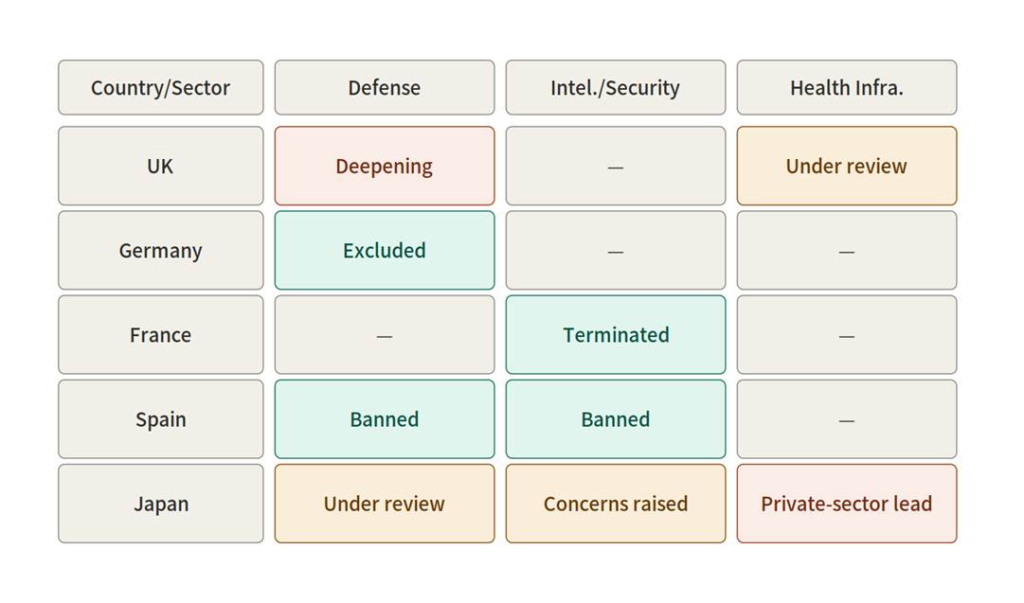
Figure: Matrix of national responses to Palantir, by country and sector
4-1 Why These Are “Contrasting Cases”
The two pathways examined in Chapters 2 and 3 — invocation by the National Intelligence Agency, and invocation by critical infrastructure operators — both remain “at a stage prior to legal completion.” But can a relationship with a techno-sovereign actor, once deepened, actually be stopped before reaching that completion? The cases of Germany, France, and Spain offer a concrete answer to this question.
4-2 Germany: Exclusion from a New Project
In April 2026, the head of the German armed forces’ cyber and information domain command stated that it did not plan to award a contract to Palantir for a new project, explaining that allowing a private American company access to the nation’s classified databases was inconceivable. This is an instance, relevant to both Pathway 1 and Pathway 2, in which a relationship was halted by political decision before it reached the stage of full-fledged dependence. This is limited, however, to exclusion from one specific new project, and does not mean all past relationships have been wound down.
4-3 France: An Abrupt Reversal Right After Renewal
In June 2026, France’s General Directorate for Internal Security (DGSI) announced that it was terminating its contract with Palantir (the Gotham system), which had been in place since 2016, and switching to the French domestic firm ChapsVision. Prime Minister Lecornu stated: “We must use our own AI models. We cannot accept a new strategic dependency in the digital domain.”
This “termination,” however, remains at the stage of a political announcement for now. Palantir told AFP that its contract — renewed for three years only in December 2025 — remains “pleinement en vigueur” (“fully in force”), and the migration to ChapsVision is not expected before roughly 2027; neither side has disclosed whether the legal conditions for termination have actually been met. This case, too, is thus subject to the same reservation this article has applied consistently to Pathway 1 and Pathway 2: it remains “prior to legal completion.”
What makes this case especially instructive is that the DGSI had renewed its three-year contract only half a year earlier, in December 2025. This demonstrates that Pathway 1 (an intelligence agency’s dependence on a techno-sovereign actor), even after deepening through a contract renewal, can still see a political intention to reverse course expressed. That reversal itself, however, remains at the stage of a declaration and has not yet reached actual completion of the migration — a lesson that applies, doubly, to this contrasting case itself: “so long as a relationship has not reached legal completion, even a deepened relationship can still be reversed.”
4-4 Spain: A Blanket Ban Across State-Owned Enterprises
In 2026, the Spanish prime minister’s office instructed companies under SEPI (the State Industrial Holding Company) — including Indra, Telefónica, and the major shipbuilder Navantia — to refrain from entering contracts with Palantir. The stated rationale was concern over the vulnerability of sensitive state data at organizations handling highly confidential communications and military information. This is an example of a broader response — a precautionary blanket ban applied across an entire class of state-owned enterprises, rather than to individual contracts.
4-5 A Common Pattern, and Its Implications for Japan
What these three countries share is that a relationship with a techno-sovereign actor, regardless of contract renewals or an existing operational track record, can still be halted by political decision so long as it has not reached “legal completion” (incorporation into new legislation or a permanent institutional framework).
Applied to this article’s central question, this means: even if Pathway 1 (the National Intelligence Agency) or Pathway 2 (critical infrastructure operators) in Japan approach legal completion through the Statistical Exception or its operational practice, the cases of Germany, France, and Spain show that a course correction remains possible so long as that stage has not yet been reached. Conversely, once a relationship “is completed” — through an undisclosed administrative practice or institutional incorporation, as with the UK NHS’s Section 254 Direction — the political cost of a course correction rises sharply.
What Japan currently faces is precisely this stage — “prior to completion.”
Overseas reporting notes that the timing of Germany’s and France’s policy shifts came immediately after the temporary access restriction imposed on Anthropic’s Claude Mythos and Fable for non-U.S. users on June 12, 2026. Several analyses view that episode as having impressed upon European intelligence agencies “the fragility of dependence on foreign AI infrastructure,” contributing to Germany’s and France’s rapid policy reversals. This can be seen as a case in which the risk anticipated by this article’s Recommendation 4 (a disclosure regime for foundation-model providers and their countries of origin) has already materialized in Europe.
4-6 A Fragile Foundation — An Admission of Being “Unguarded,” From a Policymaker Himself
Even though the two pathways examined in Chapters 2 and 3 both remain “prior to legal completion,” how far the institutional foundation needed to stop them has actually been built is a separate question requiring its own scrutiny.
On this point, Hirai Takuya, chair of the LDP’s Headquarters for the Promotion of a Digital Society (and a former minister for digital affairs), stated the following at an FCCJ press conference titled “Japan’s AI Future” on July 2, 2026 (FCCJ official YouTube, https://www.youtube.com/live/pgKW3xoNqho?si=lW_jskV-O0gda73V, at 49:41–50:02), on the subject of data-access rights and security safeguards in international joint research and development:
“Until now, Japan has been quite unguarded in that respect.”
At the same press conference, Hirai put forward “AI sovereignty” (open strategic autonomy) as a guiding principle of AI policy — the idea of avoiding excessive dependence on any single company, country, or model, while retaining the capacity to develop and operate AI independently when necessary. Yet the fact that the security-clearance regime and data-access safeguards meant to underpin this principle have been described as “unguarded” by a policymaker himself is a significant primary source, showing that the institutional preparedness needed to prevent legal completion, for either Pathway 1 or Pathway 2, has not yet caught up with the moment.
Hirai also indicated that the government would support Japanese companies entering the “ontology” field pioneered by Palantir. This reveals a layered picture: Japan faces the risk of dependence on Palantir even as it simultaneously seeks to acquire the Palantir-style business model for itself.
It should also be noted that a tension exists between MOD Councillor Yoshino’s “not yet decided” testimony and press reporting. In June 2026, the Asahi Shimbun reported that the Ministry of Defense had settled on a policy direction toward adopting Palantir’s Maven Smart System as its AI-enabled command-and-control system, and intended to incorporate this AI use into the revision of Japan’s three security-related documents due by year’s end. The paper attributed this to unnamed defense-ministry sources and explicitly noted that the authorities had not officially confirmed it. This is less a contradiction than a configuration typical of this kind of policy formation — cautious, hedged public testimony alongside internal policy deliberation that has already moved ahead — and it suggests that Pathway 2 may already be more advanced than this article otherwise assumes.
Chapter 5: Policy Recommendations
Building on the analysis above, we recommend the following concrete safeguards against Pathway 1 (the National Intelligence Agency) and Pathway 2 (critical infrastructure operators), respectively.
5-1 A Check on Pathway 1: Third-Party Review of the Statistical Exception’s Administrative Use
When the National Intelligence Agency invokes the Statistical Exception, or the APPI’s exception permitting use outside the original purpose, to aggregate data, a mechanism should be established whereby a third-party body independent of the administration periodically verifies that operations genuinely remain within “the scope necessary to carry out its duties.” To prevent a scenario like Argentina’s DNU 941 — in which a single presidential decree creates an obligation to share data without a court order or notice — the institutionalization of such review should be undertaken now, while the pathway remains “prior to legal completion.”
5-2 A Check on Pathway 2: Adding an Anonymization Requirement to the Statistical Exception
Current law contains no requirement to anonymize names or other identifying information under the Statistical Exception. As the SOMPO Care case shows, the data potentially covered includes health information. Given the lesson of the UK NHS’s Section 254 Direction — where an undisclosed administrative practice entrenched non-consensual data access — the absence of an anonymization requirement is a gap that directly determines the scale of harm should Pathway 2 reach legal completion, and should be closed as a top priority in the forthcoming commission rules and guidelines.
5-3 Establishment of an Independent Third-Party Oversight Body
With group litigation left out of the amendment, Pathway 2 operates, in practice, on advance disclosure between businesses and self-reporting. An independent third-party body should be established to continuously verify whether data provision under the Statistical Exception genuinely remains limited to statistical purposes.
5-4 A Disclosure Regime for Foundation-Model Providers and Their Countries of Origin
As the SOMPO and Fujitsu cases show, the platforms used by critical infrastructure operators are designed to selectively incorporate multiple external AI models. When introducing AI systems in highly sensitive domains such as defense, healthcare, or elder care, the entity should identify which AI model actually underpins the system and which country provides it, and should require that the risk of access being cut off by that provider country’s geopolitical decisions be documented as an evaluation criterion in system selection and ongoing operation. The temporary access restriction imposed on Claude Mythos and Fable in June 2026 is a concrete example showing that such a risk is not merely theoretical.
5-5 Resolving the “Unguarded” Problem — Building a Security Clearance Regime
To resolve the state of being “unguarded,” as Hirai himself admitted, Japan should accelerate the development of a data-access-rights and security-clearance regime for international joint AI development. This would provide a shared institutional foundation for safeguards against both Pathway 1 and Pathway 2.
5-6 Learning from Germany, France, and Spain — Clarifying Criteria for “Stopping Before Completion”
As the German, French, and Spanish cases show, a relationship with a techno-sovereign actor can still be redirected by political decision so long as it has not reached legal completion. Japan, too, should codify in advance the concrete criteria for what signs would trigger a review of a given contract or relationship — a step that would lower the political cost of any later course correction.
Chapter 6: Surveying the Whole Picture
We distill this article’s central question into a single figure. From one door — the Statistical Exception — two paths branch off: Pathway 1 (the National Intelligence Agency) and Pathway 2 (critical infrastructure operators), each corresponding to a current state within Japan and an overseas precedent.
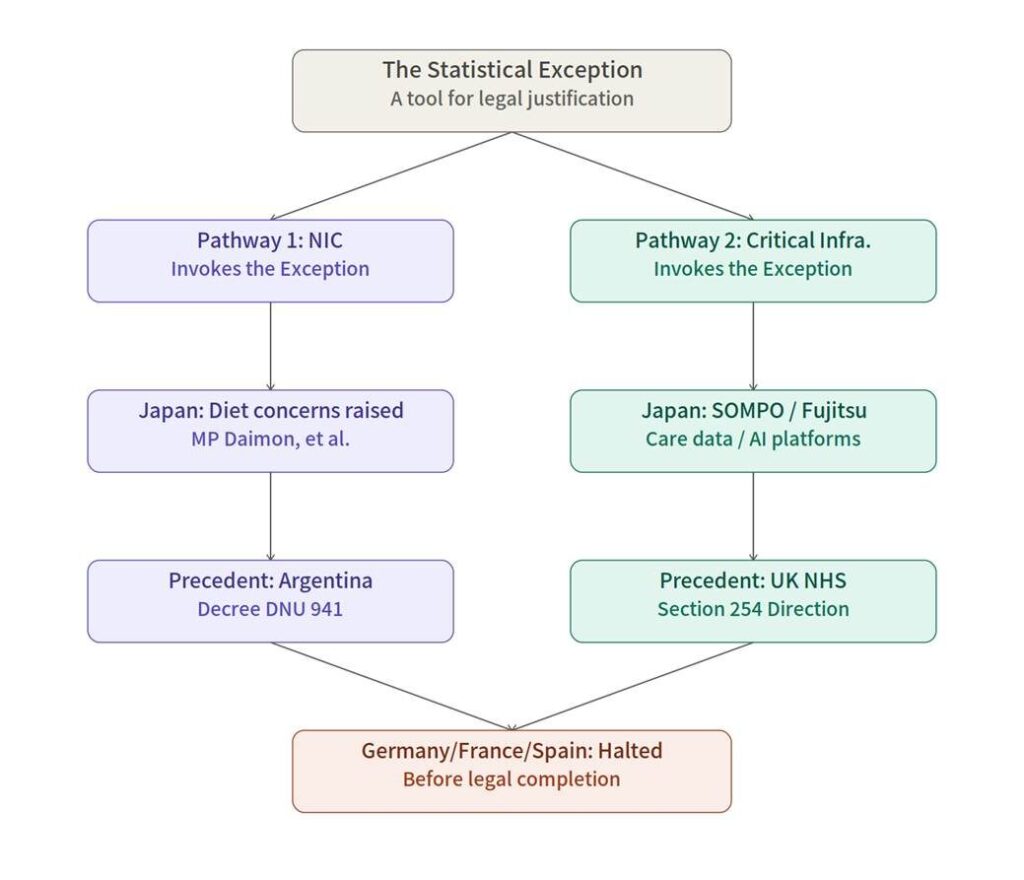
Figure: The structure of the two pathways created by the Statistical Exception
Viewed through the auxiliary lens of the Ideological Infiltration Index, a hypothetical framework proposed by our institute (original source: “Palantir and Japan: Signs of Dark Enlightenment Infiltration,” Japan Institute for Crisis Management, https://inst-ds.org/cyber-security/1745/), Japan’s position appears as follows.
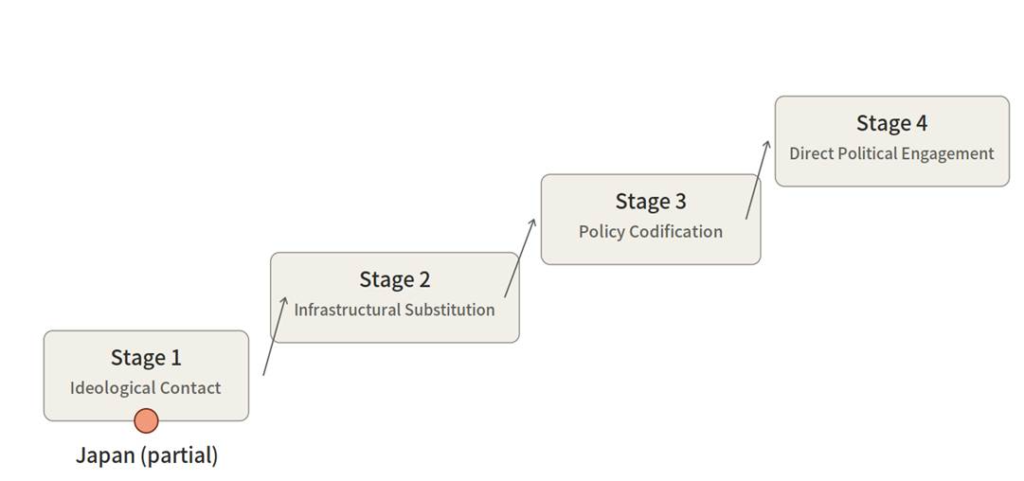
Figure: The four stages of the Ideological Infiltration Index and Japan’s current position
Setting the degree of ideological infiltration aside, and repositioning the two pathways instead by their degree of legal completion, produces the following figure.
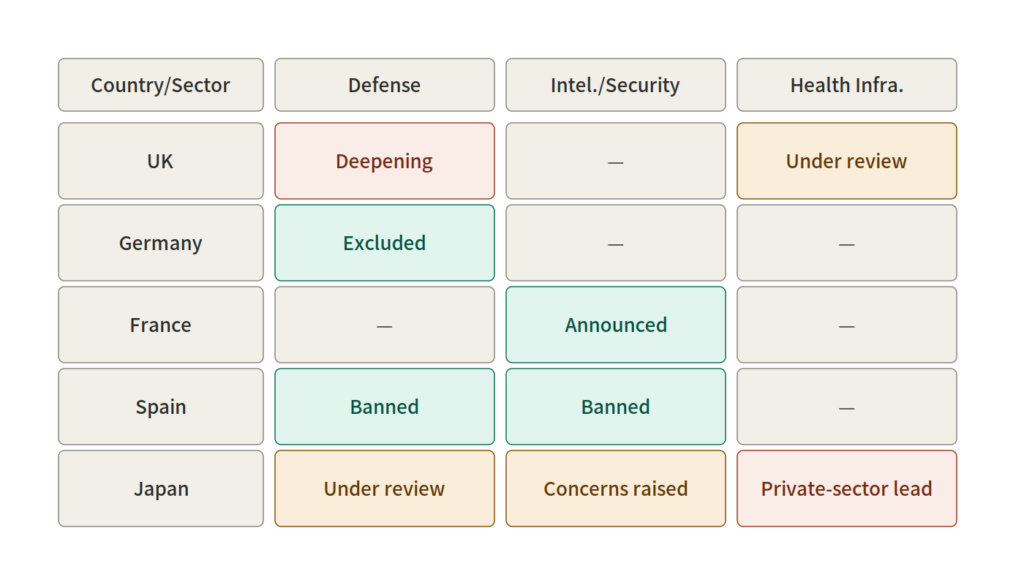
Figure: Positioning by degree of legal completion
Conclusion
Japan Still Stands Before Both Pathways Reach “Completion”
The two pathways examined in this article — the National Intelligence Agency’s invocation of the Statistical Exception (Pathway 1), and critical infrastructure operators’ provision of data to techno-sovereign actors through the Statistical Exception (Pathway 2) — are, at present, not legally completed facts in Japan. That said, both are “incomplete” to differing degrees of certainty. Pathway 1 has reached the stage of being pressed in the Diet as a concern, with the government not denying the underlying legal structure while explaining operational limits. Pathway 2 has reached the stage where the Statistical Exception itself has not yet taken effect, and no concrete case of its use has been confirmed.
Yet the precedents of Argentina’s presidential decree and the UK NHS’s undisclosed administrative direction show that a pathway of this kind can reach completion without flashy new legislation — through nothing more than a combination of an existing exception and administrative practice.
The word “unguarded,” admitted by Hirai Takuya himself, and the Ministry of Defense’s testimony that “a decision has not been made” and that “multiple options are under consideration,” are dual evidence that Japan stands just short of this completion. At the same time, the cases of Germany, France, and Spain show that a course correction remains possible at this stage.
The door opened by the Statistical Exception has already swung open. What passes through it remains, for now, Japan’s own choice.
References
Primary Sources (Legislation, Diet Records, Government)
● Personal Information Protection Commission, “Summary of the Advisory Notice Issued to OpenAI,” June 2, 2023.
● Minutes of the House of Councillors Cabinet Committee, Meeting No. 9, 221st Session of the Diet (May 21, 2026): Questions by MP Daimon Mikishi; testimony by government witnesses Oka Motohiko (Cabinet Councillor, Cabinet Intelligence and Research Office) and Ogawa Kuniko (Councillor, Personal Information Protection Commission secretariat); testimony by Minister of State Kihara Minoru (Chief Cabinet Secretary). https://kokkai.ndl.go.jp/simple/txt/122114889X00920260521/91–98 (statement numbers 91–98).
● Kyodo News, “Government Signals Plan to Formulate a ‘National Intelligence Strategy,’ Aiming to Deepen Public Understanding,” April 10, 2026 (via Yahoo! News); confirms Oka Motohiko’s title as Cabinet Councillor, Cabinet Intelligence and Research Office. https://news.yahoo.co.jp/articles/922f1ffe2957dd6751df976723f09e4eaaa93aed
● House of Councillors internet broadcast of Diet proceedings, MP Daimon Mikishi’s questions (Japanese Communist Party): pursuing privacy concerns over the National Intelligence Council Establishment Act bill, May 14, 2026, https://www.youtube.com/watch?v=hh4LC2My25s / the Palantir issue at the House of Councillors Cabinet Committee, June 16, 2026 / “The Relationship Between the Ministry of Defense’s AI Systems and Palantir,” House of Councillors Special Committee on the Formation of a Digital Society and the Utilization of Artificial Intelligence, July 8, 2026, https://www.youtube.com/watch?v=VhbN9J5irhM (MP Daimon: 4:49–5:00, 6:46–6:59, 7:16–7:57, 9:55–10:11, 10:25–11:02, 10:34–10:51, 11:27–11:58, 13:14–13:20, 13:22–13:26 / MOD Councillor Yoshino: 3:42–4:19, 5:58–6:17, 6:17–6:33, 8:07–8:54, 8:33–8:46).
● Prime Minister Takaichi Sanae, House of Councillors Budget Committee testimony, March 17, 2026 (on the use of Palantir’s services).
● FCCJ (Foreign Correspondents’ Club of Japan) official YouTube, “PRESS CONFERENCE: ‘Japan’s AI Future’ by Takuya Hirai, LDP,” July 2, 2026, https://www.youtube.com/live/pgKW3xoNqho (relevant remarks at 49:41–50:02).
Primary Sources (Corporate Announcements)
● SOMPO Holdings and Palantir joint announcement, June 19, 2020, https://www.sompo-hd.com/~/media/hd/files/news/2020/20200619_1.pdf
● Palantir official case study (SOMPO), https://www.palantir.com/jp/casestudies/sompo/
● Fujitsu–Anthropic strategic partnership announcement, May 27, 2026, https://global.fujitsu/ja-jp/pr/news/2026/05/27-01
● Palantir official documentation (list of supported AIP models), https://www.palantir.com/docs/foundry/aip/supported-llms
● Anthropic official statement, “On Mythos/Fable Access Restrictions,” June 2026, https://www.anthropic.com/news/fable-mythos-access
Domestic Reporting and Expert Commentary
● Various Nikkei Cross Tech articles (practical explanation of the Statistical Exception; NCO consolidation), January 14 and June 11, 2026.
● Nagashima Ohno & Tsunematsu, “The AI Exception and Data Governance,” April 16, 2026, https://www.nagashima.com/publications/publication20260416-2/
● Business & Law, “The Outer Bounds of the Statistical Purposes Exception,” June 30, 2026, https://businessandlaw.jp/articles/a20260630-1/
● rocket-boys.co.jp, “The Content of the Amended Act on the Protection of Personal Information,” July 10, 2026, https://rocket-boys.co.jp/security-measures-lab/amended-personal-information-protection-act-2026/
Overseas Primary Sources and Major Media
● Hansard (UK Parliamentary Record), debate on the NHS Federated Data Platform, April 16, 2026, https://hansard.parliament.uk/commons/2026-04-16/debates/2FDCA71C-D0C1-4738-BEE8-A4BDA311DB99/NHSFederatedDataPlatform
● Computer Weekly, “MPs call on NHS to scrap Palantir,” 2026, https://www.computerweekly.com/news/366645814/MPs-call-on-NHS-to-scrap-Palantir-and-its-Federated-Data-Platform
● The Register, “NHS patients can’t opt out of Palantir’s data platform,” June 13, 2026, https://www.theregister.com/databases/2026/06/13/nhs-patients-cant-opt-out-of-palantirs-data-platform-but-their-hospital-can/5254766
● Euronews, “DGSI drops Palantir for French firm,” June 16, 2026, https://www.euronews.com/business/2026/06/16/dgsi-drops-palantir-for-french-firm-says-sebastien-lecornu
● Franceinfo, “France’s intelligence services distance themselves from Palantir,” June 16, 2026 (reports Palantir’s statement to AFP that its contract remains “pleinement en vigueur”), https://www.franceinfo.fr/internet/intelligence-artificielle/le-renseignement-francais-met-fin-a-son-partenariat-avec-la-societe-americaine-palantir-annonce-sebastien-lecornu_8063300.html
● Strasbourg Policy Centre, “France’s DGSI Drops Palantir for Local Rival in Sovereignty Push,” June 16, 2026 (notes the timing relative to Anthropic’s Mythos/Fable access restriction), https://strasbourgcentre.com/frances-dgsi-ditches-palantir-for-local-rival-a-pivot-toward-digital-sovereignty/
● Asahi Shimbun diplomatic/defense press club, “SDF to use AI in command and control; consideration of adopting U.S.-based Palantir underway, alongside domestic development,” June 2026, reported via unnamed defense-ministry sources, with no official confirmation, https://x.com/asahi_gaikou/status/2070417545157660848
● Cryptopolitan, “Germany skips Palantir for military use,” April 2026, https://www.cryptopolitan.com/germany-skips-palantir-for-military-use/
● Naked Capitalism, “Europe’s blacklisting of Palantir is gathering pace,” July 2026, https://www.nakedcapitalism.com/2026/07/europes-blacklisting-of-palantir-is-gathering-pace.html
Secondary Sources (cited with their nature disclosed)
● A note.com blog by “Akahata Reader 2023,” summarizing Diet proceedings (questions by MPs Shiokawa Tetsuya and Daimon Mikishi, May 20 and 21, 2026) — a personal blog whose author identifies as a supporter of the Japanese Communist Party; article numbers cited there warrant independent confirmation against the official Diet record.
● Various articles from the Japan Institute for Crisis & Disaster Management, a general incorporated foundation (the original inspiration for this article; the institute states on its own site that it does not guarantee the accuracy or completeness of its content), https://inst-ds.org/cyber-security/1584/ / https://inst-ds.org/cyber-security/1048/ / https://inst-ds.org/cyber-security/1745/ / https://inst-ds.org/ai/1820/
Glossary
Act on the Protection of Personal Information (APPI)
Enacted in 2003. Sets the rules governing how businesses handle personal information. Its core principle prohibits, in general, third-party provision of personal data without the data subject’s consent, structured around a narrow, enumerated list of exceptions. It is revised every few years.
Personal Information Protection Commission (PPC)
The independent administrative commission that administers the APPI, with the power to issue recommendations and orders to businesses.
Statistical Purposes Exception (the “AI Exception”)
A provision newly created by the amended APPI. Waives the requirement of the data subject’s consent for third-party provision of personal data, and for the acquisition of Sensitive Personal Information, so long as the purpose is limited to AI model training or the compilation of statistics.
Sensitive Personal Information
Personal information — such as medical history, criminal record, or belief and creed — requiring particular care so as not to give rise to unjust discrimination, prejudice, or other disadvantage to the individual concerned. Subject to stricter rules on acquisition and provision under the APPI than ordinary personal information.
National Intelligence Council Establishment Act
Legislation strengthening the government’s intelligence function, enacted May 27, 2026. Elevates the Cabinet Intelligence and Research Office into a “National Intelligence Agency,” giving it a comprehensive coordinating role across the government’s intelligence bodies.
Techno-sovereign actor
A term used in this article to denote a private company that holds data, AI technology, and infrastructure on a scale rivaling that of a state, and that can influence the sovereign decision-making of a particular state. In this article, the term refers principally to Palantir Technologies.
Palantir Foundry / AIP
Palantir Technologies’ data-integration platform (Foundry) and its platform for embedding generative AI into business processes (AIP). AIP is designed to be “model-agnostic,” selectively incorporating multiple external AI models.
Ideological Infiltration Index
An analytical framework independently proposed by the Japan Institute for Crisis & Disaster Management. Diagnoses the process of political and ideological infiltration into a given country across four stages: (1) ideological contact, (2) infrastructural substitution, (3) policy codification, and (4) direct political engagement. This is not an academically established theory but a hypothetical framework still under examination. (Original source: “Palantir and Japan: Signs of Dark Enlightenment Infiltration,” Japan Institute for Crisis & Disaster Management, https://inst-ds.org/cyber-security/1745/)
AI Sovereignty (Open Strategic Autonomy)
An AI-policy principle articulated by Hirai Takuya, chair of the LDP’s Headquarters for the Promotion of a Digital Society, at the FCCJ press conference: the idea of avoiding excessive dependence on any single company, country, or model, while retaining the capacity to freely choose the best AI in the world and, where necessary, to develop and operate it independently.
Claude Mythos / Project Glasswing
Anthropic’s cybersecurity-specialized AI model (Mythos) and the defense-limited international cooperation framework built around it (Project Glasswing). In June 2026, access from outside the United States was temporarily suspended under a U.S. export-control directive.
Decree DNU 941
A presidential decree issued by Argentina’s Milei government on December 31, 2025. Amends the national intelligence law, obliging multiple state agencies to share personal data with the state intelligence agency (SIDE) without a court order or notice.
Section 254 Direction (UK Health and Social Care Act)
The legal basis by which patient opt-outs are, in practice, nullified under the UK NHS’s Federated Data Platform. Operates not through new legislation but through an undisclosed administrative direction issued under an existing exception in the law.
Closing Note
The “Ideological Infiltration Index” is an analytical framework that diagnoses the degree of political and technological infiltration into a given country across four stages: (1) ideological contact, (2) infrastructural substitution, (3) policy codification, and (4) direct political engagement. Its original source is the Japan Institute for Crisis Management’s “Palantir and Japan: Signs of Dark Enlightenment Infiltration” (https://inst-ds.org/cyber-security/1745/). The institute states on its own site that it does not guarantee the accuracy or completeness of its information, and this index, too, is not an academically established theory but a hypothetical framework still under examination. This article does not treat it as objective fact, but uses it, with appropriate reservations, as one lens for gauging Palantir’s infiltration into Japan (see Chapter 6).
* This article may be freely quoted or reproduced, provided the source (Japan Institute for Crisis & Disaster Management / author / URL) is credited. Please refrain from excerpting or reproducing it in ways that alter its headings or context.
Author: Miho Funayama
Miho Funayama is a strategic analyst specializing in international standardization, technology intelligence, intellectual property analysis, and geopolitical and crisis risk management. She holds a degree in International Politics from Sophia University and completed graduate studies in International Political Economy, Philosophy, and Psychology at Aoyama Gakuin University. She previously led patent research and strategic analysis on international standards and emerging technologies at Canon Inc., where she served as Deputy International Secretary of ISO/IEC JTC 1/SC 28 and received the ITSCJ Award for Contribution to International Standardization three times. She is currently a Director and Chief Researcher at the Japan Institute for Crisis Management, a Fellow at the Institute of Middle East–Asia Information Strategy, and a Professional Associate Member of the Foreign Correspondents’ Club of Japan.
Her research focuses on the intersection of cybersecurity, geopolitical risk, and information warfare, examining decision-making structures and psychological operations through an interdisciplinary lens spanning international politics, philosophy, and psychology.