
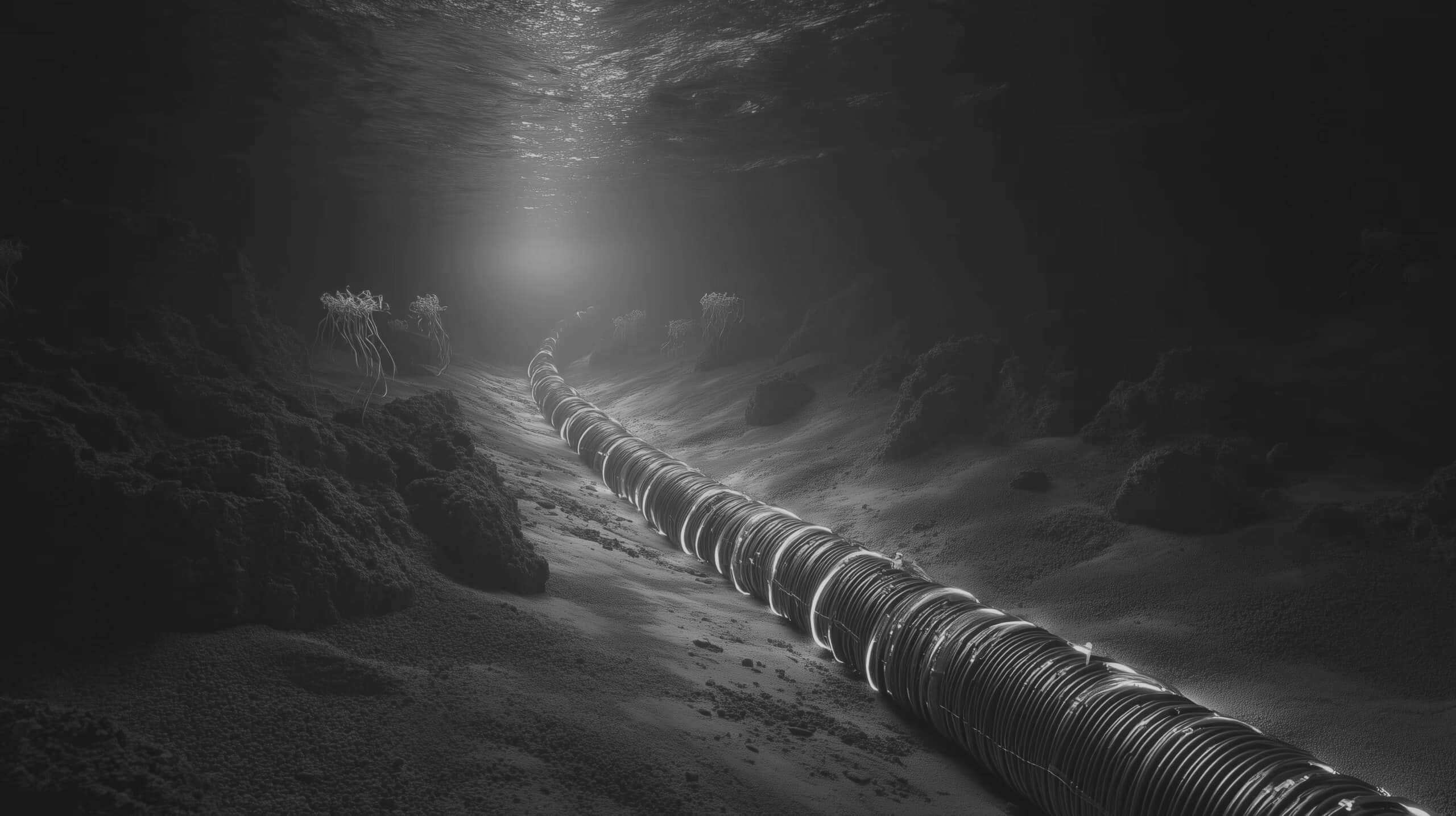
【前編】中東海域における「海峡・海底通信ケーブル」危機と日本への影響
― 「バブ・エル・マンデブ海峡」封鎖リスクが示す日本の「海底通信ケーブル」依存構造の脆弱性―
Part 1: The Strait & Submarine Cable Crisis in Middle Eastern Waters
Bab-el-Mandeb at Risk: Exposing Japan’s Submarine Cable Dependency
2026年3月29日
発行元: 一般財団法人 日本危機管理研究所
*英訳版は日本語版の後に掲載しています。/ The English translation follows the Japanese text below.
【本稿の位置づけ】
中東・紅海海域の「海底通信ケーブル」リスクは、Foreign Policy(2024年)やCSIS(2026年)が英語圏で論じ、三菱総合研究所等が台湾有事を軸とした日本への影響を分析しているが、先行研究はいずれも単一領域に留まっており、これらを横断した日本語論考は存在しない。本稿は、物理攻撃・サイバー攻撃・GPS/AIS干渉・情報戦を「統合インフラ戦」という単一フレームで整理し、日本固有の二重依存構造(エネルギー・通信)への影響を定量的に示すとともに、代替ルート競争と日米安全保障の視点を加えることで、先行研究にない実践的な政策提言を導出することを目的とする。
なお本稿は前後編の構成をとる。本稿(前編)が「何が壊れうるか」を問うとすれば、後編は「誰が次の秩序を設計するか、そして日本はそこでいかなる役割を担えるか」を問う。後編は別稿として近日公開予定である。【後編】海底ケーブルを制する者が世界を制す——日本は『インフラ覇権競争』に参画できるか – 一般財団法人日本危機管理研究所
■ キーワード
・ フーシ派参戦拡大(Houthi Escalation)
・ 中東海峡リスク(Maritime Chokepoint Risk)
・ ホルムズ海峡(Strait of Hormuz)
・ バブ・エル・マンデブ海峡(Bab el-Mandeb Strait)
・ 海底通信ケーブル(Submarine Communication Cables)
・ 海洋インフラ脅威(Maritime Infrastructure Threats)
・ サイバー攻撃(Cyber Attacks)
・ 統合インフラ戦(Integrated Infrastructure Warfare)
・ GPSスプーフィング(Global Positioning System Spoofing)
・ AIS干渉(Automatic Identification System Interference)
・ 情報戦・偽情報(Information Warfare / Disinformation)
・ エネルギー供給リスク(Energy Supply Risk)
・ 海底ケーブル切断(Submarine Cable Severance)
・ グレーゾーン作戦(Gray Zone Operations)(武力行使未満の組織的妨害)
・ データの動脈(Data Arteries)
・ 代替ケーブルルート競争(Submarine Cable Route Competition)
・ 日米インフラ安全保障(Japan-US Infrastructure Security)
目次
エグゼクティブサマリー
1.現状(Situation)― フーシ派の軍事関与拡大と戦域の広域化
2.背景(Geopolitical Background)― 二大チョークポイントの地政学的構造 コラム:バブ・エル・マンデブとホルムズ、二つの海峡のリスク構造
3.事件の本質(Core Nature of the Crisis)― 統合インフラ戦という把握 3-1.海底通信ケーブルへの実証された脅威 3-2.サイバー攻撃:港湾・通信インフラへの実証事例 3-3.GPS・AISスプーフィング:航行システムへの現実の攻撃 3-4.情報戦・偽情報:経済と世論への波及 3-5.統合インフラ戦としての本質的理解
4.日本への影響(Impact on Japan)― エネルギーと通信の二重依存構造 4-1.エネルギー安全保障:ホルムズ依存の現実 4-2.通信インフラ:海底ケーブル依存の実態と日本固有のリスク 4-3.特に影響が想定される分野 4-4.サイバー攻撃・情報戦の二次的波及 4-5.代替ルート競争と日本への戦略的示唆 4-6.日米安全保障とケーブル:見落とされた連結点
5.結論と政策提言(Conclusion & Policy Recommendations)― 物理・サイバー防衛統合の時代へ 5-1.統合インフラ戦時代への移行 5-2.物理防衛とサイバー防衛の統合の必要性 5-3.海底ケーブルをめぐる国際競争という視座 5-4.政策提言:脆弱性分析から導出される具体的アクション
参考資料
■ エグゼクティブサマリー
・軍事的拡大: フーシ派のミサイル攻撃により、紅海を超えた広域戦場化が現実のものとなっている。これはイエメン内戦の延長ではなく、イランを後ろ盾とする多層的代理戦争への変質であり、中東全域の海上安全保障を同時に不安定化させる構造的転換点である。
・実証済みの物理被害: 2024年2月、紅海でHGC・AAE-1・EIGの3海底ケーブルが実際に切断・損傷し、インド・欧州間の通信に重大な障害が発生した。「将来のリスク」ではなく「記録済みの現実」として認識することが、政策対応の出発点となる。
・二大チョークポイント同時不安定化: バブ・エル・マンデブ海峡(物流・データ)とホルムズ海峡(エネルギー)が同時に危機に晒されている。両海峡のリスクは性質が異なるが、同時に顕在化した場合、日本はエネルギーと通信の両生命線を一度に失うシナリオに直面する。
・サイバー攻撃の顕在化: 港湾・通信拠点・ケーブル陸揚げ局へのサイバー攻撃リスクが、2020年イスラエル港湾攻撃等の実証事例とともに浮上している。物理的な破壊を伴わずとも、制御システムへの侵入だけで重要インフラを機能停止させ得る点が現代的脅威の本質である。
・GPS・AISの脆弱性: スプーフィング(位置情報の偽装)・ジャミング(電波妨害)により、航行・物流が実際に混乱する事例が紅海周辺で報告されている。低コストで実施可能なこの非対称攻撃は、物理攻撃なき海難事故を引き起こし得る点で過小評価されやすい脅威である。
・情報戦の影響: 偽情報・心理戦が市場・エネルギー価格・世論に波及する構造的リスクがある。フーシ派の攻撃予告だけで戦争リスク保険料が数倍に跳ね上がった事実が示す通り、実害の発生を待たずして経済的損害が先行するのが情報戦の特性である。
・統合インフラ戦の典型: 本事象は「物理攻撃+サイバー攻撃+情報戦」が融合した統合インフラ戦であり、グレーゾーン作戦の典型事例である。三つの攻撃層が相互に増幅し合う構造を持つため、単一領域の防衛策では対処できない。
・日本の二重依存: 日本はエネルギー(ホルムズ依存約88%)と通信(海底ケーブル依存約95%)の両面で構造的脆弱性を抱える。この二つが同一の地理的チョークポイントに依存している点が、他国にない日本固有のリスク構造であり、本稿の分析が日本に特化した意味がここにある。
・代替ルート競争の加速: MetaのProject Waterworthに代表されるように、ハイパースケーラーが中東回避ルートへの再設計を進めている。この動きは民間主導だが地政学的含意を持ち、日本がインド太平洋ケーブル網の設計・誘致においてイニシアティブをとれるかどうかが、中長期的な通信安全保障の分岐点となる。
・日米安保とケーブルの連結: 海底ケーブルは日本の「データの動脈」であり、その障害は日本のエネルギー・経済リスクにとどまらず、米軍のインド太平洋における指揮・統制・デジタル接続にも直結する。ケーブル防護を日米同盟の機能維持という観点から再定義することが、本稿が提言する政策の根幹をなす。
1.現状(Situation)フーシ派の軍事関与拡大と戦域の広域化
— Escalation of Houthi Involvement and Expansion of the Operational Theater —
中東情勢は局地的衝突の段階を超え、複数戦域が連動する不安定な局面に入りつつある。その中核にあるのが、イエメンの武装組織フーシ派(Houthi)の関与拡大である。
フーシ派は2023年10月以降、パレスチナ・ガザ地区への連帯を名目に、紅海を航行する商業船舶への攻撃を本格化させた。米国防総省の発表によれば、2023年10月から2024年初頭にかけて50隻以上の民間船舶が攻撃・妨害を受けており、その範囲はイスラエル方向へのミサイル発射を含む広域作戦へと拡大している。
フーシ派はイランの支援を受けているとみられ、地域紛争は「局地戦」から「多層的代理戦争(Multi-layered Proxy Warfare)」へと変質しつつある。これにより、紅海・ペルシャ湾を含む広範な海域の安全性が同時に揺らぎ始めている。
特に注目すべきは、2024年2月に実際に発生した海底通信ケーブル切断事案である。紅海北部において、HGC(Hong Kong Guangzhou Cable)、AAE-1(Asia Africa Europe-1)、EIG(Europe India Gateway)の3本の主要ケーブルが相次いで損傷・切断された。この事案はフーシ派との関連が疑われており、インド・欧州間の通信に著しい障害を引き起こした。「可能性」ではなく、すでに現実の事象として記録されている点は重要である。
2.背景(Geopolitical Background)二大チョークポイントの地政学的構造
— Geopolitics of Strategic Maritime Chokepoints —
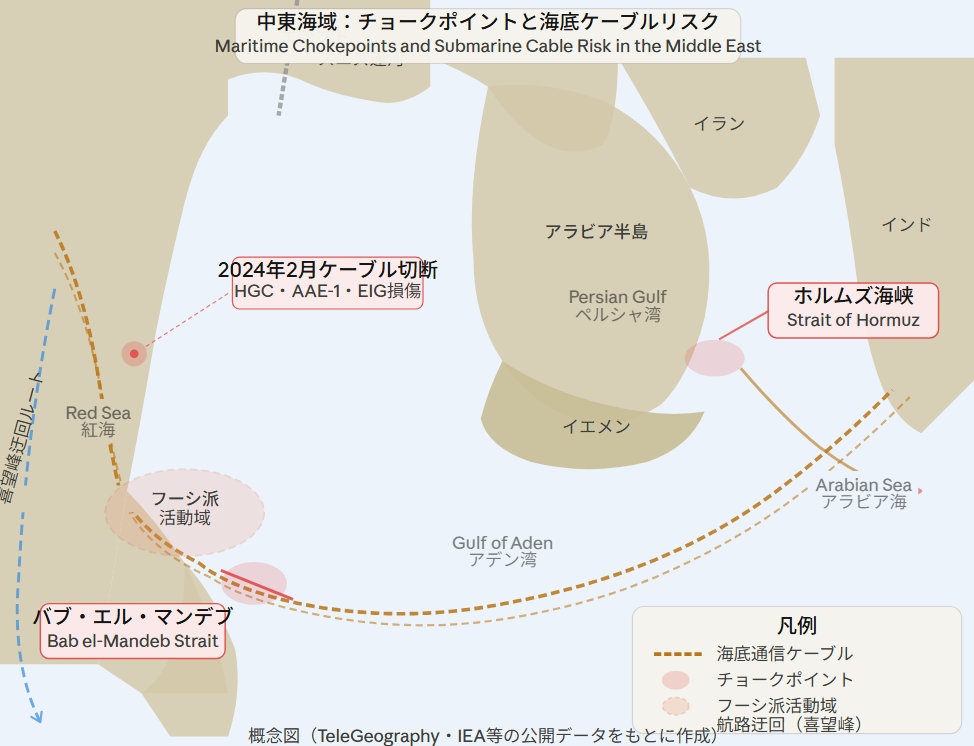
今回の緊張の背後には、世界経済を支える海上交通の要衝を巡る構造的リスクが存在する。その中核にあるのが、「バブ・エル・マンデブ海峡(Bab el-Mandeb Strait)」と「ホルムズ海峡(Strait of Hormuz)」という二大チョークポイントである。
バブ・エル・マンデブ海峡は、スエズ運河を経由する欧州・アジア物流の要衝であり、年間約2万隻の船舶が通過する。IEAのデータによれば、同海峡を通過する原油は日量約380万バレル(2023年)に上る。一方ホルムズ海峡は、世界の原油供給の約20%、LNG供給の約20%が通過する世界最重要の海上石油輸送路であり、日本の原油輸入の約88%がこの海峡を通る(EIA、2023年)。
これら二つの海峡が同時に不安定化する現在の事態は、単なる地域紛争の域を超え、グローバル経済に直接的影響を及ぼす構造的リスクである。実際に、マースク(Maersk)やCMA CGMなど主要海運各社が喜望峰経由への航路変更を実施しており、一航路あたり約7〜10日の輸送日数延長と輸送コストの大幅増加が生じている(Clarksons Research、2024年)。
【重要】 バブ・エル・マンデブとホルムズふたつの海峡の違い:リスクの性質を区別する
重要な点として、両海峡のリスク構造は性質が異なる。バブ・エル・マンデブ海峡は「物流・データのリスク」に直結しており、海底通信ケーブルが集中する紅海海域の安全性に直結する。一方ホルムズ海峡は、主として「エネルギー供給のリスク」に関わる。日本が特に注意すべきは、この二つのリスクが独立して、かつ同時に顕在化する可能性がある点である。
3.事件の本質(Core Nature of the Crisis)
— Integrated Warfare Targeting Maritime and Data Infrastructure —
3-1.海底通信ケーブルへの実証された脅威
前述の通り、2024年2月の紅海ケーブル切断は「想定リスク」ではなく「実証された脅威」である。TeleGeographyのデータによれば、紅海・中東海域には欧州・中東・アジアを結ぶ主要海底ケーブルが約16〜17本集中しており、これらは全世界のインターネットトラフィックの大部分を担う「データの動脈」である。
特に、AAE-1はヨーロッパ・インド・東アジアを結ぶ基幹ケーブルであり、EIGはヨーロッパ・インド間の主要ルートの一つである。これらの同時損傷は、金融市場の決済遅延、クラウドサービスの障害、軍事・外交通信の混乱を引き起こし得る。International Cable Protection Committee(ICPC)は、海底ケーブル障害の主因は船錨・漁業活動による偶発事故だが、近年は意図的切断のリスクも増大していると指摘している。
3-2.サイバー攻撃:港湾・通信インフラへの実証事例
物理攻撃と並行し、サイバー攻撃も現実の脅威として顕在化している。2020年4月、イスラエルの海水処理施設がイランとの関連が疑われるサイバー攻撃を受けた。同年、イスラエルの主要港湾(アシュドッド港等)の運航管理システムも攻撃対象となったとされる(CISAレポート)。これらは、港湾施設や重要インフラが「非可視領域(サイバー空間)」から機能停止させられ得ることを実証した事例である。
海底ケーブルの「陸揚げ局(Cable Landing Station)」もサイバー攻撃の標的となり得る。陸揚げ局はケーブルシステムの制御・増幅機能を担う物理拠点であり、その制御システムに侵入されれば、物理的な切断なしに通信を妨害・傍受することが可能となる。NATOサイバー防衛センター(CCDCOE)は、こうした海底インフラへのハイブリッド攻撃を現代戦の主要リスクの一つと位置づけている。
3-3.GPS・AISスプーフィング:航行システムへの現実の攻撃
商船が依存するGPS(衛星測位)とAIS(自動船舶識別システム)は、電子的干渉に対して構造的に脆弱である。紅海・ペルシャ湾周辺では、実際に多数のスプーフィング(偽情報)事例が報告されている。MarineTrafficの分析によれば、2023〜2024年にかけてアデン湾・紅海周辺でのAIS位置情報異常が顕著に増加しており、船舶の実際の位置と報告位置が大きくずれるケースが記録されている。
GPSスプーフィングは偽のGPS信号を発信して、位置情報をだます行為であるが、低コストで実施可能な非対称攻撃である。 攻撃者はこれによって船舶を意図的に危険水域や禁止区域へ誘導することができる。米国運輸省(DOT)はGPS干渉に関する技術報告書を公開しており、この種の攻撃が「物理攻撃なき海難事故」を引き起こし得ると警告している。
3-4.情報戦・偽情報:経済と世論への波及
本事象においては、物理的・デジタル的攻撃に加え、情報空間における戦いも並行して進行している。フーシ派の「攻撃予告」や「標的船舶リスト」の流布は、実際の攻撃発生有無にかかわらず、保険料の急騰(ロイズのデータによれば戦争リスク保険料が2024年初頭に数倍に上昇)と大規模な航路変更を引き起こした。
RANDコーポレーションの分析によれば、現代のハイブリッド戦争において偽情報は「コストゼロの経済攻撃」として機能する。実害が発生しなくとも、市場の不確実性を高め、企業行動や政府意思決定に影響を与えるからである。
3-5.統合インフラ戦としての本質的理解
以上を総合すると、本事象は単なる軍事衝突ではなく、「物理攻撃(ミサイル・ドローン・ケーブル切断)+サイバー攻撃(港湾・陸揚げ局・制御システム)+情報戦(偽情報・心理戦)」が融合した統合インフラ戦(Integrated Infrastructure Warfare)として把握する必要がある。これは現代の紛争において「戦場」が海上・サイバー・情報空間の三層に同時展開するという新たな戦争形態の典型である。
注目すべきはその手法が、宣戦布告なき武力行使未満の組織的妨害、すなわちグレーゾーン作戦(Gray Zone Operations)の域にとどめられている点である。攻撃主体の特定を困難にしながら経済・通信・心理に打撃を与えるこの手法は、通常の軍事的抑止が機能しにくい構造的な問題を内包している。だからこそ、これを戦争とみなして備えることが、グレーゾーン時代における最初の、そして最も重要な防御判断となる。
4.日本への影響(Impact on Japan)
— Structural Vulnerabilities from Dual Dependence on Energy and Data Infrastructure —
4-1.エネルギー安全保障:ホルムズ依存の現実
日本は原油輸入量の約88%を中東に依存しており、そのほぼ全量がホルムズ海峡を通過する(経済産業省、2023年エネルギー白書)。LNGについても、輸入量の約20%がホルムズ海峡経由であり、同海峡の封鎖・通航制限は日本のエネルギー安全保障に直接的かつ深刻な影響を与える。これは単なる価格上昇にとどまらず、製造業・発電・物流全体の停滞を引き起こし得る。
4-2.通信インフラ:海底ケーブル依存の実態と日本固有のリスク
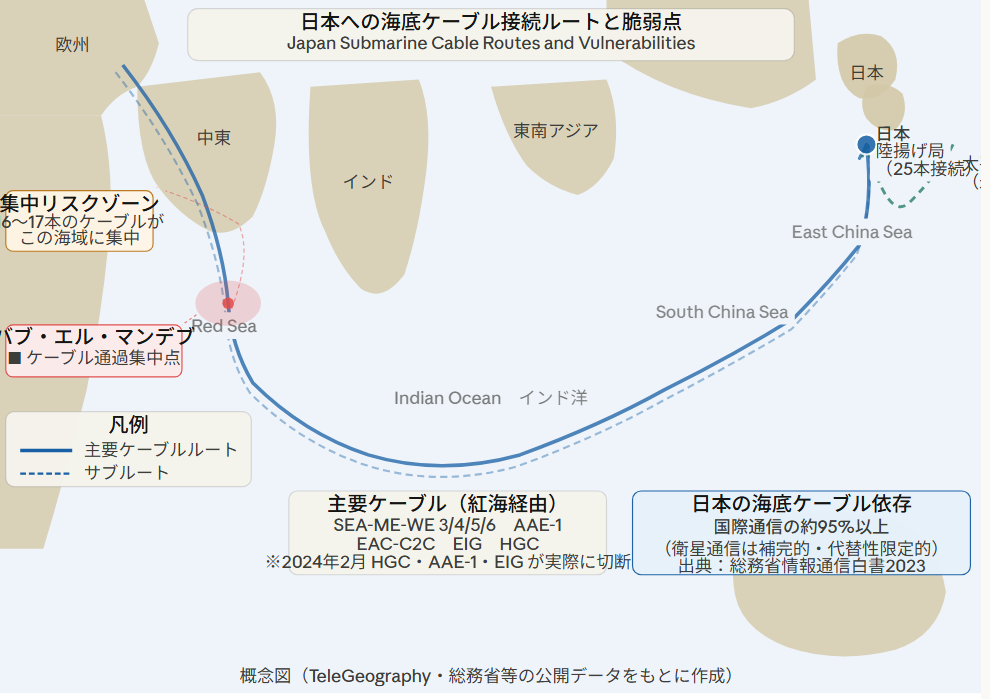
日本の国際通信インフラにおける海底ケーブル依存は、世界平均を上回る水準にある。総務省の情報通信白書(2023年)によれば、日本の国際インターネットトラフィックの約95%以上が海底ケーブルを経由している。衛星通信はレイテンシ・帯域・コストの面で代替性が極めて限定的であり、スターリンク等の低軌道衛星も現時点では基幹通信の代替には至っていない。
日本に接続する主要海底ケーブルの多くは、東南アジア・インド洋・中東・欧州ルートを経由しており、紅海・バブ・エル・マンデブ周辺の障害はこのルートに直撃する。TeleGeographyのケーブルマップに基づけば、EAC-C2C、SEA-ME-WE 3/4/5/6、AAE-1などの主要ケーブルが当該海域を通過しており、これら複数ケーブルの同時障害は日欧間通信の著しい劣化をもたらす。
4-3.特に影響が想定される分野
エネルギーと通信インフラの複合的障害が生じた場合、以下の分野への影響が特に深刻となる:
・ 金融市場:国際決済・高頻度取引(HFT)は超低遅延通信に依存しており、ケーブル障害は市場の流動性低下や取引停止を招く可能性がある。
・ クラウドサービス・データセンター:日本企業が利用する多くのクラウドサービスは海外データセンターに依存しており、通信障害は業務継続性に直結する。
・ 製造業・サプライチェーン管理:自動車・電機等の製造業はグローバルなリアルタイム発注・在庫管理を行っており、通信遅延はジャスト・イン・タイム生産体制を直撃する。
・ AI・データ処理基盤:大規模言語モデルの推論・学習基盤の多くが海外クラウドに依存しており、通信断絶はAIシステムの機能低下をもたらす。
・ 重要インフラ(電力・水道・交通):制御システムがクラウド連携や国際通信に依存する場合、サイバー攻撃と通信障害の複合的影響を受け得る。
4-4.サイバー攻撃・情報戦の二次的波及
日本国内の企業・重要インフラも、直接攻撃を受けなくとも間接的な影響を受け得る。港湾システムや海運管理ソフトウェアのサプライチェーンを通じたマルウェア侵入、偽情報による市場パニックや企業の意思決定混乱、SNSを通じた世論操作による政策判断への影響が「二次的影響」として現実化するリスクがある。
特に注意すべきは、日本がこうした脅威に対する防衛体制において、欧米諸国と比較して制度的・技術的に遅れている分野があることである。これは単一のリスクではなく、複合的かつ連鎖的な影響を伴う構造的脆弱性として認識する必要がある。
4-5.代替ルート競争と日本への戦略的示唆
紅海リスクの深刻化を受け、グローバルなハイパースケーラー(大規模クラウド・通信事業者)は中東経由ルートを回避する新たなケーブル設計へと動き始めている。Metaが推進する「Project Waterworth」(総延長約50,000km、中東を経由しない大西洋・インド洋横断ルート)はその代表例であり、こうした動きはケーブルルートの地政学的再編を加速させている。
日本にとってこれは単なる傍観者的事象ではない。日本が将来的なケーブルルートの設計・誘致・共同整備においてイニシアティブを持てるかどうかが、中長期的な通信安全保障の分岐点となる。特に、米国・オーストラリア・インドとの「Quad」枠組みを活用したインド太平洋ケーブル網の構築は、中国が資金提供するケーブルへの依存を低減する戦略的手段として注目される。
4-6.日米安全保障とケーブル:見落とされた連結点
海底ケーブルへの脅威は、エネルギー・経済リスクにとどまらず、日米安全保障体制そのものに関わる問題である。米ワシントン大学のJSIS研究が指摘するように、日本は米軍のインド太平洋における指揮・統制・デジタル接続の最前線拠点であり、日本に陸揚げされるケーブルの障害は米軍の作戦通信にも直結し得る。
したがって、海底ケーブルの防護は日本単独の問題ではなく、日米同盟の機能維持という観点からも再定義される必要がある。米国がNATOとの間で展開している「海底インフラ共同監視イニシアティブ」に相当する枠組みを、インド太平洋においても日米主導で構築することが急務である。これは、本稿が提言する「日米・日欧間のケーブルセキュリティ協定の締結」と直接連動する政策課題である。
5.結論と政策提言(Conclusion & Policy Recommendations)
— Toward an Era Requiring the Integration of Physical and Cyber Defense —
5-1.統合インフラ戦時代への移行
― 戦争はグレーゾーン作戦へと変容している ―
紅海における一連の事象は、従来の軍事面における安全保障概念を超えた「統合インフラ戦」の時代への移行を示す具体的事例である。海峡(物理)・海底ケーブル(通信)・サイバー空間(データ)が同時に戦場化するという新たな戦争形態は、グレーゾーン作戦の典型例であり、もはや仮説ではなく、現実に進行中の事態である。
5-2.物理防衛とサイバー防衛の統合の必要性
― 「データの動脈」を守る戦略的転換 ―
従来の安全保障は、海上・陸上・空域という物理空間の防衛を中心に設計されてきた。しかし紅海における一連の事象が示すのは、「データの動脈」(Data Arteries)そのものが攻撃対象となる時代への移行である。
海底ケーブルへの物理的切断、陸揚げ局へのサイバー侵入、GPS・AISスプーフィングによる航行妨害、偽情報による市場混乱——これらは別個の脅威ではなく、一つの統合された攻撃体系の構成要素である。したがって防衛もまた、物理・サイバー・情報の三層を統合した体系として再設計されなければならない。
日本においてこの転換が特に急務である理由は、エネルギーと通信という二つの生命線が同一の地理的チョークポイントに依存しているという構造的脆弱性にある。どちらか一方が遮断されても深刻であるが、両者が同時に機能不全に陥るシナリオは、経済・安全保障の双方において回復不能な損害をもたらし得る。具体的な対応策は5-4において提示する。
5-3.海底ケーブルをめぐる国際競争という視座
留意すべきは、海底ケーブルが国家間競争の対象となりつつある点である。近年、中国を含む一部国家において、海底インフラに対する監視・切断能力の強化が報告されている。2023年にはロシアの調査船が北海・バルト海の海底ケーブル近傍を繰り返し航行したことが問題視され、NATOが監視を強化した事例がある。
これが実戦環境で用いられた場合、通信遮断は局地的事象にとどまらず、広域的かつ長期的な影響を及ぼす可能性がある。本稿で論じた中東情勢は、地域紛争にとどまらず、「グローバルなインフラ覇権競争の一断面」として理解する必要がある。
【後編予告】海底ケーブル覇権戦争が始まった――誰がインド太平洋・中東のハブを制するか、そして日本の選択
【後編】海底ケーブルを制する者が世界を制す——日本は『インフラ覇権競争』に参画できるか – 一般財団法人日本危機管理研究所
この競争の全体像は、後編において詳述する。
前編が明らかにした「チョークポイントへの依存」という脆弱性の認識は、世界をすでに次の局面へと動かしている。問いは「何が壊れうるか」から「誰が新たなルートとハブを設計するか」へと移行した。後編では以下を論じる。
- ネタニヤフ構想の失速:IMECが描いたイスラエルをデジタルハブとする野心的構想は、ガザ侵攻の長期化により凍結状態に入った。地政学的に不安定な地域にケーブルの結節点を置くという発想そのものの限界が露呈した。
- 中国の二正面戦略:HMN Technologies(旧華為海洋)による「敷設を通じた平時の浸透」と、馬祖島事案に代表される「切断によるグレーゾーン攻撃」——この二つを一体として論じる。
- Project Waterworthの地政学的本質:Metaが推進する総延長約50,000kmのインド洋横断ケーブル構想は、単なる民間投資ではない。ハイパースケーラーが国家に先行してインフラ秩序を再設計しつつあることを示す象徴的事例である。
- 沖縄ケーブルハブの二重性:沖縄・具志頭村に集中する国際海底ケーブルの陸揚げ局は、中国の二正面戦略における最優先標的候補であると同時に、日本が能動的に強化すべきインド太平洋の戦略資産でもある。
前編が「守るべき脆弱性の地図」を描いたとすれば、後編は「日本が描くべき戦略の地図」を問う。インフラの設計に参画できない国家は、静かに周縁へと押しやられていく。
5-4.政策提言:脆弱性分析から導出される具体的アクション
本稿の分析を踏まえ、日本が優先的に取り組むべき政策的アクションとして以下を提言する。各提言は第4節で示した脆弱性に直接対応している。
① エネルギー依存(4-1)への対応:調達・備蓄の構造改革 ホルムズ依存88%という単一経路リスクに対し、エネルギー備蓄の拡充と中東以外からの代替調達ルートの確保を国家戦略として明示する。これは価格変動への対応にとどまらず、封鎖・通航制限という極端シナリオを前提とした構造改革として位置づける必要がある。
② ケーブル依存(4-2)への対応:海底ケーブル防護の法制化 国際通信の95%超を担う海底ケーブルを重要経済安保インフラとして明示的に位置づけ、陸揚げ局の防護基準・外資規制・情報共有義務を整備する。物理防護とサイバー防護を一体の法制度として設計することが不可欠である。
③ 分野別影響(4-3)への対応:複合BCPの義務化 金融・クラウド・製造業・重要インフラという複数分野が同時被害を受けるシナリオを前提に、一定規模以上の事業者に対してエネルギー・通信の複合危機を想定したBCPの策定と定期訓練を義務づける。単一障害を想定した現行BCPでは対応不十分である。
④ サイバー・情報戦の二次波及(4-4)への対応:二層の制度整備 港湾・陸揚げ局へのサイバー攻撃リスクには日米・日欧間のケーブルセキュリティ協定と共同監視体制で対応する。並行して、偽情報による金融・エネルギー市場への波及に対しては、官民連携による早期検知体制とGPS・AIS異常の監視システムを整備する。
⑤ 代替ルート競争(4-5・4-6)への対応:インド太平洋ケーブル網での主導権確保 Project Waterworth等に象徴されるケーブルルートの地政学的再編と、日米安保上の要請を踏まえ、Quad枠組みを活用したインド太平洋ケーブル網の設計・誘致に日本がイニシアティブをとる。これは中国資金依存のケーブルインフラからの戦略的分離であると同時に、米軍のインド太平洋における指揮・統制機能を支える同盟上の責務でもある。
■ 参考資料
本レポートは以下の三層の情報に基づき構成されている:①国際報道(速報性・事実確認)、②国際機関・業界データ(構造分析)、③サイバー・安全保障研究(脅威評価)
1.国際報道・一次情報(情勢確認)
・ Reuters:フーシ派によるミサイル発射・船舶攻撃・海底ケーブル切断に関する速報(※複数ソース照合推奨)
・ BBC:中東情勢・紅海航路・地域安全保障の背景分析
・ Al Jazeera:フーシ派およびイエメン情勢に関する現地視点の報道
・ 米国防総省(DoD):フーシ派の船舶攻撃件数に関する公式声明(2023年10月〜2024年初頭)
・ イスラエル国防軍(IDF):ミサイル迎撃・領域防衛に関する公式発表
2.エネルギー・海上輸送関連
・ International Energy Agency(IEA):バブ・エル・マンデブ海峡通過原油量(日量約380万バレル)
・ U.S. Energy Information Administration(EIA):ホルムズ海峡依存度分析(世界原油・LNG供給の約20%)
・ 日本経済産業省:エネルギー白書2023(日本の原油輸入における中東依存率約88%)
・ Lloyd’s of London:2024年初頭の戦争リスク保険料の急騰に関するデータ
・ Clarksons Research:喜望峰迂回による輸送日数延長・コスト増加の動向分析(2024年)
3.海底ケーブル・通信インフラ
・ TeleGeography:世界海底通信ケーブルマップ・障害事例データ(紅海域の主要ケーブル集中状況)
・ International Cable Protection Committee(ICPC):海底ケーブルの保護・障害リスクに関する国際機関資料
・ Submarine Telecoms Forum:海底ケーブルの運用・リスク・技術分析
・ 2024年2月紅海ケーブル切断事案報道:HGC・AAE-1・EIG損傷に関する複数報道機関の報告
・ 日本総務省情報通信白書2023:日本の国際通信の海底ケーブル依存率(約95%以上)
・ Submarine Networks / Foreign Policy(2024年):紅海フーシ派リスクと海底ケーブルへの脅威分析
・ CSIS(2026年1月):2024年紅海ケーブル切断によるアジア・欧州間トラフィック25%喪失の記録
・ Meta Project Waterworth:中東回避・インド洋横断ルート(約50,000km)の構想と地政学的意義
・ 三菱総合研究所(2024年):台湾有事を軸とした海底ケーブル切断の日本経済への影響試算
4.サイバーセキュリティ・海事サイバー
・ International Maritime Organization(IMO):海事サイバーリスク管理ガイドライン(MSC-FAL.1/Circ.3)
・ NATO Cooperative Cyber Defence Centre of Excellence(CCDCOE):重要インフラ防護・海底ケーブルへのハイブリッド攻撃分析
・ Cybersecurity and Infrastructure Security Agency(CISA):港湾・海事インフラに対するサイバー脅威レポート(2020年イスラエル港湾攻撃事案含む)
・ ENISA:海事・通信インフラに対するサイバーリスク分析
・ Dragos:産業制御システム(ICS)への攻撃動向
5.航行システム・電子戦(GPS/AIS)
・ U.S. Department of Transportation:GPS干渉・スプーフィングに関する技術報告書
・ MarineTraffic:2023〜2024年アデン湾・紅海周辺のAIS位置情報異常事例分析
・ Royal Institute of Navigation:航法システムの脆弱性研究
・ IEEE学術論文:GPSスプーフィング・ジャミングに関する技術研究
6.情報戦・心理戦(PSYOP・偽情報)
・ RAND Corporation:情報戦・認知戦・ハイブリッド戦の分析(「コストゼロの経済攻撃」としての偽情報)
・ Atlantic Council:偽情報・サイバー影響工作に関するレポート
・ EUvsDisinfo:偽情報事例データベース
7.総合安全保障・統合戦概念・政策
・ Center for Strategic and International Studies(CSIS):重要インフラと安全保障の統合分析
・ Chatham House:中東地政学・エネルギー安全保障
・ Japan Institute of International Affairs(JIIA):日本視点の安全保障・中東分析
・ NATO 2023年報告:北海・バルト海ケーブル近傍でのロシア調査船監視問題
・ 日本内閣サイバーセキュリティセンター(NISC):重要インフラのサイバーセキュリティに係る行動計画
・ University of Washington JSIS研究:日本がインド太平洋における米軍の指揮・統制・デジタル接続の最前線拠点であることの安全保障的含意・ Quad(日米豪印)枠組み関連文書:インド太平洋海底ケーブル網構築に関する協議動向
【後編】海底ケーブルを制する者が世界を制す——日本は『インフラ覇権競争』に参画できるか – 一般財団法人日本危機管理研究所
執筆者プロフィール
舩山 美保 一般財団法人 日本危機管理研究所 理事・主任研究員
国際標準化、技術インテリジェンス、知的財産分析、地政学・危機管理を専門とする戦略アナリスト。 キヤノン株式会社において国際標準・新技術分野の特許調査および戦略分析業務に従事。ISO/IEC JTC 1/SC 28(オフィス機器)副国際幹事として、国際規格策定および多国間交渉の調整を担い、国際標準化活動への貢献によりITSCJ国際標準化貢献賞を3回受賞。 中東アジア情報戦略研究所フェロー。公益社団法人 日本外国特派員協会(FCCJ)プロフェッショナル・アソシエイト会員。 上智大学国際政治学科卒業。青山学院大学大学院修了(国際政治経済学・哲学・心理学)
研究領域:
言語・行動パターンの体系的分析手法を応用した意思決定構造・行動構造の解析を専門とする。とりわけPSYOP(心理作戦)および情報戦の分析、ならびに危機管理政策の視点からセキュリティインテリジェンスの研究・分析を行っている。国際政治学・心理学・哲学にまたがる学際的バックグラウンドを基盤に、国家・非国家アクターによる認知領域への介入メカニズムの解明に取り組む。
【Part 1】The Strait & Submarine Cable Crisis in Middle Eastern Waters
Bab-el-Mandeb at Risk: Exposing Japan’s Submarine Cable Dependency
Published: March 29, 2026
Publisher: Japan Institute of Crisis Management (一般財団法人 日本危機管理研究所)
Positioning of This Report
While the submarine cable risks in the Middle East and Red Sea region have been discussed in English-language forums such as Foreign Policy (2024) and CSIS (2026), and domestic institutions such as Mitsubishi Research Institute have analyzed the impact on Japan through the lens of a Taiwan contingency, all prior studies remain confined to a single domain. No Japanese-language analysis has addressed these issues in an integrated manner. This report aims to organize physical attacks, cyberattacks, GPS/AIS interference, and information warfare under a single analytical framework — “Integrated Infrastructure Warfare” — quantitatively demonstrate the impact on Japan’s unique dual-dependency structure (energy and communications), and derive practical policy recommendations not found in prior research, by incorporating perspectives on alternative route competition and Japan-U.S. security.
This report is structured in two parts. If Part 1 asks “what can be broken,” Part 2 asks “who will design the next order, and what role can Japan play.” Part 2 will be published separately in the near future.
Keywords
- Houthi Escalation
- Maritime Chokepoint Risk
- Strait of Hormuz
- Bab-el-Mandeb Strait
- Submarine Communication Cables
- Maritime Infrastructure Threats
- Cyber Attacks
- Integrated Infrastructure Warfare
- GPS Spoofing
- AIS Interference (Automatic Identification System Interference)
- Information Warfare / Disinformation
- Energy Supply Risk
- Submarine Cable Severance
- Gray Zone Operations (organized interference below the threshold of armed force)
- Data Arteries
- Submarine Cable Route Competition
- Japan-U.S. Infrastructure Security
Table of Contents
Executive Summary
1. Situation — Escalation of Houthi Involvement and Expansion of the Operational Theater
2. Geopolitical Background — The Geopolitical Structure of Two Major Chokepoints Column: Bab-el-Mandeb and Hormuz — Comparing the Risk Structures of Two Straits
3. Core Nature of the Crisis — Understanding the Crisis as Integrated Infrastructure Warfare
- 3-1. Documented Threats to Submarine Communication Cables
- 3-2. Cyberattacks: Verified Cases Against Port and Communications Infrastructure
- 3-3. GPS/AIS Spoofing: Real-World Attacks on Navigation Systems
- 3-4. Information Warfare and Disinformation: Ripple Effects on Economics and Public Opinion
- 3-5. The Essential Understanding: Integrated Infrastructure Warfare
4. Impact on Japan — Structural Vulnerabilities from Dual Dependence on Energy and Data Infrastructure
- 4-1. Energy Security: The Reality of Hormuz Dependency
- 4-2. Communications Infrastructure: The Reality of Submarine Cable Dependency and Japan’s Unique Risk
- 4-3. Sectors Expected to Be Particularly Affected
- 4-4. Secondary Spillover from Cyberattacks and Information Warfare
- 4-5. Alternative Route Competition and Strategic Implications for Japan
- 4-6. Japan-U.S. Security and Cables: An Overlooked Nexus
5. Conclusion and Policy Recommendations — Toward an Era Requiring the Integration of Physical and Cyber Defense
- 5-1. The Transition to an Era of Integrated Infrastructure Warfare
- 5-2. The Need to Integrate Physical and Cyber Defense
- 5-3. The International Competition over Submarine Cables
- 5-4. Policy Recommendations: Concrete Actions Derived from Vulnerability Analysis
References
Executive Summary
- Military Escalation: Houthi missile attacks have transformed the Red Sea into a wide-area battlefield extending beyond Yemen. This represents not a continuation of the Yemeni civil war, but a structural turning point in which Iran-backed multi-layered proxy warfare simultaneously destabilizes maritime security across the entire Middle East.
- Documented Physical Damage: In February 2024, three submarine cables in the Red Sea — HGC, AAE-1, and EIG — were actually severed or damaged, causing serious disruption to communications between India and Europe. Recognizing this as a recorded reality, not a future risk, is the starting point for any policy response.
- Simultaneous Destabilization of Two Chokepoints: Both the Bab-el-Mandeb Strait (logistics and data) and the Strait of Hormuz (energy) are under threat simultaneously. While the nature of risk differs between the two straits, if both materialize at the same time, Japan faces a scenario in which it loses both its energy and communications lifelines at once.
- Emergence of Cyber Threats: The risk of cyberattacks targeting ports, communications hubs, and cable landing stations has come to the fore, as demonstrated by the 2020 Israeli port attack and other verified incidents. The defining feature of modern threats is that critical infrastructure can be incapacitated through intrusion into control systems alone — without any physical destruction.
- Vulnerability of GPS and AIS: Cases of spoofing and jamming — causing real disruption to navigation and logistics — have been reported in waters around the Red Sea. This asymmetric attack, executable at low cost, is an easily underestimated threat precisely because it can cause maritime accidents without any physical strike.
- Impact of Information Warfare: There is a structural risk that disinformation and psychological operations will ripple through markets, energy prices, and public opinion. As demonstrated by the fact that Houthi attack announcements alone caused war risk insurance premiums to surge several-fold, information warfare inflicts economic damage before any actual harm occurs.
- A Textbook Case of Integrated Infrastructure Warfare: This situation must be understood as integrated infrastructure warfare — a fusion of physical attack, cyberattack, and information warfare — and a textbook example of gray zone operations. Because the three attack vectors mutually amplify one another, single-domain defense measures are insufficient.
- Japan’s Dual Dependency: Japan carries structural vulnerabilities on two fronts: energy (approximately 88% dependent on the Strait of Hormuz) and communications (approximately 95% dependent on submarine cables). The fact that both lifelines depend on the same geographic chokepoints constitutes a risk structure unique to Japan — and this is precisely why an analysis focused specifically on Japan is warranted.
- Accelerating Competition for Alternative Routes: As exemplified by Meta’s Project Waterworth, hyperscalers are moving to redesign cable routes that bypass the Middle East. While private-sector led, this shift carries significant geopolitical implications, and whether Japan can take initiative in designing and attracting Indo-Pacific cable networks will be a critical juncture for long-term communications security.
- The Cable-Alliance Nexus: Submarine cables are Japan’s “data arteries,” and disruption to them goes beyond energy and economic risk — it directly affects U.S. command, control, and digital connectivity across the Indo-Pacific. Redefining cable protection as a matter of maintaining the functionality of the Japan-U.S. alliance is the foundation of the policy recommendations put forward in this report.
1. Situation — Escalation of Houthi Involvement and Expansion of the Operational Theater
The situation in the Middle East has moved beyond the stage of localized conflict and entered an unstable phase in which multiple theaters of operation are interconnected. At the core of this shift is the escalating involvement of the Houthi armed group in Yemen.
Since October 2023, the Houthis have intensified attacks on commercial vessels transiting the Red Sea, ostensibly in solidarity with Palestinians in Gaza. According to U.S. Department of Defense announcements, more than 50 civilian vessels were attacked or harassed between October 2023 and early 2024, with operations expanding to include missile launches toward Israel across a wide-area campaign.
The Houthis are believed to be backed by Iran, and the regional conflict is transforming from a “localized war” into a “multi-layered proxy warfare” structure. As a result, the security of a broad maritime area — including the Red Sea and the Persian Gulf — has begun to simultaneously deteriorate.
Of particular note is the actual submarine cable severing incident that occurred in February 2024. In the northern Red Sea, three major cables — HGC (Hong Kong Guangzhou Cable), AAE-1 (Asia Africa Europe-1), and EIG (Europe India Gateway) — were successively damaged and severed. The incident is suspected to be linked to the Houthis, and caused severe disruption to communications between India and Europe. It is important to recognize that this is not a hypothetical scenario but an event already on record.
2. Geopolitical Background — The Geopolitical Structure of Two Major Chokepoints
Behind the current tensions lies a structural risk centered on the maritime chokepoints that underpin the global economy. At the core are two major strategic passages: the Bab-el-Mandeb Strait and the Strait of Hormuz.
The Bab-el-Mandeb Strait is a critical artery for Europe-Asia logistics via the Suez Canal, with approximately 20,000 vessels transiting annually. According to IEA data, crude oil passing through the strait amounts to approximately 3.8 million barrels per day (2023). The Strait of Hormuz, meanwhile, is the world’s most critical maritime oil transit route, through which approximately 20% of global oil supply and 20% of LNG supply passes — and approximately 88% of Japan’s crude oil imports transit this strait (EIA, 2023).
The simultaneous destabilization of these two straits constitutes a structural risk with direct global economic consequences, far beyond a regional conflict. In practice, major shipping companies including Maersk and CMA CGM have rerouted via the Cape of Good Hope, resulting in transit time extensions of approximately 7–10 days per voyage and significant increases in shipping costs (Clarksons Research, 2024).
Key Point: Distinguishing the Risk Profiles of Bab-el-Mandeb and Hormuz
It is important to note that the risk structures of the two straits differ in nature. The Bab-el-Mandeb Strait is directly linked to “logistics and data risk,” as it connects to the security of the Red Sea region where submarine communication cables are concentrated. The Strait of Hormuz, by contrast, is primarily associated with “energy supply risk.” What Japan must pay particular attention to is the possibility that these two risks could materialize independently and simultaneously.
3. Core Nature of the Crisis — Integrated Warfare Targeting Maritime and Data Infrastructure
3-1. Documented Threats to Submarine Communication Cables
As noted above, the February 2024 Red Sea cable severing is not a “hypothetical risk” but a “demonstrated threat.” According to TeleGeography data, approximately 16–17 major submarine cables connecting Europe, the Middle East, and Asia are concentrated in the Red Sea and Middle Eastern waters, forming the “data arteries” that carry the majority of global internet traffic.
In particular, AAE-1 is a trunk cable connecting Europe, India, and East Asia, while EIG is one of the primary routes between Europe and India. Simultaneous damage to these cables could cause settlement delays in financial markets, disruptions to cloud services, and interference with military and diplomatic communications. The International Cable Protection Committee (ICPC) notes that while the primary causes of submarine cable failures are accidental incidents such as ship anchors and fishing activity, the risk of intentional severing has also increased in recent years.
3-2. Cyberattacks: Verified Cases Against Port and Communications Infrastructure
Alongside physical attacks, cyberattacks have also emerged as a real-world threat. In April 2020, an Israeli water treatment facility was subjected to a cyberattack suspected to be linked to Iran. In the same year, the operational management systems of major Israeli ports, including Ashdod Port, were reportedly targeted (CISA report). These incidents demonstrated that port facilities and critical infrastructure can be incapacitated from an “invisible domain” — cyberspace — without any physical damage.
Cable landing stations are also potential targets of cyberattacks. As the physical hubs responsible for controlling and amplifying cable systems, intrusion into their control systems would make it possible to disrupt or intercept communications without any physical severing. NATO’s Cooperative Cyber Defence Centre of Excellence (CCDCOE) has identified hybrid attacks against such submarine infrastructure as one of the primary risks of modern warfare.
3-3. GPS/AIS Spoofing: Real-World Attacks on Navigation Systems
GPS (satellite positioning) and AIS (Automatic Identification System), upon which commercial vessels depend, are structurally vulnerable to electronic interference. Numerous spoofing incidents have actually been reported in the waters around the Red Sea and Persian Gulf. According to analysis by MarineTraffic, AIS position anomalies in the Gulf of Aden and Red Sea increased markedly between 2023 and 2024, with cases recorded where a vessel’s reported position deviated significantly from its actual location.
GPS spoofing — the transmission of false GPS signals to deceive positioning systems — is an asymmetric attack that can be carried out at low cost. Attackers can use it to deliberately guide vessels into hazardous or restricted waters. The U.S. Department of Transportation has published technical reports on GPS interference, warning that this type of attack can cause “maritime accidents without any physical strike.”
3-4. Information Warfare and Disinformation: Ripple Effects on Economics and Public Opinion
In this situation, alongside physical and digital attacks, conflict in the information domain is also proceeding in parallel. Houthi “attack warnings” and the circulation of “targeted vessel lists” — regardless of whether actual attacks occurred — triggered surges in insurance premiums (according to Lloyd’s data, war risk insurance premiums rose several-fold in early 2024) and large-scale route diversions.
According to analysis by the RAND Corporation, in modern hybrid warfare, disinformation functions as a “zero-cost economic attack.” Even without actual harm occurring, it raises market uncertainty and influences corporate behavior and government decision-making.
3-5. The Essential Understanding: Integrated Infrastructure Warfare
Taken together, this situation must be understood not as a mere military conflict, but as Integrated Infrastructure Warfare — a fusion of physical attack (missiles, drones, cable severing), cyberattack (ports, landing stations, control systems), and information warfare (disinformation, psychological operations). This is a defining example of the new form of conflict in which the “battlefield” simultaneously spans three domains: maritime, cyber, and information space.
Notably, the methods employed remain within the bounds of organized interference below the threshold of armed force — that is, gray zone operations — making attribution of the attacking party difficult while inflicting damage on economic, communications, and psychological targets. This approach contains a structural problem in which conventional military deterrence does not effectively function. It is precisely for this reason that treating this as warfare and preparing accordingly constitutes the first and most critical defensive judgment in the gray zone era.
4. Impact on Japan — Structural Vulnerabilities from Dual Dependence on Energy and Data Infrastructure
4-1. Energy Security: The Reality of Hormuz Dependency
Japan depends on the Middle East for approximately 88% of its crude oil imports, virtually all of which transits the Strait of Hormuz (Ministry of Economy, Trade and Industry, Energy White Paper 2023). Regarding LNG, approximately 20% of imports also pass through the Strait of Hormuz, meaning that any closure or restriction of the strait would have a direct and severe impact on Japan’s energy security. This is not limited to price increases; it could trigger a broad slowdown across manufacturing, power generation, and logistics.
4-2. Communications Infrastructure: The Reality of Submarine Cable Dependency and Japan’s Unique Risk
Japan’s dependence on submarine cables for international communications exceeds the global average. According to the Ministry of Internal Affairs and Communications’ Information and Communications White Paper (2023), over approximately 95% of Japan’s international internet traffic passes through submarine cables. Satellite communications are extremely limited as alternatives in terms of latency, bandwidth, and cost, and low-earth orbit satellites such as Starlink have not yet reached the point of substituting for core communications infrastructure.
Many of the major submarine cables connected to Japan route through Southeast Asia, the Indian Ocean, the Middle East, and Europe, meaning that disruptions around the Red Sea and Bab-el-Mandeb directly affect these routes. Based on TeleGeography’s cable map, major cables including EAC-C2C, SEA-ME-WE 3/4/5/6, and AAE-1 pass through the relevant waters, and simultaneous failure of multiple cables would cause significant degradation of communications between Japan and Europe.
4-3. Sectors Expected to Be Particularly Affected
Should a compound failure of energy and communications infrastructure occur, the following sectors would be particularly severely affected:
- Financial markets: International settlements and high-frequency trading (HFT) depend on ultra-low-latency communications, and cable failures could lead to reduced market liquidity and trading halts.
- Cloud services and data centers: Many cloud services used by Japanese companies depend on overseas data centers, and communications disruptions would directly affect business continuity.
- Manufacturing and supply chain management: Industries such as automotive and electronics conduct global real-time ordering and inventory management, and communication delays would directly impact just-in-time production systems.
- AI and data processing infrastructure: The inference and training infrastructure for large language models largely depends on overseas cloud platforms, and communication disruptions would degrade AI system functionality.
- Critical infrastructure (power, water, transportation): Where control systems depend on cloud connectivity or international communications, they may be subject to the compound effects of cyberattacks and communications disruptions.
4-4. Secondary Spillover from Cyberattacks and Information Warfare
Domestic Japanese companies and critical infrastructure may also be indirectly affected, even without being directly attacked. These secondary impacts — including malware intrusion through supply chains in port systems and maritime management software, market panic and corporate decision-making disruption caused by disinformation, and influence on policy judgments through social media-based opinion manipulation — carry real risks of materializing.
Of particular concern is the fact that Japan lags behind Western nations in certain institutional and technical areas of defense against such threats. This must be recognized not as a single risk, but as a structural vulnerability entailing compound and cascading impacts.
4-5. Alternative Route Competition and Strategic Implications for Japan
In response to the deepening Red Sea risk, global hyperscalers (large-scale cloud and communications providers) have begun moving toward redesigning cable infrastructure to avoid Middle Eastern routes. Meta’s “Project Waterworth” — a trans-Atlantic and trans-Indian Ocean route totaling approximately 50,000 km that bypasses the Middle East — is a prime example, and these developments are accelerating the geopolitical restructuring of cable routes.
For Japan, this is not a spectator event. Whether Japan can take initiative in the design, attraction, and co-development of future cable routes will be a decisive juncture for long-term communications security. In particular, building an Indo-Pacific cable network through the Quad framework — involving the United States, Australia, and India — is attracting attention as a strategic means of reducing dependence on China-funded cable infrastructure.
4-6. Japan-U.S. Security and Cables: An Overlooked Nexus
The threat to submarine cables is not merely a matter of energy and economic risk — it is directly relevant to the Japan-U.S. security framework itself. As research from the University of Washington’s Jackson School of International Studies points out, Japan is a frontline hub for U.S. command, control, and digital connectivity across the Indo-Pacific, meaning that disruptions to cables landing in Japan could directly affect U.S. military operational communications.
Accordingly, submarine cable protection must be redefined not only as Japan’s own concern, but from the perspective of maintaining the functionality of the Japan-U.S. alliance. Establishing a framework for the Indo-Pacific equivalent of the “joint submarine infrastructure monitoring initiative” that the United States has deployed with NATO — led jointly by Japan and the United States — is an urgent priority. This is directly linked to the policy objective put forward in this report: the conclusion of a Japan-U.S. and Japan-Europe cable security agreement.
5. Conclusion and Policy Recommendations — Toward an Era Requiring the Integration of Physical and Cyber Defense
5-1. The Transition to an Era of Integrated Infrastructure Warfare — Warfare Is Transforming into Gray Zone Operations
The series of events in the Red Sea represents a concrete example of the transition to an era of “Integrated Infrastructure Warfare” that transcends conventional military security concepts. The new form of warfare — in which straits (physical), submarine cables (communications), and cyberspace (data) are simultaneously weaponized — is a textbook case of gray zone operations, and is no longer hypothetical; it is an ongoing reality.
5-2. The Need to Integrate Physical and Cyber Defense — A Strategic Shift to Protect “Data Arteries”
Conventional security has been designed primarily around the defense of physical space — maritime, land, and airspace. However, what the series of events in the Red Sea demonstrates is a transition to an era in which “data arteries” themselves become targets of attack.
Physical severing of submarine cables, cyber intrusion into landing stations, navigation disruption through GPS/AIS spoofing, market disruption through disinformation — these are not separate threats but components of a single integrated attack system. Defense, therefore, must also be redesigned as an integrated system across three layers: physical, cyber, and information.
The reason this transition is particularly urgent for Japan lies in the structural vulnerability that both energy and communications — Japan’s two lifelines — depend on the same geographic chokepoints. The incapacitation of either alone would be severe, but a scenario in which both simultaneously fail could cause irreversible damage to both the economy and national security. Specific countermeasures are presented in Section 5-4.
5-3. The International Competition over Submarine Cables
It should be noted that submarine cables are becoming an arena of interstate competition. In recent years, certain states including China have been reported to be enhancing capabilities for monitoring and severing submarine infrastructure. In 2023, repeated transit of Russian survey vessels near submarine cables in the North Sea and Baltic Sea drew concern, prompting NATO to strengthen surveillance.
If these capabilities were employed in a combat environment, communications disruptions could extend far beyond localized incidents, with wide-ranging and long-term consequences. The Middle East situation discussed in this report must be understood not merely as a regional conflict, but as “one dimension of a global competition for infrastructure dominance.”
Preview of Part 2: The Submarine Cable Hegemony War Has Begun — Who Will Control the Indo-Pacific and Middle East Hubs, and Japan’s Choice
Part 2 will elaborate on the full picture of this competition. The recognition of “chokepoint dependency” as a vulnerability — established in Part 1 — has already set the world in motion toward the next phase. The question has shifted from “what can be broken” to “who will design the new routes and hubs.” Part 2 will address the following:
- The Stalling of the Netanyahu Vision: The ambitious plan — embodied in IMEC — to establish Israel as a digital hub has been frozen by the prolonged Gaza offensive. The very concept of placing cable nodes in a geopolitically unstable region has been exposed as fundamentally flawed.
- China’s Two-Front Strategy: HMN Technologies (formerly Huawei Marine) pursues “peacetime penetration through installation” while the Matsu Island incident exemplifies “gray zone attacks through severance” — these two dimensions must be examined as a unified strategy.
- The Geopolitical Essence of Project Waterworth: Meta’s trans-Indian Ocean cable initiative spanning approximately 50,000 km is not merely a private-sector investment. It is a symbolic case of hyperscalers moving ahead of nation-states to redesign infrastructure order.
- The Dual Nature of Okinawa as a Cable Hub: The cable landing stations concentrated in Gushikami Village, Okinawa — a primary target candidate under China’s two-front strategy — are simultaneously a strategic asset of the Indo-Pacific that Japan should proactively strengthen.
If Part 1 drew a “map of vulnerabilities to be defended,” Part 2 asks for “the map of strategy that Japan must draw.” Nations that cannot participate in the design of infrastructure will be quietly pushed to the periphery.
5-4. Policy Recommendations: Concrete Actions Derived from Vulnerability Analysis
Based on the analysis in this report, the following policy actions are recommended as priorities for Japan. Each recommendation directly corresponds to the vulnerabilities identified in Section 4.
① Response to Energy Dependency (4-1): Structural Reform of Procurement and Stockpiling In response to the single-route risk of 88% Hormuz dependency, Japan should explicitly articulate as national strategy the expansion of energy stockpiles and the securing of alternative procurement routes from outside the Middle East. This must be positioned not merely as a response to price volatility, but as a structural reform premised on the extreme scenario of closure or restriction of transit — that is, a genuine contingency-based reform.
② Response to Cable Dependency (4-2): Legislation for Submarine Cable Protection Submarine cables — which carry over 95% of international communications — must be explicitly designated as critical economic security infrastructure, with protection standards for landing stations, foreign investment regulations, and information-sharing obligations established. Physical and cyber protection must be designed as a unified legal framework.
③ Response to Sector-Specific Impacts (4-3): Mandatory Compound BCP Premised on a scenario in which multiple sectors — finance, cloud, manufacturing, and critical infrastructure — are simultaneously affected, operators above a certain scale should be required to formulate and regularly exercise business continuity plans (BCPs) that assume compound energy and communications crises. Current BCPs, which assume single-point failures, are insufficient.
④ Response to Secondary Spillover from Cyber and Information Warfare (4-4): Two-Layer Institutional Framework Cyberattack risks against ports and landing stations should be addressed through Japan-U.S. and Japan-Europe cable security agreements and joint monitoring frameworks. In parallel, to address disinformation-driven spillover into financial and energy markets, a public-private early detection system and GPS/AIS anomaly monitoring infrastructure should be established.
⑤ Response to Alternative Route Competition (4-5, 4-6): Securing Leadership in the Indo-Pacific Cable Network In light of the geopolitical restructuring of cable routes — as symbolized by Project Waterworth — and the imperatives of the Japan-U.S. security relationship, Japan should take initiative in designing and attracting an Indo-Pacific cable network through the Quad framework. This represents both a strategic decoupling from cable infrastructure financed by China, and an alliance obligation to support U.S. command, control, and operational functionality across the Indo-Pacific.
References
This report is based on three tiers of information: ① international reporting (timeliness and fact verification), ② international institutional and industry data (structural analysis), ③ cyber and security research (threat assessment).
1. International Reporting and Primary Sources
- Reuters: Breaking reports on Houthi missile launches, vessel attacks, and submarine cable severing (multiple source cross-referencing recommended)
- BBC: Background analysis on Middle East developments, Red Sea shipping routes, and regional security
- Al Jazeera: On-the-ground reporting on Houthi and Yemen situation
- U.S. Department of Defense (DoD): Official statements on Houthi vessel attack counts (October 2023–early 2024)
- Israel Defense Forces (IDF): Official announcements on missile interception and area defense
2. Energy and Maritime Transport
- International Energy Agency (IEA): Crude oil volume transiting Bab-el-Mandeb (approx. 3.8 million barrels/day)
- U.S. Energy Information Administration (EIA): Hormuz dependency analysis (approx. 20% of global oil and LNG supply)
- Ministry of Economy, Trade and Industry, Japan: Energy White Paper 2023 (Middle East dependency approx. 88% of Japan’s crude oil imports)
- Lloyd’s of London: Data on war risk insurance premium surges in early 2024
- Clarksons Research: Analysis of transit time extensions and cost increases from Cape of Good Hope rerouting (2024)
3. Submarine Cables and Communications Infrastructure
- TeleGeography: Global submarine cable map and incident data (concentration of major cables in the Red Sea and Middle Eastern waters)
- International Cable Protection Committee (ICPC): International institutional materials on submarine cable protection and failure risks
- Submarine Telecoms Forum: Operational, risk, and technical analysis of submarine cables
- February 2024 Red Sea cable severing incident reports: Multiple media reports on damage to HGC, AAE-1, and EIG
- Ministry of Internal Affairs and Communications, Japan: Information and Communications White Paper 2023 (Japan’s submarine cable dependency ratio: approx. 95%+)
- Submarine Networks / Foreign Policy (2024): Analysis of Houthi risks in the Red Sea and threats to submarine cables
- CSIS (January 2026): Record of 25% loss of Asia-Europe traffic from the 2024 Red Sea cable severing
- Meta Project Waterworth: Concept and geopolitical significance of the trans-Indian Ocean route bypassing the Middle East (approx. 50,000 km)
- Mitsubishi Research Institute (2024): Estimates of economic impact on Japan from submarine cable severing in a Taiwan contingency
4. Cybersecurity and Maritime Cyber
- International Maritime Organization (IMO): Maritime Cyber Risk Management Guidelines (MSC-FAL.1/Circ.3)
- NATO Cooperative Cyber Defence Centre of Excellence (CCDCOE): Analysis of critical infrastructure protection and hybrid attacks on submarine cables
- Cybersecurity and Infrastructure Security Agency (CISA): Cyber threat reports on port and maritime infrastructure (including the 2020 Israeli port attack)
- ENISA: Cyber risk analysis for maritime and communications infrastructure
- Dragos: Industrial control system (ICS) attack trend analysis
5. Navigation Systems and Electronic Warfare (GPS/AIS)
- U.S. Department of Transportation: Technical reports on GPS interference and spoofing
- MarineTraffic: Analysis of AIS position anomalies in the Gulf of Aden and Red Sea (2023–2024)
- Royal Institute of Navigation: Research on navigation system vulnerabilities
- IEEE academic papers: Technical research on GPS spoofing and jamming
6. Information Warfare and Psychological Operations
- RAND Corporation: Analysis of information warfare, cognitive warfare, and hybrid warfare (“zero-cost economic attack” framing of disinformation)
- Atlantic Council: Reports on disinformation and cyber influence operations
- EUvsDisinfo: Disinformation incident database
7. Integrated Security, Hybrid Warfare Concepts, and Policy
- Center for Strategic and International Studies (CSIS): Integrated analysis of critical infrastructure and security
- Chatham House: Middle East geopolitics and energy security
- Japan Institute of International Affairs (JIIA): Security and Middle East analysis from a Japanese perspective
- NATO 2023 Report: Russian survey vessel monitoring near submarine cables in the North Sea and Baltic Sea
- National center of Incident readiness and Strategy for Cybersecurity (NISC): Action plan for cybersecurity of critical infrastructure
- University of Washington JSIS Research: Security implications of Japan as a frontline hub for U.S. command, control, and digital connectivity in the Indo-Pacific
- Quad (Japan-U.S.-Australia-India) framework documents: Deliberations on Indo-Pacific submarine cable network construction
Author: Miho Funayama
Director of Japan Institute for Crisis Management / Research Fellow of Middle East Asia Intelligence Strategy Institute/Professional Associate Member of The Foreign Correspondents’ Club of Japan (FCCJ)
B.A. in International Politics, Sophia University; M.A. in International Political Economy, Philosophy, and Psychology, Aoyama Gakuin University Graduate School.
Served at Canon Inc., specializing in patent research and analysis of international standards and emerging technologies. Held the position of Vice International Secretary of ISO/IEC JTC1 SC28 (Office Equipment), leading the development and coordination of international standards through multilateral negotiation processes.
Research Focus:
Specializes in the structural analysis of decision-making and behavioral patterns through systematic linguistic and behavioral analysis methodologies. Conducts research and analysis in security intelligence from the perspectives of PSYOP (Psychological Operations), information warfare, and crisis management policy. Drawing on an interdisciplinary foundation in international politics, psychology, and philosophy, focuses on elucidating the mechanisms of cognitive domain intervention by state and non-state actors.
関連記事

日本のMythos参加が露呈したもの ー「6週間の空白」を契機に、サイバー主権の再設計へ What Japan’s Participation in Mythos Has Laid Bare
脅迫するAI AI as a Tool of Coercion
燃料を失う日 The Day We Lose Our Fuel
Recent Posts
- 日本のMythos参加が露呈したもの ー「6週間の空白」を契機に、サイバー主権の再設計へ What Japan’s Participation in Mythos Has Laid Bare
- 後編 ロシアの学生ハッカー工場は今、日本に照準を合わせている Russia’s Hacker Factory Goes Global: CRINK Cyber Alliances, Space Warfare, and AI Disinformation
- 前編 ロシア・バウマン大学、通称「GRU大学」——教室はハッカー工場、2,000枚の内部文書が暴いたハッカー養成システムの全貌 Part 1: Inside Russia’s “GRU University”: 2,000 Leaked Documents Reveal the Hacker Factory Operating Inside Bauman’s Classrooms
- 金融インフラが戦場になる時代 ——2026年イラン戦争 崩れゆくペトロダラーと新貨幣秩序の胎動 When Financial Infrastructure Becomes the Battlefield— The 2026 Iran War: The Crumbling Petrodollar and the Dawn of a New Monetary Order
- 【後編】盗んだ資金はミサイルになり、情報はロシアへ流れる——北朝鮮「地政学的サイバー同盟」の全貌