
【後編】海底ケーブルを制する者が世界を制す——日本は『インフラ覇権競争』に参画できるか
Part2: He Who Controls Submarine Cables Controls the World
— Can Japan Compete in the “Infrastructure Supremacy Race”?
2026年4月1日
発行元: 一般財団法人日本危機管理研究所
*英訳版は日本語版の後に掲載しています。/ The English translation follows the Japanese text below.
【本稿の位置づけ】
海底ケーブルをめぐる地政学的リスクについては、前編(「中東海域における海峡・海底通信ケーブル危機と日本への影響」、2026年3月)において、「バブ・エル・マンデブ海峡」のチョークポイントリスクと日本の二重依存構造を論じた。前編が「何が壊れうるか」を問うたとすれば、本稿は「誰が次の秩序を設計するか、そして日本はそこでいかなる役割を担えるか」を問う。【前編】中東海域における「海峡・海底通信ケーブル」危機と日本への影響ー 「バブ・エル・マンデブ海峡」封鎖リスクが示す日本の「海底通信ケーブル」依存構造の脆弱性ー – 一般財団法人日本危機管理研究所
先行研究はCSIS(2026年)やForeign Policy(2024年)をはじめ、チョークポイントの脆弱性分析に集中しており、「ハブ設計競争」という次の局面を正面から論じた日本語論考は存在しない。本稿はこの空白を埋めることを第一の目的とする。
加えて本稿は、以下の三点において先行研究にない新規性を持つ。第一に、「チョークポイント防衛」から「ハブ覇権競争」への構造転換を一つの分析軸として明示した点。第二に、中国による海底ケーブルの「敷設による浸透」と「切断によるグレーゾーン攻撃」を二正面戦略として一体的に分析した点。第三に、沖縄・具志頭村の国際海底ケーブル陸揚げ局を太平洋ケーブルハブの戦略的脆弱性かつ能動的資産として位置づけ、日米同盟の文脈で論じた点である。これら三点を横断した日本語論考は、現時点で存在しない。
【執筆時点の状況】
本稿は2026年3月末、前編が想定シナリオとして論じた事態が現実化した時点で執筆されている。2026年2月28日の米・イスラエルによるイラン攻撃を受け、イランは3月2日に「ホルムズ海峡」の封鎖を正式に宣言した。これに対し日本は複数の外交的対応を同時並行で進めている。駐日イラン大使は日本に対し「友好国として通過を認める用意がある」として事実上の仲介役を打診し、赤沢経済産業大臣はサウジアラビアのヤンブー港・UAEのフジャイラ港を経由する紅海・ホルムズ非依存の代替陸路ルートを確保、同ルートによる原油タンカーの初入港が3月28日に実現した。
前編が「二重依存構造の脆弱性」として分析した事態は、本稿執筆中に「現在進行中の危機」へと変容した。本稿はこの緊迫した現実を射程に収めながら、エネルギーと通信インフラをめぐる日本の戦略的選択を論じる。
■ キーワード/Keywords
- 海底ケーブル覇権競争(Submarine Cable Hegemony Competition)
- インド太平洋ケーブルハブ(Indo-Pacific Cable Hub)
- チョークポイントからハブへ(From Chokepoint to Hub)
- インド・中東・欧州経済回廊(IMEC:India-Middle East-Europe Economic Corridor)
- ネタニヤフ構想の失速(Stalling of the Netanyahu Corridor Vision)
- 米中インフラ覇権争い(US-China Infrastructure Hegemony Competition)
- HMN Technologies(旧華為海洋ネットワークス)
- 海底ケーブル敷設シェア競争(Submarine Cable Laying Share Competition)
- グレーゾーン切断(Gray Zone Cable Severance)
- 馬祖島事案(Matsu Island Cable Severance Incident)
- 二正面戦略(Two-Front Strategy:敷設と切断)
- Project Waterworth(Meta社・中東回避インド洋横断ケーブル構想)
- 沖縄ケーブルハブ(Okinawa Cable Hub)
- 陸揚げ局防護(Cable Landing Station Protection)
- クリーンネットワーク(Clean Network Initiative)
- Quad枠組みとケーブル安全保障(Quad Framework and Cable Security)
- 能動的インフラ外交(Proactive Infrastructure Diplomacy)
目 次
3.中東ハブをめぐる国際競争――ネタニヤフ構想の失速と米中の攻防
3-1.ネタニヤフ構想が描いた中東ハブ
3-2.ガザ侵攻による失速と構造的矛盾の露呈
3-3.米中の攻防――「敷設」をめぐる静かな戦争
4-1.馬祖島事案――グレーゾーン切断の典型
4-2.HMN Technologies――「敷設」に埋め込まれたリスク
4-3.二正面戦略の全体像
5.Project Waterworthの本質と日本の能動的選択
5-1.Project Waterworthは何を意味するか
5-2.日本にとっての戦略的機会
5-3.能動的選択のための三つの柱
6-1.本稿が示した構造転換
6-2.政策提言――五つの優先アクション
6-3.結語――設計する国家か、周縁の国家か
■ 巻末用語解説
■ 参考資料
■ エグゼクティブサマリー
- 【構造転換の認識】
「チョークポイントを守れ」という受動的防衛の時代は終わりつつある。2024年の紅海ケーブル切断が示したのは、海峡への過集中という設計思想そのものの脆弱性であり、問題はすでに「誰が新たなルートとハブを設計するか」という能動的競争の局面へと移行している。
- 【IMEC構想の失速】
ネタニヤフ政権が描いたインド・中東・欧州経済回廊(IMEC)は、イスラエルをデジタルハブとして確立する野心的構想だったが、ガザ侵攻の長期化により事実上凍結状態に入った。この失速は、地政学的に不安定な地域にケーブルの結節点を置くという発想そのものの脆弱性を露呈した。
- 【米中インフラ覇権争いの非対称性】
米国はクリーンネットワーク・イニシアティブのもとHMN Technologies排除を進めるが、中国系企業は価格競争力と施工速度で西側を圧倒しており、資金力に乏しい途上国は中国製ケーブルを選ばざるを得ない構造がある。「誰のケーブルを使うか」は技術・安全保障の問題である以前に、経済力の問題でもある。
- 【中国の二正面戦略】
中国は「敷設による平時の浸透」と「切断によるグレーゾーン攻撃」を組み合わせた二正面戦略を展開している可能性が指摘されている。2023年の馬祖島事案はその典型であり、「錨の引きずり」という日常的海上活動の形式をとることで意図の立証を困難にする手口は、バルト海でのロシアの手法と構造的に一致する。
- 【沖縄ケーブルハブの二重性】
沖縄・具志頭村に集中する国際海底ケーブル陸揚げ局は、太平洋・アジアを結ぶインド太平洋の重要なケーブルハブである。馬祖島との地理的類似性、代替通信手段の乏しさ、米軍指揮通信との直結性を考えれば、沖縄ハブは中国の二正面戦略における最優先標的候補の一つである可能性が高く、日本が能動的に強化すべき戦略資産でもある。
- 【Project Waterworthの地政学的本質】
Metaが推進する総延長約50,000kmの海底ケーブル構想は、単なる民間インフラ投資ではない。中東回避・インド洋横断という設計思想は、地政学的リスクへの対応であると同時に、ハイパースケーラーが国家に先行してインフラ秩序を再設計しつつあることを示す。日本はこの動きに受動的に追随するのか、能動的に参画するのかを選択しなければならない。
- 【日本の能動的選択】
沖縄ケーブルハブの防護・強化、Quad枠組みを活用したインド太平洋ケーブル網への参画、陸揚げ局の法的防護体制の整備――これらは個別の政策課題ではなく、「インフラ覇権競争における日本の立ち位置」という一つの戦略的問いへの答えとして統合的に設計されなければならない。ケーブルの設計に参画できない国家は、静かに周縁へと押しやられていく。
1. 開幕―「切断」から「設計」へ、戦場が移った
2024年2月、紅海北部で三本の海底通信ケーブルが相次いで損傷した。HGC、AAE-1、EIG――欧州とインド・アジアを結ぶ「データの動脈」である。この事案は本稿の前編で詳述したとおり、インド・欧州間トラフィックの最大25%を喪失させる現実的被害をもたらした。
しかし世界は、そこで足を止めなかった。むしろ逆に加速した。
フーシ派によるケーブル切断が「実証済みの脅威」として記録されると同時に、世界の巨大テクノロジー企業、国家政府、軍事同盟は、次の問いに一斉に動き始めた。――「では、どこで、誰が、どのルートでケーブルを引くのか」。
チョークポイント(海峡)を守る時代は終わりつつある。問題は、脆弱な海峡を回避しながら、誰が新たなインフラ覇権の設計図を握るか、という段階に移行した。「バブ・エル・マンデブ」という物理的な隘路から、インド太平洋・中東の「ハブ」をめぐる覇権戦争へ。これが、本稿が論じる新たな戦場の本質である。
本稿は前編の問題提起―日本のエネルギーと通信の二重依存構造―を受け、その「出口」を問う。
具体的には、
①中東チョークポイントからハブ競争への構造転換、
②ネタニヤフ構想が示す中東ハブ戦略の現実と限界、
③米中インフラ覇権争いの構造、
④Meta「Project Waterworth」の地政学的本質、
⑤以上を踏まえた日本の能動的な選択肢、
を順に論じる。
前編が「何が壊れうるか」を問うたとすれば、本稿は「誰が次の秩序を設計するか、そして日本はそこでいかなる役割を担えるか」を問う。海底に眠るケーブルが、21世紀の国際秩序の基盤となった今、その設計に参画できない国家は、静かに周縁へと押しやられていく。
2. チョークポイントからハブへ――問題の構造転換
2024年の紅海ケーブル切断が世界に突きつけたのは、単なる「海峡を守れ」という警告ではなかった。より本質的なメッセージは、「海峡を通るケーブルに依存する構造そのものを問い直せ」という戦略的要請だった。
前編で論じたとおり、「バブ・エル・マンデブ海峡」には欧州・中東・アジアを結ぶ主要海底ケーブルが約16〜17本集中している。この過集中構造こそが脆弱性の根源であり、一点を攻撃するだけで広域の通信網が麻痺するという非対称性を生んでいる。問題は「誰が海峡を攻撃したか」ではなく、「なぜこれほど多くのケーブルが一つの海峡に束ねられているのか」という設計上の問題に帰着する。
この認識が共有されたとき、世界の視線は自然に次の問いへと移行した。―迂回するなら、どこを通るのか。そしてその新ルート上の「ハブ」を誰が握るのか。
海底ケーブルネットワークにおける「ハブ」とは、複数のケーブルが陸揚げされ、乗り継ぎ・分岐・増幅が行われる戦略的拠点を指す。シンガポール、マルセイユ、ムンバイがその典型だが、新たなルート設計の中でインド太平洋と中東に新たなハブをどこに置くかが、いま国家・企業・軍事同盟の間で激しく競われている。
ハブを制する者は、そこを通過するトラフィックの経路を左右し、有事の際には情報の流れを遮断あるいは傍受できる立場に立つ。これはもはやインフラ整備の問題ではなく、21世紀の情報秩序をめぐる地政学的競争である。チョークポイントという受動的な脆弱性から、ハブという能動的な権力拠点へ -問題の構造はここで大きく転換した。
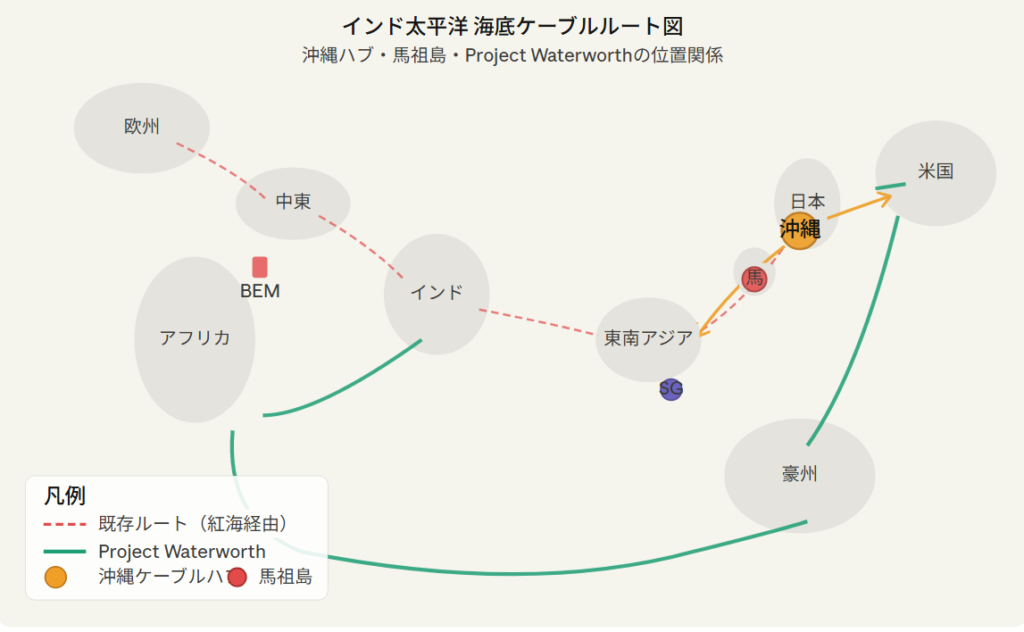
図1:インド太平洋ケーブルルート図:沖縄ハブ・馬祖島・Project Waterworthの位置関係
3. 中東ハブをめぐる国際競争――ネタニヤフ構想の失速と米中の攻防
3-1.ネタニヤフ構想が描いた中東ハブ
2023年9月、国連総会の場でイスラエルのネタニヤフ首相が提示した地図が注目を集めた。インドからアラブ湾岸諸国、イスラエルを経由して欧州へと至る「インド・中東・欧州経済回廊(IMEC)」構想である。これは鉄道・港湾・エネルギーパイプラインに加え、海底ケーブルを含むデジタルインフラの回廊として設計されており、アブラハム合意で正常化したアラブ諸国との関係を経済的に実体化する試みだった。米国はこれをG20の枠組みで後押しし、中国主導の「一帯一路」に対抗するインド太平洋版インフラ戦略として位置づけた。
構想の核心は、紅海・スエズルートへの依存を回避しつつ、イスラエルをインド太平洋と欧州をつなぐデジタルハブとして確立する点にあった。もしこれが実現すれば、「バブ・エル・マンデブ」という脆弱なチョークポイントを迂回する新たな情報動脈が生まれ、イスラエルはその結節点として地政学的価値を飛躍的に高めるはずだった。
3-2.ガザ侵攻による失速と構造的矛盾の露呈
しかし2023年10月のハマスによる攻撃とその後のガザ侵攻が、この構想を根底から揺るがした。IMEC参加を見込んでいたサウジアラビアをはじめとするアラブ湾岸諸国は、イスラエルとの経済協力を公言できる政治環境を失い、構想は事実上凍結状態に入った。インフラ回廊の「安定したハブ」としてのイスラエルという前提が、紛争の長期化によって根本から崩れたのである。
この失速は単なる外交的挫折にとどまらない。中東に安定したハブを置くという発想そのものの脆弱性を露呈した。地政学的に不安定な地域にケーブルの結節点を設けることは、平時には経済合理性を持つが、有事には即座に攻撃対象となる。ネタニヤフ構想の失速は、「中東経由」という設計思想への根本的な疑問符となった。
3-3.米中の攻防――「敷設」をめぐる静かな戦争
IMECが失速する一方で、より静かな、しかし本質的な競争が進行している。海底ケーブルの「敷設権」をめぐる米中の争いである。
中国はHMN Technologies(旧華為海洋)を通じ、アフリカ・東南アジア・中東向けケーブルの敷設シェアを拡大してきた。HMNが関与するケーブルは、敷設・保守の過程で通信データへのアクセス機会を持ちうるとして、米国・オーストラリア・日本が相次いで警戒を強めている。米国務省は「クリーンネットワーク」イニシアティブのもと、同盟国に対してHMN排除を働きかけており、日本のNECや米国のSubComといった西側企業への案件誘導が図られている。
しかしここに非対称な現実がある。中国系企業は価格競争力と施工速度で西側企業を圧倒しており、資金力に乏しい途上国はコストの低い中国製ケーブルを選ばざるを得ない構造がある。「誰のケーブルを使うか」という選択は、技術・安全保障の問題である以前に、経済力の問題でもある。米中のインフラ覇権争いは、この非対称性を抱えたまま、インド太平洋全域で静かに進行している。
4. 中国による妨害の実態―「敷設」と「切断」の二正面戦略
4-1.馬祖島事案――グレーゾーン切断の典型
2023年2月、台湾の離島・馬祖島に接続する海底ケーブル2本が相次いで切断された。切断はいずれも中国船籍の船舶による「錨の引きずり」が原因とされたが、意図的行為か偶発事故かの立証は極めて困難であり、台湾当局は明確な断定を避けた。結果として馬祖島の住民約1万4千人は数週間にわたりインターネット接続をほぼ失い、マイクロ波回線による限定的な通信に依存せざるを得なかった。
この事案が示す本質は二点ある。
第一に、離島・遠隔地は代替通信手段が極めて乏しく、ケーブル切断だけで事実上の通信孤立が実現するという非対称性。
第二に、「錨の引きずり」という日常的な海上活動の形式をとることで、攻撃の意図を曖昧にし、国際法上の責任追及を回避できるというグレーゾーン作戦の典型性である。前編で論じた統合インフラ戦略のフレームに照らせば、これは「物理攻撃」でありながら「証明不可能な攻撃」という二重の性格を持つ。
バルト海でも類似の構造が確認されている。2023年以降、ロシア船籍の調査船がNATO加盟国間の海底ケーブル付近を繰り返し航行し、フィンランド・エストニア間のケーブルが損傷する事案が発生した。手口の類似性は偶然ではなく、「立証困難な切断」がグレーゾーン作戦の標準的手法として確立しつつあることを示唆している。
4-2.HMN Technologies―「敷設」に埋め込まれたリスク
中国の二正面戦略のもう一つの軸が、HMN Technologies(旧華為海洋ネットワークス)に代表されるケーブル敷設・保守事業を通じた「平時の浸透」である。
海底ケーブルの敷設・保守を担う企業は、ケーブルの物理的構造・中継器の位置・陸揚げ局の設備仕様に関する詳細な技術情報を保有する。さらに保守作業の名目で定期的にケーブルにアクセスする機会を持つ。これは有事における選択的遮断や傍受のための事前準備として機能しうる、と米国・オーストラリアの安全保障当局は指摘する。
重要なのは、HMNが関与したケーブルが現時点でも多数稼働中であり、過去の敷設実績が将来の脆弱性として残存し続けるという点である。ケーブルの設計寿命は通常25年程度であり、今日敷設されたケーブルは2050年代まで使用される。敷設時点での企業選定は、数十年単位の安全保障上の選択である。
4-3.「二正面戦略」の全体像
「敷設による浸透」と「切断によるグレーゾーン攻撃」―この二つを重ねると、中国の海底ケーブル戦略の全体像が浮かび上がる。平時は敷設シェアの拡大を通じてインフラへのアクセスを確保し、有事には切断・遮断・傍受の選択肢を手元に置く。これは軍事力の直接行使ではなく、インフラそのものを地政学的レバレッジとして活用する戦略であり、摘発・抑止が極めて困難な構造を持つ。
日本にとってこの「二正面戦略」は対岸の火事ではない。沖縄本島南部・具志頭村には太平洋・アジアを結ぶ国際海底ケーブルの主要陸揚げ局が集中しており、インド太平洋における重要なケーブルハブを形成している。馬祖島と沖縄・南西諸島の地理的類似性は顕著である―離島・遠隔地という地形、代替通信手段の乏しさ、そして台湾海峡有事における最前線という位置づけ。さらにこのハブは、米軍のインド太平洋における指揮・統制通信とも直結しており、切断された場合の影響は日本の民間通信にとどまらず、日米同盟の作戦機能そのものに波及する。沖縄のケーブル陸揚げ局は、中国の「二正面戦略」において最も高い戦略的価値を持つ標的候補の一つと見なさなければならない。
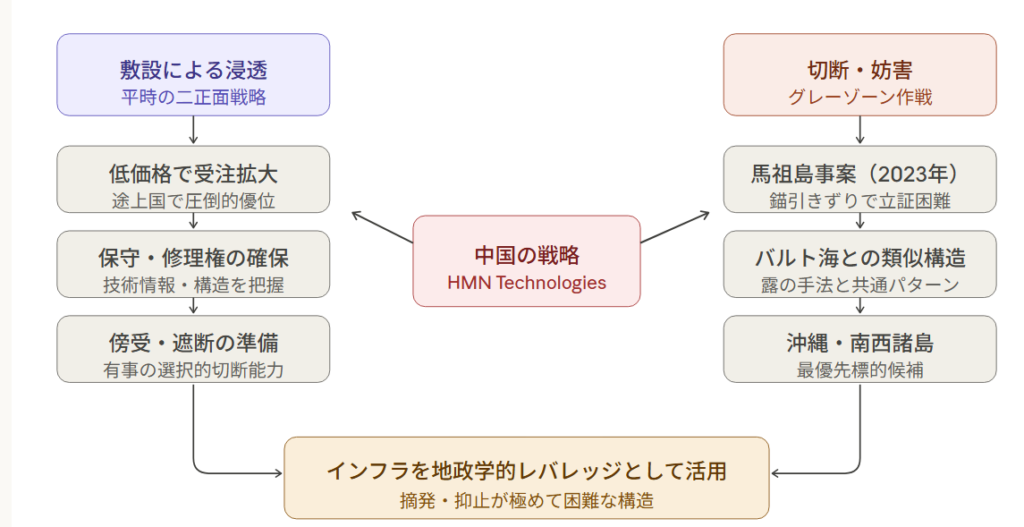
図2:中国の「二正面戦略」:「敷設」と「切断」の一体的構造
5.「Project Waterworth」の本質と日本の能動的選択
5-1.「Project Waterworth」は何を意味するか
2025年2月、Metaは総延長約50,000kmに及ぶ新たな海底ケーブル構想「Project Waterworth」を公式発表した。インド・ブラジル・南アフリカ・オーストラリア・米国を結ぶこの構想の最大の特徴は、中東・紅海ルートを意図的に回避し、インド洋を横断する設計を採用している点にある。深海敷設技術を活用することで、浅海域での錨引きずりによる切断リスクを低減するという技術的革新も盛り込まれている。
注目すべきはその発表のタイミングである。トランプ・モディ首脳共同声明と連動する形でこの構想が公表されたことは、「Project Waterworth」が単なる民間インフラ投資ではなく、インド太平洋における米印の地政学的連携を実体化するインフラ外交の一環として機能していることを示唆する。Metaという民間企業が、国家の外交戦略と事実上連動したケーブル設計を主導しているという現実は、21世紀のインフラ覇権競争の新たな局面を象徴している。
より本質的な問いはこうである。―ハイパースケーラー(超大規模クラウド・IT企業)が国家に先行してインフラ秩序を再設計しつつある時代に、国家はいかなる役割を担えるのか。GoogleのGrace Hopper、AmazonのAmazon Express、そしてMetaのProject Waterworth―巨大テクノロジー企業が次々と独自の海底ケーブルを敷設する動きは、かつて国家と通信事業者が担っていたインフラ設計の主導権が、民間プラットフォーム企業へと移行しつつあることを意味する。国家安全保障の観点からこの移行を無批判に受け入れることはできない。
5-2.日本にとっての戦略的機会
「Project Waterworth」の構想ルートに日本は含まれていない。これは見落としではなく、現時点での日本の戦略的存在感の欠如を反映している。しかしこれは同時に、日本が能動的に参画する余地が残されていることを意味する。
TeleGeographyのデータによれば、2025年以降に計画されている太平洋・アジア新設ケーブルのうち、日本への接続が予定されているものは4本に上る。一方、中国向けの新設ケーブルは米国の外交圧力もあり事実上ゼロへと向かっており、インド太平洋のケーブルトラフィックが日本経由ルートへ再集中する構造的条件が整いつつある。沖縄・具志頭村の陸揚げ局を核とするケーブルハブは、この再集中の受け皿として機能しうる地政学的位置にある。
Quad枠組みにおいても、2024年9月のデラウェアサミット首脳声明はインド太平洋ケーブル網への1億4千万ドル超のコミットメントを明示した。米国際開発金融公社(DFC)はシンガポール〜米国間ケーブルに最大1億9千万ドルの融資を決定している。日本はこの資金・外交の流れに乗り、沖縄ハブを起点とするケーブル網の設計・誘致においてイニシアティブを取れる立場にある。
5-3.能動的選択のための三つの柱
日本が採るべき能動的選択は、以下の三つの柱として整理できる。
第一の柱:沖縄ケーブルハブの戦略的強化
沖縄・具志頭村の陸揚げ局を単なる通信インフラとしてではなく、インド太平洋ケーブル網の戦略的結節点として位置づけ直す必要がある。具体的には、陸揚げ局の物理防護基準の引き上げ、サイバーセキュリティ体制の強化、外資規制の整備を一体として推進する。同時に、沖縄ハブを経由する新規ケーブルの誘致を国家戦略として明示し、ルート設計段階から日本が関与できる体制を整える。
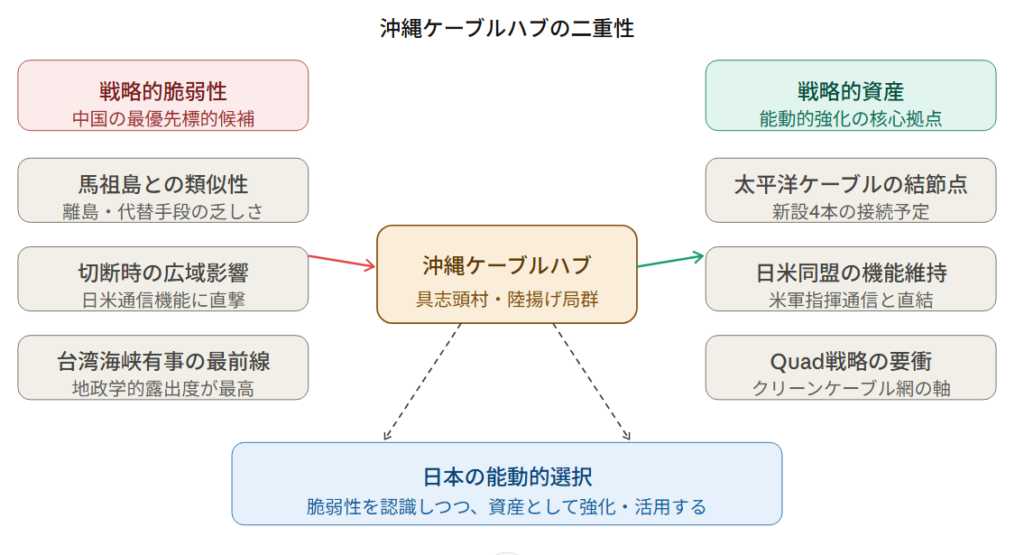
図3:沖縄ケーブルハブの二重性
第二の柱:Quad枠組みを活用したケーブル外交の展開
米国・オーストラリア・インドとの間で、HMN排除とクリーンケーブル網の構築を共通目標として掲げた「インド太平洋ケーブルセキュリティ協定」の締結を主導する。NATOが北大西洋で展開している「Baltic Sentry」に相当する共同監視体制を、インド太平洋において日米主導で構築することが急務である。ケーブル外交は安全保障政策であると同時に、同盟管理の具体的手段でもある。
第三の柱:法制度の整備――ケーブルを安全保障インフラとして定義する
現行の経済安全保障推進法は重要インフラの保護を定めているが、海底ケーブルの陸揚げ局を明示的に対象とした防護基準・情報共有義務・外資規制は十分ではない。海底ケーブルを「データの動脈」として経済安保インフラに明示的に位置づける法改正を早急に行い、物理防護とサイバー防護を一体とした法制度を設計する必要がある。
6.まとめと政策提言――インフラ覇権競争に参画する国家へ
6-1.本稿が示した構造転換
本稿が一貫して論じてきたのは、一つの構造転換である。海底ケーブルをめぐる問題は、「海峡を守る」という受動的防衛の段階から、「誰がハブを設計し、誰のケーブルが世界をつなぐか」という能動的覇権競争の段階へと移行した。この転換は緩やかに進行してきたが、2024年の紅海ケーブル切断と中国の「二正面戦略」の顕在化、そして「Project Waterworth」の登場によって、もはや「将来の課題」ではなく「現在進行中の競争」として認識しなければならない段階に達している。
前編が明らかにした「日本のエネルギーと通信の二重依存構造」は、この競争における日本の出発点の脆弱さを示していた。
しかし本稿が示したのは、その脆弱さが同時に戦略的機会の所在を指し示しているという逆説である。沖縄ケーブルハブは攻撃対象であると同時に、インド太平洋の結節点として能動的に強化しうる資産である。日本周辺海域へのケーブル再集中は脅威であると同時に、日本が設計に参画する機会でもある。脆弱性の地図は、そのまま戦略の地図となりうる。
6-2.政策提言――五つの優先アクション
本稿の分析を踏まえ、日本が優先的に取り組むべき政策アクションを五点に絞り提言する。
① 沖縄ケーブルハブの国家戦略への明示的位置づけ
沖縄・具志頭村の陸揚げ局群を、経済安全保障上の最重要インフラとして国家戦略文書に明示する。防護基準・外資規制・情報共有義務を法制化し、物理防護とサイバー防護を一体とした管理体制を構築する。同時に、沖縄ハブを経由する新規ケーブルの誘致を国家主導で推進し、インド太平洋のケーブルトラフィック再集中を戦略的に取り込む。
② 経済安全保障推進法の改正によるケーブルインフラの明示的保護
現行法の対象に海底ケーブルおよび陸揚げ局を明示的に追加し、設計・敷設段階からの安全保障審査、外国企業の参画制限、障害発生時の情報共有義務を整備する。ケーブルの設計寿命が25年に及ぶことを踏まえ、今日の法制整備が数十年単位の安全保障上の選択であるという認識のもとで法改正を急ぐ。
③ 「インド太平洋ケーブルセキュリティ協定」の締結主導
Quad枠組みを活用し、日米豪印間でHMN排除とクリーンケーブル網の構築を共通目標とした多国間協定の締結を日本が主導する。NATOの「Baltic Sentry」に相当する共同海底インフラ監視体制をインド太平洋に構築し、グレーゾーン切断への抑止力を形成する。ケーブル外交を日本の安全保障外交の主要アジェンダとして格上げする。
④ 日米同盟におけるケーブル防護の制度化
海底ケーブルへの脅威を日米安全保障条約の文脈で明示的に位置づけ、共同監視・共同対処の枠組みを制度化する。米軍のインド太平洋における指揮・統制通信と日本のケーブルハブが直結している現実を踏まえ、ケーブル防護を日米同盟の機能維持という観点から再定義する。
⑤ ハイパースケーラーとの官民連携によるケーブル設計への参画
「Project Waterworth」に代表されるように、ケーブル設計の主導権が民間プラットフォーム企業へと移行しつつある現実を直視し、国家がこの動きに関与する枠組みを整備する。具体的には、新規ケーブル計画の設計段階における政府の安全保障審査の義務化、日本経由ルートへの財政的インセンティブの付与、NECをはじめとする国内ケーブル企業の国際競争力強化への支援を組み合わせた官民連携モデルを構築する。
6-3.まとめ―設計する国家か、周縁の国家か
海底に敷かれたケーブルは見えない。しかしその上を流れるデータは、金融・外交・軍事・日常生活のすべてを支えている。誰がそのケーブルを敷き、誰がそのハブを管理し、誰がその設計図を描くか―この問いへの答えが、21世紀の国際秩序における各国の立ち位置を静かに、しかし決定的に規定していく。
中国は敷設と切断の二正面で動いている。米国はクリーンネットワークとQuadで対抗している。Metaは国家に先行して新たなルートを描いている。この競争に日本はいかなる姿勢で臨むのか。
沖縄という太平洋の結節点を持ち、Quadの一角を担い、世界有数のケーブル製造技術を保有する日本には、この競争に能動的に参画する条件が揃っている。必要なのは技術でも資金でもなく、「インフラ覇権競争に参画する国家」としての戦略的意志である。ケーブルの設計に加わらない国家は、他者が描いた秩序の中で静かに周縁へと押しやられていく。その選択を、今この瞬間も私たちは迫られている。
■ 巻末用語解説
・ハイパースケーラー
Meta(旧Facebook)、Google、Amazon、Microsoftなど、世界規模で超大型データセンターやクラウドインフラを運営する巨大IT企業の総称。近年は独自の海底ケーブルを敷設し、国家に先行してインフラ設計の主導権を握りつつある。
・チョークポイント
海上交通における戦略的な隘路(あいろ)。バブ・エル・マンデブ海峡やホルムズ海峡のように、多くの船舶が通過せざるを得ない狭い水道を指す。ここが封鎖・妨害されると、物流・エネルギー・通信に甚大な影響が生じる。
・陸揚げ局(ケーブルランディングステーション)
海底ケーブルが陸上に引き上げられる拠点施設。ケーブルの制御・増幅・分岐機能を担う。物理攻撃とサイバー攻撃の両方の標的となりうる重要インフラ。沖縄・具志頭村にはインド太平洋主要ケーブルの陸揚げ局が集中している。
・グレーゾーン作戦
武力行使の閾値(いきち)を意図的に下回りながら、相手国のインフラや意思決定に影響を与える組織的な妨害活動。「錨の引きずりによるケーブル切断」のように、偶発事故との区別が困難な手法が典型例。
・HMN Technologies(旧華為海洋ネットワークス)
中国の通信大手ファーウェイ(華為)の傘下にあった海底ケーブル敷設・保守企業。2021年に社名変更。アフリカ・東南アジア・中東での敷設実績を持ち、米国・オーストラリア・日本から安全保障上のリスクとして警戒されている。
・Project Waterworth
Meta社が2025年2月に発表した総延長約50,000kmの海底ケーブル構想。インド・ブラジル・南アフリカ・オーストラリア・米国を結び、中東・紅海ルートを意図的に回避するインド洋横断設計を採用している。
・Quad(クアッド)
日本・米国・オーストラリア・インドの4カ国による安全保障協力の枠組み。インド太平洋地域における海底ケーブルの安全確保にも取り組んでおり、2024年のデラウェアサミットでケーブル網への大規模投資を表明した。
・クリーンネットワーク・イニシアティブ
中国企業(特にHMN Technologies)が関与する海底ケーブルを排除し、信頼できる企業のみで構成するケーブル網を構築しようとする米国主導の外交・政策的取り組み。
・IMEC(インド・中東・欧州経済回廊)
2023年のG20でインド・米国・EUなどが合意したインフラ回廊構想。鉄道・港湾・エネルギーに加えデジタルインフラ(海底ケーブル含む)を整備し、インドから中東・イスラエルを経て欧州へつなぐ構想。ガザ侵攻の長期化により凍結状態にある。
・Baltic Sentry(バルティック・セントリー)
北大西洋・バルト海での海底ケーブル損傷事案を受けてNATOが強化した海底インフラの共同監視・防護体制。本稿はこれに相当する体制をインド太平洋で日米主導で構築することを提言している。
■ 参考資料
本レポートは以下の情報に基づき構成されている。
1.国際報道・一次情報
- Reuters:紅海ケーブル切断・フーシ派攻撃に関する速報(2024年)
- BBC:中東情勢・紅海航路・地域安全保障の背景分析
- 米国防総省(DoD):フーシ派の船舶攻撃件数に関する公式声明(2023〜2024年)
- Meta Engineering公式ブログ(2025年2月14日):Project Waterworth公式発表
2.エネルギー・海上輸送関連
- International Energy Agency(IEA):バブ・エル・マンデブ海峡通過原油量データ
- U.S. Energy Information Administration(EIA):ホルムズ海峡依存度分析
- 日本経済産業省:エネルギー白書2023(中東依存率約88%)
- Clarksons Research:喜望峰迂回による輸送コスト増加の動向分析(2024年)
3.海底ケーブル・通信インフラ
- TeleGeography:世界海底通信ケーブルマップ・障害事例データ
- International Cable Protection Committee(ICPC):海底ケーブル保護・障害リスク資料
- CSIS(2026年1月):2024年紅海ケーブル切断によるアジア・欧州間トラフィック25%喪失の記録
- 日本総務省情報通信白書2023:日本の国際通信の海底ケーブル依存率(約95%以上)
- 三菱総合研究所(2024年):台湾有事を軸とした海底ケーブル切断の日本経済への影響試算
4.サイバーセキュリティ・海事サイバー
- NATO Cooperative Cyber Defence Centre of Excellence(CCDCOE):重要インフラ防護・ハイブリッド攻撃分析
- Cybersecurity and Infrastructure Security Agency(CISA):港湾・海事インフラへのサイバー脅威レポート
- ENISA:海事・通信インフラに対するサイバーリスク分析
5.IMEC・中東ハブ構想関連
- G20ニューデリー首脳会合(2023年9月):IMEC覚書(MOU)署名に関する公式文書
- Atlantic Council(2025年8月):「The India-Middle East-Europe Economic Corridor」
- Carnegie Endowment for International Peace(2023年12月):IMECの失速リスク分析
- ECFR(2024年4月):「The infinite connection」欧州視点からのIMEC実現可能性分析
6.HMN Technologies・ケーブル敷設競争関連
- CSIS(2024年8月):「Safeguarding Subsea Cables」HMNのシェア推移・米国の政策対応
- Carnegie Endowment(2024年12月):「Subsea Communication Cables in Southeast Asia」
- University of Washington JSIS(2025年10月):「Undersea Alliances」日米ケーブル安全保障協力分析
- Recorded Future / Insikt Group(2025年):台湾周辺・バルト海ケーブル損傷事案44件の包括分析
7.中国による切断・グレーゾーン攻撃関連
- Indo-Pacific Defense Forum(2025年4月):「Critical Conduits」台湾海峡〜バルト海ケーブル損傷事案分析
- ASIS International(2025年1月):「Nation-States Suspected of Cutting the Cords」
8.Project Waterworth・ハイパースケーラーのインフラ再設計
- IEEE Spectrum(2025年3月):Project Waterworthの技術的詳細・ルート設計の独立分析
- TechCrunch(2025年2月):Project Waterworth確認報道・インド洋ケーブル政策への含意
- TeleGeography:Project Waterworth含む世界海底ケーブル計画データ(570本稼働中・81本計画中)
9.Quad・日米ケーブル安全保障協力
- Quad首脳声明(2024年9月、デラウェアサミット):インド太平洋ケーブル網への1億4千万ドル超のコミットメント
- 米国際開発金融公社(DFC):トランス太平洋ネットワーク向け最大1億9千万ドルローン融資詳細
- 米国務省:クリーンネットワーク・イニシアティブに関する外交文書・公式声明
10.総合安全保障・政策
- NATO 2023年報告:北海・バルト海ケーブル近傍でのロシア調査船監視問題
- 日本内閣サイバーセキュリティセンター(NISC):重要インフラのサイバーセキュリティに係る行動計画
- 日本危機管理研究所・前編レポート(2026年3月):中東海域における海峡・海底通信ケーブル危機と日本への影響
【前編】中東海域における「海峡・海底通信ケーブル」危機と日本への影響ー 「バブ・エル・マンデブ海峡」封鎖リスクが示す日本の「海底通信ケーブル」依存構造の脆弱性ー – 一般財団法人日本危機管理研究所
執筆者プロフィール
舩山 美保 一般財団法人 日本危機管理研究所 理事
国際標準化、技術インテリジェンス、知的財産分析、地政学・危機管理を専門とする戦略アナリスト。 キヤノン株式会社において国際標準・新技術分野の特許調査および戦略分析業務に従事。ISO/IEC JTC 1/SC 28(オフィス機器)副国際幹事として、国際規格策定および多国間交渉の調整を担い、国際標準化活動への貢献によりITSCJ国際標準化貢献賞を3回受賞。 中東アジア情報戦略研究所フェロー。公益社団法人 日本外国特派員協会(FCCJ)プロフェッショナル・アソシエイト会員。 上智大学国際政治学科卒業。青山学院大学大学院修了(国際政治経済学・哲学・心理学)
研究領域:
言語・行動パターンの体系的分析手法を応用した意思決定構造・行動構造の解析を専門とする。とりわけPSYOP(心理作戦)および情報戦の分析、ならびに危機管理政策の視点からセキュリティインテリジェンスの研究・分析を行っている。国際政治学・心理学・哲学にまたがる学際的バックグラウンドを基盤に、国家・非国家アクターによる認知領域への介入メカニズムの解明に取り組む。
関連記事

日本のMythos参加が露呈したもの ー「6週間の空白」を契機に、サイバー主権の再設計へ What Japan’s Participation in Mythos Has Laid Bare
脅迫するAI AI as a Tool of Coercion
燃料を失う日 The Day We Lose Our Fuel
Recent Posts
- 日本のMythos参加が露呈したもの ー「6週間の空白」を契機に、サイバー主権の再設計へ What Japan’s Participation in Mythos Has Laid Bare
- 後編 ロシアの学生ハッカー工場は今、日本に照準を合わせている Russia’s Hacker Factory Goes Global: CRINK Cyber Alliances, Space Warfare, and AI Disinformation
- 前編 ロシア・バウマン大学、通称「GRU大学」——教室はハッカー工場、2,000枚の内部文書が暴いたハッカー養成システムの全貌 Part 1: Inside Russia’s “GRU University”: 2,000 Leaked Documents Reveal the Hacker Factory Operating Inside Bauman’s Classrooms
- 金融インフラが戦場になる時代 ——2026年イラン戦争 崩れゆくペトロダラーと新貨幣秩序の胎動 When Financial Infrastructure Becomes the Battlefield— The 2026 Iran War: The Crumbling Petrodollar and the Dawn of a New Monetary Order
- 【後編】盗んだ資金はミサイルになり、情報はロシアへ流れる——北朝鮮「地政学的サイバー同盟」の全貌
Archives
Categories
【Part 2】He Who Controls Submarine Cables Controls the World
— Can Japan Compete in the “Infrastructure Supremacy Race”?
Submarine Cable Hegemony, the Okinawa Hub, China’s Two-Front Strategy, and the Geopolitics of Project Waterworth
Published: April 1, 2026
Publisher: Japan Institute of Crisis Management (一般財団法人 日本危機管理研究所)
Positioning of This Report
The geopolitical risks surrounding submarine cables were addressed in Part 1 (“The Strait and Submarine Cable Crisis in Middle Eastern Waters and Its Impact on Japan,” March 2026), which examined the chokepoint risks of the Bab-el-Mandeb Strait and Japan’s dual-dependency structure. If Part 1 asked “what can be broken,” this report asks “who will design the next order, and what role can Japan play in it.”
Prior research — including CSIS (2026) and Foreign Policy (2024) — has concentrated on chokepoint vulnerability analysis, and no Japanese-language study has directly addressed the next phase: the competition to design hubs. Filling this gap is the primary purpose of this report.
In addition, this report brings three points of originality not found in prior research. First, it explicitly identifies the structural shift from “chokepoint defense” to “hub hegemony competition” as a single analytical axis. Second, it analyzes China’s submarine cable strategies of “penetration through laying” and “gray zone attack through severance” as a unified two-front strategy. Third, it positions the international submarine cable landing stations concentrated in Gushikami Village, Okinawa as both a strategic vulnerability and a proactive asset of the Pacific cable hub, examining them in the context of the Japan-U.S. alliance. No Japanese-language analysis crossing all three of these dimensions currently exists.
Situation at the Time of Writing:
This report is being written at the end of March 2026, at the point when the scenario Part 1 discussed as hypothetical has become reality. Following the U.S.-Israel coordinated strikes on Iran on February 28, 2026, Iran formally declared the closure of the Strait of Hormuz on March 2. Japan has responded with multiple simultaneous diplomatic measures: the Iranian Ambassador to Japan approached Japan as a “friendly nation willing to grant passage” — effectively soliciting mediation — and Minister of Economy, Trade and Industry Akazawa secured an alternative land route bypassing the Red Sea and Hormuz via Saudi Arabia’s Yanbu Port and the UAE’s Fujairah Port, with the first crude oil tanker arriving via this route on March 28.
The situation that Part 1 analyzed as “the vulnerability of Japan’s dual-dependency structure” has transformed, mid-writing of this report, into an ongoing crisis. This report examines Japan’s strategic choices regarding energy and communications infrastructure against this urgent reality.
Keywords
- Submarine Cable Hegemony Competition
- Indo-Pacific Cable Hub
- From Chokepoint to Hub
- IMEC (India-Middle East-Europe Economic Corridor)
- Stalling of the Netanyahu Corridor Vision
- U.S.-China Infrastructure Hegemony Competition
- HMN Technologies (formerly Huawei Marine Networks)
- Submarine Cable Laying Share Competition
- Gray Zone Cable Severance
- Matsu Island Cable Severance Incident
- Two-Front Strategy (Laying and Severance)
- Project Waterworth (Meta’s trans-Indian Ocean cable bypassing the Middle East)
- Okinawa Cable Hub
- Cable Landing Station Protection
- Clean Network Initiative
- Quad Framework and Cable Security
- Proactive Infrastructure Diplomacy
Table of Contents
Executive Summary
1. Opening — The Battlefield Has Shifted: From “Severance” to “Design”
2. From Chokepoint to Hub — The Structural Transformation of the Problem
3. International Competition over the Middle East Hub — The Stalling of the Netanyahu Vision and the U.S.-China Struggle
- 3-1. The Middle East Hub That the Netanyahu Vision Envisioned
- 3-2. Stalling from the Gaza Offensive and the Exposure of Structural Contradictions
- 3-3. The U.S.-China Struggle — The Quiet War over “Laying Rights”
4. The Reality of Chinese Obstruction — The Two-Front Strategy of “Laying” and “Severance”
- 4-1. The Matsu Island Incident — A Textbook Case of Gray Zone Severance
- 4-2. HMN Technologies — The Risk Embedded in “Laying”
- 4-3. The Full Picture of the Two-Front Strategy
5. The Essence of Project Waterworth and Japan’s Proactive Choices
- 5-1. What Does Project Waterworth Mean?
- 5-2. Strategic Opportunity for Japan
- 5-3. Three Pillars for Proactive Choice
6. Conclusion and Policy Recommendations — Toward a Nation Participating in the Infrastructure Hegemony Competition
- 6-1. The Structural Transformation This Report Has Demonstrated
- 6-2. Policy Recommendations — Five Priority Actions
- 6-3. Closing Remarks — A Nation That Designs, or a Nation on the Periphery?
Glossary
References
Executive Summary
- Recognition of Structural Transformation: The era of passive defense — “protect the chokepoints” — is drawing to a close. What the 2024 Red Sea cable severing demonstrated was the vulnerability of the design philosophy itself: excessive concentration on straits. The problem has already moved to the phase of active competition over “who will design the new routes and hubs.”
- Stalling of the IMEC Vision: The India-Middle East-Europe Economic Corridor (IMEC) envisioned by the Netanyahu government — an ambitious plan to establish Israel as a digital hub — has effectively entered a frozen state due to the prolonged Gaza offensive. This stalling exposed the fundamental vulnerability of the very concept of placing cable nodes in geopolitically unstable regions.
- Asymmetry of U.S.-China Infrastructure Hegemony Competition: While the United States is pursuing the exclusion of HMN Technologies under the Clean Network Initiative, Chinese companies overwhelmingly outcompete Western rivals in price competitiveness and construction speed, creating a structural reality in which developing nations with limited financial resources have no choice but to select Chinese-made cables. “Whose cable to use” is, before being a matter of technology and security, a matter of economic power.
- China’s Two-Front Strategy: China is believed to be deploying a two-front strategy combining “peacetime penetration through laying” and “gray zone attacks through severance.” The 2023 Matsu Island incident is a defining example; the method of making intent difficult to prove by taking the form of routine maritime activity — “anchor dragging” — is structurally identical to Russia’s methods in the Baltic Sea.
- The Dual Nature of the Okinawa Cable Hub: The international submarine cable landing stations concentrated in Gushikami Village, Okinawa form an important cable hub in the Indo-Pacific connecting the Pacific and Asia. Given the geographic similarity to Matsu Island, the scarcity of alternative communications means, and the direct connection to U.S. military command communications, the Okinawa hub is likely one of the highest-priority target candidates in China’s two-front strategy — and simultaneously a strategic asset that Japan should proactively strengthen.
- The Geopolitical Essence of Project Waterworth: Meta’s submarine cable vision spanning approximately 50,000 km in total length is not merely a private infrastructure investment. The design philosophy of bypassing the Middle East and crossing the Indian Ocean represents both a response to geopolitical risk and a demonstration that hyperscalers are moving ahead of nation-states to redesign the infrastructure order. Japan must choose whether to passively follow this movement or actively participate in it.
- Japan’s Proactive Choice: The protection and strengthening of the Okinawa cable hub, participation in the Indo-Pacific cable network through the Quad framework, and the development of a legal protection framework for landing stations — these are not separate policy challenges, but must be designed in an integrated manner as the answer to a single strategic question: Japan’s position in the infrastructure hegemony competition. Nations that cannot participate in cable design will be quietly pushed to the periphery.
1. Opening — The Battlefield Has Shifted: From “Severance” to “Design”
In February 2024, three submarine communication cables were successively damaged in the northern Red Sea: HGC, AAE-1, and EIG — the “data arteries” connecting Europe with India and Asia. As detailed in Part 1 of this report, this incident caused real-world damage amounting to the loss of up to 25% of India-Europe traffic.
Yet the world did not stop there. On the contrary, it accelerated.
As Houthi cable severances were recorded as “demonstrated threats,” the world’s major technology companies, national governments, and military alliances simultaneously turned to the next question: “So where, by whom, and along which routes will cables be laid?”
The era of defending chokepoints (straits) is drawing to a close. The problem has shifted to the stage of who holds the blueprint for new infrastructure hegemony while circumventing vulnerable straits. From the physical bottleneck of “Bab-el-Mandeb” to a hegemony war over “hubs” in the Indo-Pacific and Middle East — this is the essence of the new battlefield that this report addresses.
This report takes up the problem posed in Part 1 — Japan’s dual-dependency structure in energy and communications — and asks about the “way out.”
Specifically, it addresses in order: ① The structural transformation from Middle East chokepoints to hub competition; ② The reality and limits of the Middle East hub strategy demonstrated by the Netanyahu vision; ③ The structure of U.S.-China infrastructure hegemony competition; ④ The geopolitical essence of Meta’s “Project Waterworth”; ⑤ Japan’s proactive options in light of the above.
If Part 1 asked “what can be broken,” this report asks “who will design the next order, and what role can Japan play in it.” Now that submarine cables have become the foundation of 21st-century international order, nations that cannot participate in their design will be quietly pushed to the periphery.
2. From Chokepoint to Hub — The Structural Transformation of the Problem
What the 2024 Red Sea cable severance confronted the world with was not simply a warning to “protect the straits.” The more essential message was a strategic imperative: “Reconsider the very structure of dependence on cables that transit straits.”
As discussed in Part 1, approximately 16–17 major submarine cables connecting Europe, the Middle East, and Asia are concentrated in the Bab-el-Mandeb Strait. This over-concentration is the root of vulnerability, generating an asymmetry in which attacking a single point paralyzes a wide-area communications network. The problem reduces not to “who attacked the strait” but to a design-level question: “why are so many cables bundled through a single strait.”
Once this recognition was shared, the world’s attention naturally shifted to the next question: if we detour, where do we route? And who controls the “hub” on that new route?
In submarine cable networks, a “hub” refers to a strategic base where multiple cables are landed and where relay, branching, and amplification functions are performed. Singapore, Marseille, and Mumbai are typical examples, but within the new route designs, there is now fierce competition among nations, companies, and military alliances over where to place new hubs in the Indo-Pacific and Middle East.
Whoever controls the hub controls the routing of traffic passing through it, and in times of conflict, stands in a position to cut off or intercept the flow of information. This is no longer a matter of infrastructure development — it is a geopolitical competition over the information order of the 21st century. From chokepoint — a passive vulnerability — to hub — an active power base: the structure of the problem has undergone a major transformation here.
3. International Competition over the Middle East Hub — The Stalling of the Netanyahu Vision and the U.S.-China Struggle
3-1. The Middle East Hub That the Netanyahu Vision Envisioned
In September 2023, a map presented by Israeli Prime Minister Netanyahu at the United Nations General Assembly drew wide attention: the “India-Middle East-Europe Economic Corridor (IMEC)” — a vision of a corridor from India through Arab Gulf states and Israel to Europe. Designed as a corridor of digital infrastructure including submarine cables, in addition to railways, ports, and energy pipelines, it was an attempt to give economic substance to the relationships with Arab states normalized through the Abraham Accords. The United States backed this within the G20 framework, positioning it as an Indo-Pacific infrastructure strategy to counter China’s “Belt and Road Initiative.”
The core of the vision was to establish Israel as a digital hub connecting the Indo-Pacific and Europe, while bypassing dependence on the Red Sea and Suez route. Had this been realized, a new “information artery” bypassing the vulnerable chokepoint of Bab-el-Mandeb would have emerged, with Israel dramatically enhancing its geopolitical value as its node.
3-2. Stalling from the Gaza Offensive and the Exposure of Structural Contradictions
However, the Hamas attack of October 2023 and the subsequent Gaza offensive shook this vision to its foundations. Saudi Arabia and other Arab Gulf states that had been expected to participate in IMEC lost the political environment in which they could publicly endorse economic cooperation with Israel, and the vision effectively entered a frozen state. The premise of Israel as a “stable hub” for the infrastructure corridor collapsed at its foundation due to the protracted conflict.
This stalling is more than a mere diplomatic setback. It exposed the fundamental vulnerability of the very concept of placing cable nodes in geopolitically unstable regions. Establishing a cable nexus in a geopolitically unstable area may be economically rational in peacetime, but immediately becomes a target of attack in times of conflict. The stalling of the Netanyahu vision became a fundamental question mark over the design philosophy of “routing through the Middle East.”
3-3. The U.S.-China Struggle — The Quiet War over “Laying Rights”
While IMEC stalls, a quieter but more fundamental competition is underway: the U.S.-China contest over “laying rights” for submarine cables.
China has expanded its cable-laying market share for Africa, Southeast Asia, and the Middle East through HMN Technologies (formerly Huawei Marine). As cables in which HMN is involved may have access to communications data during the laying and maintenance process, the United States, Australia, and Japan have successively heightened their vigilance. The U.S. State Department has been urging allied nations to exclude HMN under the “Clean Network” initiative, and efforts are being made to direct contracts to Western companies such as Japan’s NEC and the U.S.’s SubCom.
However, here lies an asymmetric reality. Chinese companies overwhelmingly outcompete Western firms in price competitiveness and construction speed, creating a structure in which resource-constrained developing nations have no choice but to select lower-cost Chinese cables. “Whose cable to use” is, before being a matter of technology and security, a matter of economic power. The U.S.-China infrastructure hegemony competition, carrying this asymmetry, is quietly advancing across the entire Indo-Pacific.
4. The Reality of Chinese Obstruction — The Two-Front Strategy of “Laying” and “Severance”
4-1. The Matsu Island Incident — A Textbook Case of Gray Zone Severance
In February 2023, two submarine cables connected to Taiwan’s outlying island of Matsu were severed in succession. Both severances were attributed to “anchor dragging” by Chinese-flagged vessels, but proving whether this was intentional or accidental was extremely difficult, and Taiwan’s authorities refrained from making a definitive determination. As a result, approximately 14,000 Matsu residents lost nearly all internet connectivity for several weeks, forced to depend on limited communications via microwave relay links.
This incident reveals two essential points.
First, outlying and remote islands have extremely limited alternative communications means, and cable severance alone can achieve what amounts to communications isolation — an asymmetry.
Second, it is a textbook example of gray zone operations: by taking the form of routine maritime activity — “anchor dragging” — the intent of the attack is made ambiguous, enabling evasion of responsibility under international law. Viewed through the integrated infrastructure warfare framework discussed in Part 1, this has the dual character of being a “physical attack” that is simultaneously an “unprovable attack.”
A similar structure has been confirmed in the Baltic Sea. Since 2023, Russian-flagged survey vessels have repeatedly transited near submarine cables between NATO member states, with incidents occurring in which cables between Finland and Estonia were damaged. The similarity in methods is not coincidental — it suggests that “severance difficult to prove” is becoming established as a standard method of gray zone operations.
4-2. HMN Technologies — The Risk Embedded in “Laying”
The other axis of China’s two-front strategy is “peacetime penetration” through cable laying and maintenance operations, exemplified by HMN Technologies (formerly Huawei Marine Networks).
Companies responsible for laying and maintaining submarine cables possess detailed technical information about the physical structure of the cable, the locations of repeaters, and the equipment specifications of landing stations. They also have regular access opportunities to cables under the pretext of maintenance work. U.S. and Australian security authorities point out that this can function as advance preparation for selective severance or interception in times of conflict.
What is crucial is that cables in which HMN has been involved remain in operation in large numbers at present, and past laying track records persist as future vulnerabilities. The design lifespan of a cable is typically approximately 25 years, meaning cables laid today will be in use until the 2050s. Corporate selection at the time of laying is a security choice spanning decades.
4-3. The Full Picture of the “Two-Front Strategy”
Combining “penetration through laying” and “gray zone attack through severance” — the full picture of China’s submarine cable strategy comes into view. In peacetime, access to infrastructure is secured through expansion of the laying share; in times of conflict, options of severance, interdiction, and interception are kept at hand. This is not the direct use of military force but a strategy utilizing infrastructure itself as geopolitical leverage, with a structure that makes detection and deterrence extremely difficult.
For Japan, this “two-front strategy” is not someone else’s problem. Major landing stations for international submarine cables connecting the Pacific and Asia are concentrated in Gushikami Village in southern Okinawa, forming an important cable hub in the Indo-Pacific. The geographic similarity between Matsu Island and Okinawa and the Nansei Islands is striking: remote island terrain, scarcity of alternative communications means, and frontline positioning in a Taiwan Strait contingency. Furthermore, this hub is directly connected to U.S. military command and control communications in the Indo-Pacific, meaning that if severed, the impact would extend beyond Japan’s civilian communications to affect the operational functions of the Japan-U.S. alliance itself. Okinawa’s cable landing stations must be regarded as one of the highest-priority target candidates in China’s two-front strategy in terms of strategic value.
5. The Essence of “Project Waterworth” and Japan’s Proactive Choices
5-1. What Does “Project Waterworth” Mean?
In February 2025, Meta officially announced “Project Waterworth” — a new submarine cable vision spanning approximately 50,000 km in total length. The defining feature of this vision, connecting India, Brazil, South Africa, Australia, and the United States, is its adoption of a design that intentionally bypasses the Middle East and Red Sea routes, crossing the Indian Ocean instead. It also incorporates technological innovation — the use of deep-sea laying technology to reduce the risk of severance from anchor dragging in shallow waters.
The timing of the announcement deserves attention. The fact that this vision was announced in conjunction with the Trump-Modi joint leaders’ statement suggests that “Project Waterworth” functions not merely as a private infrastructure investment but as a component of infrastructure diplomacy that gives substance to the geopolitical partnership between the United States and India in the Indo-Pacific. The reality that a private company — Meta — is leading cable design that is effectively aligned with national diplomatic strategy symbolizes a new phase in the 21st-century infrastructure hegemony competition.
The more fundamental question is this: in an era when hyperscalers (ultra-large cloud and IT companies) are moving ahead of nation-states to redesign the infrastructure order, what role can states play? Google’s Grace Hopper, Amazon’s Amazon Express, and Meta’s Project Waterworth — the successive moves by major technology companies to lay their own submarine cables represent a shift in the leadership of infrastructure design, which was once the domain of states and telecommunications operators, toward private platform companies. This shift cannot be accepted uncritically from a national security perspective.
5-2. Strategic Opportunity for Japan
Japan is not included in the planned route of “Project Waterworth.” This is not an oversight but a reflection of the current absence of Japan’s strategic presence. However, it simultaneously means that room for Japan to proactively participate remains.
According to TeleGeography data, of the new Pacific and Asian cables planned for 2025 and beyond, four are scheduled to connect to Japan. Meanwhile, new cables destined for China are effectively moving toward zero, partly due to U.S. diplomatic pressure, and the structural conditions for Indo-Pacific cable traffic to reconcentrate on Japan-routed paths are falling into place. The cable hub centered on the landing stations in Gushikami Village, Okinawa is in a geopolitical position where it can function as the receiving point for this reconcentration.
Within the Quad framework as well, the Delaware Summit leaders’ statement of September 2024 explicitly committed over $140 million to the Indo-Pacific cable network. The U.S. International Development Finance Corporation (DFC) has decided on financing of up to $190 million for a Singapore-U.S. cable. Japan is positioned to ride this flow of funding and diplomacy, and to take initiative in designing and attracting a cable network centered on the Okinawa hub.
5-3. Three Pillars for Proactive Choice
Japan’s proactive choices can be organized around three pillars:
First Pillar: Strategic Strengthening of the Okinawa Cable Hub
The landing stations in Gushikami Village, Okinawa must be repositioned not merely as communications infrastructure but as a strategic node of the Indo-Pacific cable network. Concretely, this means promoting in an integrated manner the raising of physical protection standards for landing stations, strengthening of cybersecurity frameworks, and development of foreign investment regulations. Simultaneously, attracting new cables routed through the Okinawa hub must be explicitly stated as national strategy, with a framework established for Japan to be involved from the route design stage.
Second Pillar: Deployment of Cable Diplomacy Through the Quad Framework
Japan should lead the conclusion of an “Indo-Pacific Cable Security Agreement” with the United States, Australia, and India, presenting the exclusion of HMN and the construction of a clean cable network as shared objectives. It is urgent to construct, under Japan-U.S. leadership in the Indo-Pacific, a joint monitoring framework equivalent to NATO’s “Baltic Sentry” deployed in the North Atlantic — forming a deterrent against gray zone severance. Cable diplomacy is simultaneously security policy and a concrete instrument of alliance management.
Third Pillar: Legal Framework Development — Defining Cables as Security Infrastructure
The current Economic Security Promotion Act governs the protection of critical infrastructure, but protection standards, information-sharing obligations, and foreign investment regulations explicitly targeting submarine cable landing stations are insufficient. Legal revisions must be urgently made to explicitly position submarine cables as “data arteries” within economic security infrastructure, and a legal framework must be designed that integrates physical protection and cyber protection.
6. Conclusion and Policy Recommendations — Toward a Nation Participating in the Infrastructure Hegemony Competition
6-1. The Structural Transformation This Report Has Demonstrated
What this report has consistently argued is a single structural transformation. The problem of submarine cables has shifted from the phase of passive defense — “protecting straits” — to the phase of active hegemony competition over “who designs the hubs and whose cables connect the world.” This transformation has been gradual, but with the 2024 Red Sea cable severance, the manifestation of China’s “two-front strategy,” and the emergence of “Project Waterworth,” it has reached the stage where it must be recognized no longer as a “future challenge” but as a competition currently in progress.
The “dual dependency structure of Japan’s energy and communications” that Part 1 revealed demonstrated the fragility of Japan’s starting position in this competition.
However, what this report demonstrates is the paradox that this very fragility simultaneously points to where strategic opportunities lie. The Okinawa cable hub is both a target of attack and an asset that can be proactively strengthened as a node of the Indo-Pacific. The reconcentration of cable traffic around Japan’s waters is simultaneously a threat and an opportunity for Japan to participate in the design. The map of vulnerabilities can itself become the map of strategy.
6-2. Policy Recommendations — Five Priority Actions
Based on the analysis in this report, five policy actions are recommended as priorities for Japan:
① Explicit Positioning of the Okinawa Cable Hub in National Strategy
The landing station cluster in Gushikami Village, Okinawa should be explicitly stated in national strategy documents as the most critical infrastructure for economic security. Protection standards, foreign investment regulations, and information-sharing obligations should be legislated, and an integrated management framework combining physical protection and cyber protection should be constructed. Simultaneously, the attraction of new cables routed through the Okinawa hub should be promoted under national leadership, strategically capturing the reconcentration of Indo-Pacific cable traffic.
② Explicit Protection of Cable Infrastructure Through Revision of the Economic Security Promotion Act
Submarine cables and landing stations should be explicitly added to the scope of the current law, with security screening from the design and laying stages, restrictions on participation by foreign companies, and information-sharing obligations upon failure established. Given that cable design lifespans extend to 25 years, legal revisions should be urgently pursued with the recognition that today’s legal framework development represents a security choice spanning decades.
③ Leading the Conclusion of an “Indo-Pacific Cable Security Agreement”
Using the Quad framework, Japan should lead the conclusion of a multilateral agreement with the United States, Australia, and India presenting the exclusion of HMN and the construction of a clean cable network as shared objectives. A joint submarine infrastructure monitoring framework equivalent to NATO’s “Baltic Sentry” should be constructed in the Indo-Pacific under Japan-U.S. leadership, forming deterrence against gray zone severance. Cable diplomacy should be elevated as a major agenda item of Japan’s security diplomacy.
④ Institutionalization of Cable Protection Within the Japan-U.S. Alliance
Threats to submarine cables should be explicitly positioned within the context of the Japan-U.S. Security Treaty, with a framework for joint monitoring and joint response institutionalized. Given the reality that U.S. military command, control, and communications in the Indo-Pacific are directly connected to Japan’s cable hub, cable protection should be redefined from the perspective of maintaining the functional integrity of the Japan-U.S. alliance.
⑤ Public-Private Partnership with Hyperscalers for Participation in Cable Design
Directly acknowledging the reality that, as represented by “Project Waterworth,” leadership in cable design is shifting toward private platform companies, a framework must be developed for the state to be involved in this movement. Concretely, this means constructing a public-private partnership model combining: mandatory government security screening at the design stage of new cable projects; provision of financial incentives for Japan-routed paths; and support for strengthening the international competitiveness of domestic cable companies including NEC.
6-3. Closing Remarks — A Nation That Designs, or a Nation on the Periphery?
Cables laid on the ocean floor are invisible. Yet the data flowing over them supports everything — finance, diplomacy, military operations, and daily life. Who lays those cables, who manages those hubs, who draws those blueprints — the answers to these questions will quietly yet decisively define each nation’s position in the international order of the 21st century.
China is moving on two fronts: laying and severance. The United States is countering with the Clean Network and Quad. Meta is drawing new routes ahead of nation-states. With what posture will Japan approach this competition?
Japan — possessing the Pacific node of Okinawa, holding a seat in Quad, and retaining world-class cable manufacturing technology — has the conditions to participate actively in this competition. What is needed is not technology or funding but the strategic will to be “a nation that participates in the infrastructure hegemony competition.” Nations that do not participate in cable design will be quietly pushed to the periphery of an order drawn by others. That choice is being demanded of us at this very moment.
Glossary
Hyperscaler: A collective term for giant IT companies such as Meta (formerly Facebook), Google, Amazon, and Microsoft that operate ultra-large data centers and cloud infrastructure on a global scale. In recent years, they have been laying their own submarine cables, moving ahead of nation-states to seize leadership in infrastructure design.
Chokepoint: A strategic bottleneck in maritime traffic — a narrow waterway such as the Bab-el-Mandeb Strait or Strait of Hormuz through which many vessels must pass. If blocked or disrupted, severe impacts on logistics, energy, and communications result.
Landing Station (Cable Landing Station): A base facility where submarine cables are brought ashore. It handles cable control, amplification, and branching functions. Critical infrastructure that can be the target of both physical and cyberattacks. Major landing stations for Indo-Pacific submarine cables are concentrated in Gushikami Village, Okinawa.
Gray Zone Operations: Organized interference activities that deliberately remain below the threshold of armed force while affecting the adversary’s infrastructure and decision-making. “Cable severance through anchor dragging” — difficult to distinguish from accidental incidents — is a typical example.
HMN Technologies (formerly Huawei Marine Networks): A submarine cable laying and maintenance company formerly under China’s Huawei. Renamed in 2021. Has a track record of laying cables in Africa, Southeast Asia, and the Middle East, and is regarded as a security risk by the United States, Australia, and Japan.
Project Waterworth: A submarine cable vision announced by Meta in February 2025, spanning approximately 50,000 km in total length. It connects India, Brazil, South Africa, Australia, and the United States, and adopts a trans-Indian Ocean design that intentionally bypasses the Middle East and Red Sea routes.
Quad: A security cooperation framework involving Japan, the United States, Australia, and India. It also addresses the security of submarine cables in the Indo-Pacific region, and at the 2024 Delaware Summit announced large-scale investment commitments for cable networks.
Clean Network Initiative: A U.S.-led diplomatic and policy effort to exclude Chinese companies (particularly HMN Technologies) involved in submarine cables and construct a cable network composed only of trusted companies.
IMEC (India-Middle East-Europe Economic Corridor): An infrastructure corridor vision agreed upon at the 2023 G20 by India, the United States, the EU, and others. Plans to develop infrastructure including railways, ports, energy, and digital infrastructure (including submarine cables) connecting India through the Middle East and Israel to Europe. Currently in a frozen state due to the prolonged Gaza offensive.
Baltic Sentry: A joint monitoring and protection framework for submarine infrastructure strengthened by NATO following submarine cable damage incidents in the North Atlantic and Baltic Sea. This report recommends constructing an equivalent framework in the Indo-Pacific under Japan-U.S. leadership.
References
1. International Reporting and Primary Sources
- Reuters: Breaking reports on Red Sea cable severance and Houthi attacks (2024)
- BBC: Background analysis on Middle East developments, Red Sea shipping routes, and regional security
- U.S. Department of Defense (DoD): Official statements on Houthi vessel attack counts (2023–2024)
- Meta Engineering official blog (February 14, 2025): Official Project Waterworth announcement
2. Energy and Maritime Transport
- International Energy Agency (IEA): Crude oil volume data transiting Bab-el-Mandeb
- U.S. Energy Information Administration (EIA): Hormuz dependency analysis
- Ministry of Economy, Trade and Industry, Japan: Energy White Paper 2023 (Middle East dependency approx. 88%)
- Clarksons Research: Analysis of shipping cost increases from Cape of Good Hope rerouting (2024)
3. Submarine Cables and Communications Infrastructure
- TeleGeography: Global submarine cable map and incident data
- International Cable Protection Committee (ICPC): Submarine cable protection and failure risk materials
- CSIS (January 2026): Record of 25% loss of Asia-Europe traffic from 2024 Red Sea cable severance
- Ministry of Internal Affairs and Communications, Japan: Information and Communications White Paper 2023 (approx. 95%+ submarine cable dependency)
- Mitsubishi Research Institute (2024): Estimates of economic impact on Japan from submarine cable severance in a Taiwan contingency
4. Cybersecurity and Maritime Cyber
- NATO CCDCOE: Critical infrastructure protection and hybrid attack analysis
- CISA: Cyber threat reports on port and maritime infrastructure
- ENISA: Cyber risk analysis for maritime and communications infrastructure
5. IMEC and Middle East Hub Vision
- G20 New Delhi Leaders’ Summit (September 2023): Official documents on IMEC MOU signing
- Atlantic Council (August 2025): “The India-Middle East-Europe Economic Corridor”
- Carnegie Endowment for International Peace (December 2023): Analysis of IMEC stalling risks
- ECFR (April 2024): “The infinite connection” — European analysis of IMEC feasibility
6. HMN Technologies and Cable Laying Competition
- CSIS (August 2024): “Safeguarding Subsea Cables” — HMN market share trends and U.S. policy responses
- Carnegie Endowment (December 2024): “Subsea Communication Cables in Southeast Asia”
- University of Washington JSIS (October 2025): “Undersea Alliances” — Japan-U.S. cable security cooperation analysis
- Recorded Future / Insikt Group (2025): Comprehensive analysis of 44 cable damage incidents around Taiwan and the Baltic Sea
7. Chinese Severance and Gray Zone Attacks
- Indo-Pacific Defense Forum (April 2025): “Critical Conduits” — analysis of cable damage incidents from the Taiwan Strait to the Baltic Sea
- ASIS International (January 2025): “Nation-States Suspected of Cutting the Cords”
8. Project Waterworth and Hyperscaler Infrastructure Redesign
- IEEE Spectrum (March 2025): Independent technical analysis of Project Waterworth’s design and route
- TechCrunch (February 2025): Project Waterworth confirmation reporting and implications for Indian Ocean cable policy
- TeleGeography: Global submarine cable planning data including Project Waterworth (570 operational, 81 planned)
9. Quad and Japan-U.S. Cable Security Cooperation
- Quad Leaders’ Statement (September 2024, Delaware Summit): Commitment of over $140 million to Indo-Pacific cable network
- U.S. International Development Finance Corporation (DFC): Details of up to $190 million loan financing for trans-Pacific network
- U.S. State Department: Diplomatic documents and official statements on the Clean Network Initiative
10. Integrated Security and Policy
- NATO 2023 Report: Russian survey vessel monitoring near submarine cables in the North Sea and Baltic Sea
- Cabinet Secretariat NISC: Action plan for cybersecurity of critical infrastructure
- Japan Institute of Crisis Management, Part 1 Report (March 2026): The Strait and Submarine Cable Crisis in Middle Eastern Waters and Its Impact on Japan
Author: Miho Funayama
Director of Japan Institute for Crisis Management / Fellow of Middle East Asia Intelligence Strategy Institute/Professional Associate Member of The Foreign Correspondents’ Club of Japan (FCCJ)
B.A. in International Politics, Sophia University; M.A. in International Political Economy, Philosophy, and Psychology, Aoyama Gakuin University Graduate School.
Served at Canon Inc., specializing in patent research and analysis of international standards and emerging technologies. Held the position of Vice International Secretary of ISO/IEC JTC1 SC28 (Office Equipment), leading the development and coordination of international standards through multilateral negotiation processes.
Research Focus:
Specializes in the structural analysis of decision-making and behavioral patterns through systematic linguistic and behavioral analysis methodologies. Conducts research and analysis in security intelligence from the perspectives of PSYOP (Psychological Operations), information warfare, and crisis management policy. Drawing on an interdisciplinary foundation in international politics, psychology, and philosophy, focuses on elucidating the mechanisms of cognitive domain intervention by state and non-state actors.
関連記事
日本のMythos参加が露呈したもの ー「6週間の空白」を契機に、サイバー主権の再設計へ What Japan’s Participation in Mythos Has Laid Bare
脅迫するAI AI as a Tool of Coercion
燃料を失う日 The Day We Lose Our Fuel
Recent Posts
- 日本のMythos参加が露呈したもの ー「6週間の空白」を契機に、サイバー主権の再設計へ What Japan’s Participation in Mythos Has Laid Bare
- 後編 ロシアの学生ハッカー工場は今、日本に照準を合わせている Russia’s Hacker Factory Goes Global: CRINK Cyber Alliances, Space Warfare, and AI Disinformation
- 前編 ロシア・バウマン大学、通称「GRU大学」——教室はハッカー工場、2,000枚の内部文書が暴いたハッカー養成システムの全貌 Part 1: Inside Russia’s “GRU University”: 2,000 Leaked Documents Reveal the Hacker Factory Operating Inside Bauman’s Classrooms
- 金融インフラが戦場になる時代 ——2026年イラン戦争 崩れゆくペトロダラーと新貨幣秩序の胎動 When Financial Infrastructure Becomes the Battlefield— The 2026 Iran War: The Crumbling Petrodollar and the Dawn of a New Monetary Order
- 【後編】盗んだ資金はミサイルになり、情報はロシアへ流れる——北朝鮮「地政学的サイバー同盟」の全貌