
What Japan’s Noetra (FRONTia Project) Reveals About National AI Strategies
Can Japan Establish AI Sovereignty, or Just a New Dependency?
July 22, 2026 (Japan) — English edition
Japan Institute for Crisis Management
Independently adapted from the Japanese original (published July 22, 2026) — not a direct translation.
💡 A two-page policy brief summarizing this paper’s four-layer framework and four policy recommendations is available as a free, freely reproducible PDF (2-minute read). Policymakers are encouraged to review it before reading the full analysis below.
Abstract
· Japan’s “domestic AI” compute infrastructure (140MW, ~27,500 GPUs) depends on foreign hardware, faces unresolved questions about model-weight security, and sits in a regulatory gap in critical-infrastructure law.
· Comparing Japan’s approach to critical-infrastructure designation with the EU and US shows Japan alone has not designated data centers as protected infrastructure — a gap that a March–July 2026 legislative session left unresolved, explicitly deferring it as a “future issue.”
· This paper proposes a four-layer AI sovereignty framework (data/model, weights/operations, compute, power/institutions), derived from a single-case study of Noetra and tested — preliminarily — against international comparisons and against China and Russia.
Novelty and Positioning
This paper is not an assessment of Noetra’s technical merits or its likelihood of success. It uses Noetra as a case study to propose an analytical lens for evaluating Japan’s claim to “AI sovereignty.” This paper is also not a general AI policy commentary; it evaluates AI sovereignty specifically through a cybersecurity and critical-infrastructure lens.
Most coverage of Noetra frames it as a story of Japan’s AI industrial policy — “catching up.” This paper differs from existing coverage in three respects:
● Systematically addressing physical-AI-specific security risks — the physical attack surface created by autonomous robot control, and data-leakage risks associated with releasing model weights, organized using NIST and MITRE ATLAS taxonomies.
● Testing the substance of “domestic AI” against supply-chain reality — confirming, from primary sources, that compute hardware is entirely US-made, and that Japan’s economic security law does not explicitly cover data centers as critical infrastructure.
● Deriving a four-layer sovereignty framework from a single case, then testing it — the framework (data/model, weights/operations, compute, power/institutions) emerged from close analysis of Noetra, then was checked against international comparisons (Section 2) and against China and Russia as candidate authoritarian “full-stack” cases (Section 9), to establish both its validity and its limits.
↑ Back to the Table of Contents
Keywords:
FRONTia Project,Noetra, physical AI, sovereign AI, four-layer AI sovereignty framework, critical infrastructure, semiconductor supply chain, model weight release, data center power
Table of Contents
1. The Global Race for “Sovereign AI”
2. Noetra and the FRONTia Project
3. A Four-Layer Framework for AI Sovereignty
4. Physical Security: A New Threat Surface
5. Model Weight Release and Data-Leakage Risk
6. Semiconductor Supply Chains: A Structural Vulnerability
7. Data Center Power: Comparing Critical-Infrastructure Law Across Japan, the EU, and the US
8. Can Any Country Satisfy All Four Layers? China and Russia as Reference Points
9. Conclusion: How Substantive Is Japan’s AI Sovereignty?
1. The Global Race for “Sovereign AI”
“Sovereign AI” — the idea that a nation should control the model weights, compute infrastructure, data pipelines, and talent underpinning its AI capability — became a budgeted strategic priority across most major economies in 2026.
[Methodological Note] The countries profiled below — France, Saudi Arabia, India, the UK, Germany, and Canada — were selected because they were the most prominent examples identifiable through industry-tracking overviews and subsequently verifiable through primary government or corporate announcements, not through an exhaustive survey of all G7/G20 economies. South Korea’s widely cited $26 billion fund could not be confirmed against a primary government source and is treated as unverified. The UAE (G42) and the EU-level “AI Gigafactory” program are known to exist but fall outside this paper’s research scope.
France: President Emmanuel Macron announced on February 9, 2025, ahead of the AI Action Summit, that €109 billion in public-private investment would flow into France over the coming years, confirmed on the French government’s official site. Mistral AI’s “Mistral Compute” facility will deploy 18,000 NVIDIA Grace Blackwell systems, per NVIDIA’s own June 2025 announcement.
Germany: Deutsche Telekom and NVIDIA launched one of Europe’s largest AI factories, the “Industrial AI Cloud,” deploying up to 10,000 NVIDIA Blackwell GPUs, going live in Q1 2026. Germany’s federal government has separately committed to doubling data center capacity and quadrupling AI-specific capacity by 2030, with combined public-private investment reported at €130 billion.
Canada: The federal government, through an initiative called “Enabling Large-Scale Sovereign AI Data Centres” with Telus, committed CAD 925.6 million over five years, targeting over 60,000 GPUs and 150MW of compute capacity by 2032.
Saudi Arabia: Per NVIDIA’s official announcement (May 13, 2025), the Public Investment Fund’s HUMAIN entity will build up to 500MW of AI factories with “several hundred thousand” NVIDIA GPUs over five years, with an initial phase of 18,000 NVIDIA GB300 Grace Blackwell units.
India: Per the Ministry of Electronics and Information Technology and the Press Information Bureau, IndiaAI Mission carries a five-year budget of 10.37 billion rupees (~$1.25 billion), with over 38,000 GPUs onboarded through a shared compute portal as of 2026.
United Kingdom: The Department for Science, Innovation and Technology launched a £500 million “Sovereign AI Unit” on April 16, 2026 — not GPU ownership, but startup equity and compute-access rights.
Noetra’s public support (approximately ¥1 trillion / roughly $6.2 billion over five years) falls short of France, Saudi Arabia, and Germany, but is comparable to or exceeds India, the UK, and Canada.
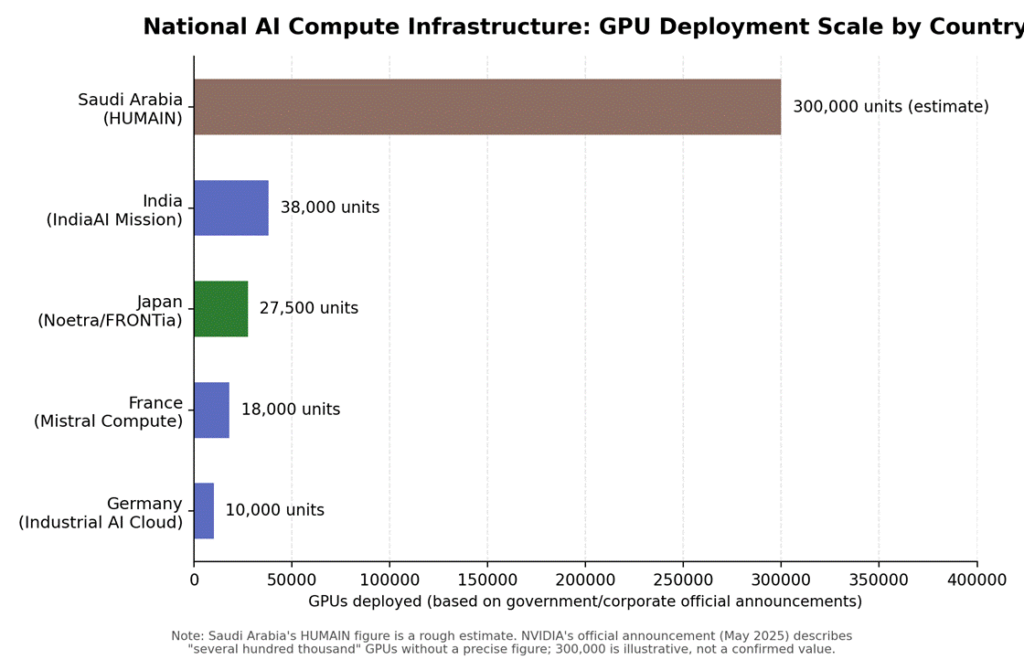
Figure 2: Japan’s ~27,500 GPUs sit between India’s 38,000+ and France’s 18,000, but are an order of magnitude below Saudi Arabia’s estimated “several hundred thousand.”
↑ Back to the Table of Contents
2. Noetra and the FRONTia Project
On June 30, 2026, Japan’s Ministry of Economy, Trade and Industry (METI) and NEDO announced that Noetra Inc. and the National Institute of Advanced Industrial Science and Technology (AIST) had been selected, following a public call for proposals, to lead a “Multimodal Foundation Model Development Project for AI Robots and Physical AI,” running through FY2030.
[Confirmed Fact] NVIDIA’s official announcement, and a statement attributed to METI Minister Ryosei Akazawa, refer to this undertaking by name as the “FRONTia Project,” describing it as “the core of the country’s physical AI ecosystem.” METI’s own press release does not state a specific funding figure; the widely reported ¥387.3 billion (initial year) / ¥1 trillion (five-year) figures come from multiple independent news reports, including Reuters, rather than from the ministry’s own published text or the minister’s recorded press-conference remarks — which explicitly deferred financial details to a separate technical briefing.
On July 16, 2026, Noetra — backed by SoftBank, Sony Group, NEC, and Honda as core investors among 44 companies — announced jointly with NVIDIA the construction of an NVIDIA DGX-based “Vera Rubin AI Factory”: 13,750+ Vera CPUs and 27,500+ Rubin GPUs, a 140MW data center, construction beginning April 2027 and going live June 2028. Trained model weights are to be released progressively to domestic developers, alongside NVIDIA’s Nemotron, Cosmos, and Isaac GR00T software stacks.
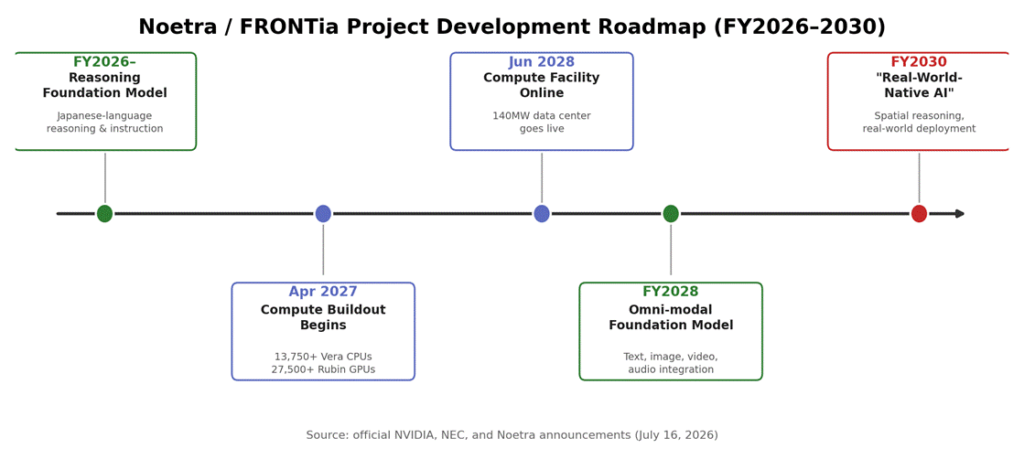
Figure 1: Model development (green) and infrastructure buildout (blue) proceed in parallel, converging on the 2030 “Real-World-Native AI” target (red).
METI’s own announcement frames the project’s rationale explicitly around Japan’s manufacturing-sector data as a comparative advantage — “one of Japan’s winning strategies” — rather than competing head-on in general-purpose frontier models.
↑ Back to the Table of Contents
3. A Four-Layer Framework for AI Sovereignty
[Methodological Note] This framework was not deduced from international comparison. The analytical process ran the other way: close analysis of Noetra (Sections 5–8) revealed that physical AI security, model-weight release risk, semiconductor supply chains, and power/institutional design were four distinct manifestations of the same underlying question — sovereignty. Rather than presenting this single-case insight as a general theory, this paper tests it against international comparisons (Section 1) and against China and Russia as candidate “full-stack” authoritarian cases (Section 9). This is inductive, case-study-based theory-building, followed by comparative testing — and this paper states that method openly rather than disguising it as deductive derivation.
On this basis, the paper proposes evaluating AI sovereignty along four axes rather than as a binary “domestic or not”:
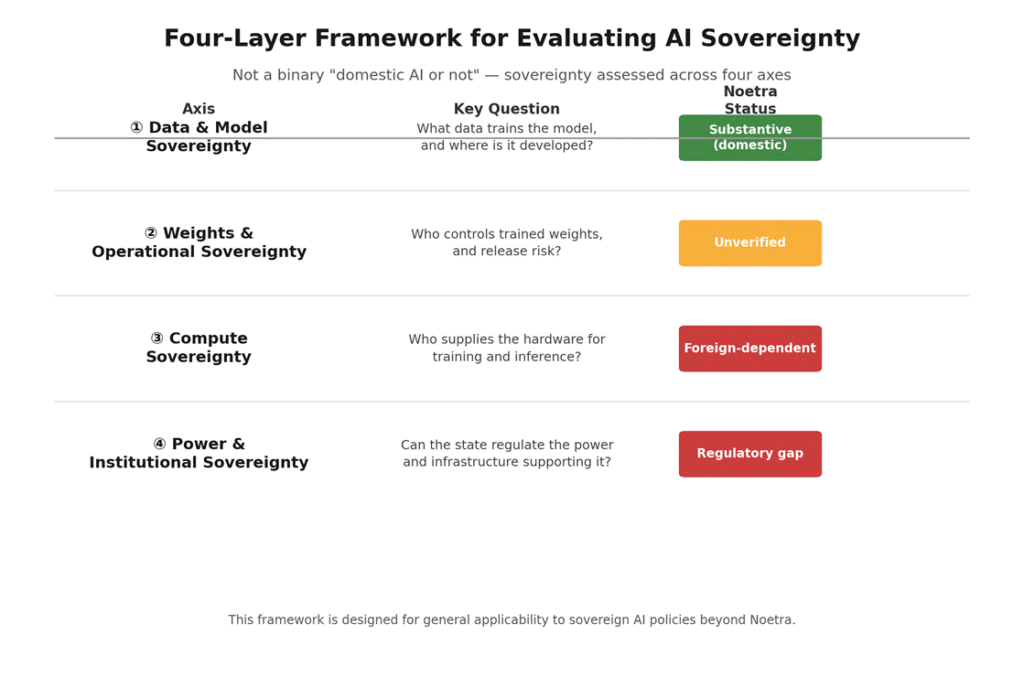
Figure 5: The Four-Layer AI Sovereignty Framework. Noetra’s substance varies sharply by layer.
↑ Back to the Table of Contents
4. Physical Security: A New Threat Surface
[Scope Note] Noetra’s system architecture, PLC integration method, digital-twin usage, and OT network design are not disclosed in public information. This section therefore does not characterize Noetra’s specific design; it surveys attack surfaces generally known to affect physical-AI systems of the kind Noetra has announced (built on NVIDIA Cosmos and Isaac GR00T), drawing on ICS/OT security literature.
Generative-AI security discourse has centered on data leakage, prompt injection, and misinformation — information-space harms. Physical AI, where an AI autonomously controls robots and machinery, changes the nature of the incident. A compromised physical-AI control model can cause physical harm — equipment damage, workplace injury — not merely data loss. This is a long-standing OT/ICS security concern, but a general-purpose multimodal model at the center of robotic control multiplies the attacker’s potential “single point of failure.”
Physical AI is also harder to verify than language models: real-time, high-dimensional physical environments make anomaly detection and audit substantially more difficult than for text-based systems.
Where such models are deployed via simulation-trained (“digital twin”) transfer to real hardware through PLCs and industrial robot controllers, the sim-to-real transfer point is a documented target for adversarial manipulation, False Data Injection against sensor values, and attacks on the communication path between the digital twin and PLC. Deploying physical-AI foundation models on factory OT networks requires OT/ICS-specific defenses (network segmentation, anomaly detection, input validation at the sim-to-real boundary) in addition to standard IT security controls.
[Inference] The risks outlined here are not claims about Noetra’s specific implementation. Where design details are not publicly available, this paper avoids speculation and instead surveys risks generally known to apply to this class of physical-AI system. Re-assessment against Noetra’s actual implementation should follow future disclosures.
Saudi Arabia’s HUMAIN is also pursuing NVIDIA Omniverse-based physical-AI simulation infrastructure, so physical AI is not uniquely Japanese. However, Noetra’s explicit 2030 target of “Real-World-Native AI,” centered on autonomous robotics deployment, goes further than other national programs reviewed here — into territory with fewer precedents for security practice.
↑ Back to the Table of Contents
5. Model Weight Release and Data-Leakage Risk
Per NVIDIA’s official announcement, Noetra’s pretrained multimodal weights are to be broadly released to domestic developers and companies. Open-weight strategies have real value for transparency and technology diffusion, but releasing weights trained on sensitive manufacturing-sector data carries documented risks:
● Model inversion / data reconstruction: reconstructing sensitive training data from model outputs or gradients. The US National Institute of Standards and Technology’s 2025 taxonomy of adversarial machine learning (NIST AI 100-2e2025) categorizes this as a privacy attack.
● Membership inference: inferring whether specific data was used in training, which the same NIST taxonomy notes can be combined with inversion attacks to reconstruct and confirm specific training records.
● Weight tampering / backdoors: malicious modification of released weight files to trigger anomalous outputs on specific inputs. MITRE ATLAS, a maintained knowledge base of adversarial tactics against AI systems, documents AI supply-chain compromise — including tampering with training data and distribution channels — with real-world cases, and recommends provenance verification and cryptographic signing as mitigations.
[Inference] These are general risk categories documented in the security literature, not claims about Noetra’s specific system. Whether Noetra’s weight-release process incorporates differential privacy, pre-release inversion-resistance testing, or signature verification is not disclosed in public information and should be reassessed as more details emerge.
↑ Back to the Table of Contents
6. Semiconductor Supply Chains: A Structural Vulnerability
As NVIDIA, NEC, and Noetra’s own announcements confirm, every Vera CPU and Rubin GPU in Noetra’s compute infrastructure is US-made. Behind the “domestic AI” label, the compute layer depends entirely on a single foreign company’s supply chain.
This is not unique to Japan: Saudi Arabia’s “several hundred thousand” GPU commitment and India’s tens of thousands of units are equally NVIDIA-dependent. In practical terms, the 2026 “sovereign AI” race is largely a competition for allocation of NVIDIA’s production capacity.
This raises an economic-security concern. The US has previously used advanced-semiconductor export controls as a geopolitical lever (against China). There is no current sign of similar restrictions targeting Japan or its allies, but a structure in which training and inference capability depends entirely on one country’s hardware supply carries a latent vulnerability that would surface only under geopolitical stress.
[Inference] Noetra’s “domestic AI” label appears accurate at the level of model architecture, training data, and operating entity, but does not extend to the hardware layer, where sovereignty in the fullest sense is absent.
↑ Back to the Table of Contents
7. Data Center Power: Comparing Critical-Infrastructure Law Across Japan, the EU, and the US
Noetra’s compute facility requires 140MW of power. METI’s own announcement acknowledges the stakes explicitly: “given the explosive growth in AI use, Japan — with its low energy self-sufficiency — faces a more pressing need than other countries to improve the energy efficiency of AI use.”
Japan’s Economic Security Promotion Act designates 16 sectors (electricity, gas, oil, water, rail, trucking, ocean shipping, port services, aviation, airports, telecoms, broadcasting, postal services, healthcare (added), finance, and credit cards) as critical infrastructure subject to security review.
[Confirmed Fact] None of these 16 sectors explicitly names data centers or AI compute facilities as an independent category. Whether Noetra’s own data-center facility falls under this security-review regime is legally unclear.
How Japan Compares to the EU and US
The EU’s NIS2 Directive explicitly includes data centers within its “Digital Infrastructure” essential-entity sector, per ENISA’s official guidance. The US critical-infrastructure framework, administered by CISA under Presidential Policy Directive 21, designates an “Information Technology Sector” among its 16 sectors, which is understood to include large-scale data center operators.
[Confirmed Fact] Both the EU (NIS2) and the US (CISA) explicitly designate “digital infrastructure/information technology,” naming data centers within that category. Japan’s Economic Security Promotion Act has no equivalent independent category.
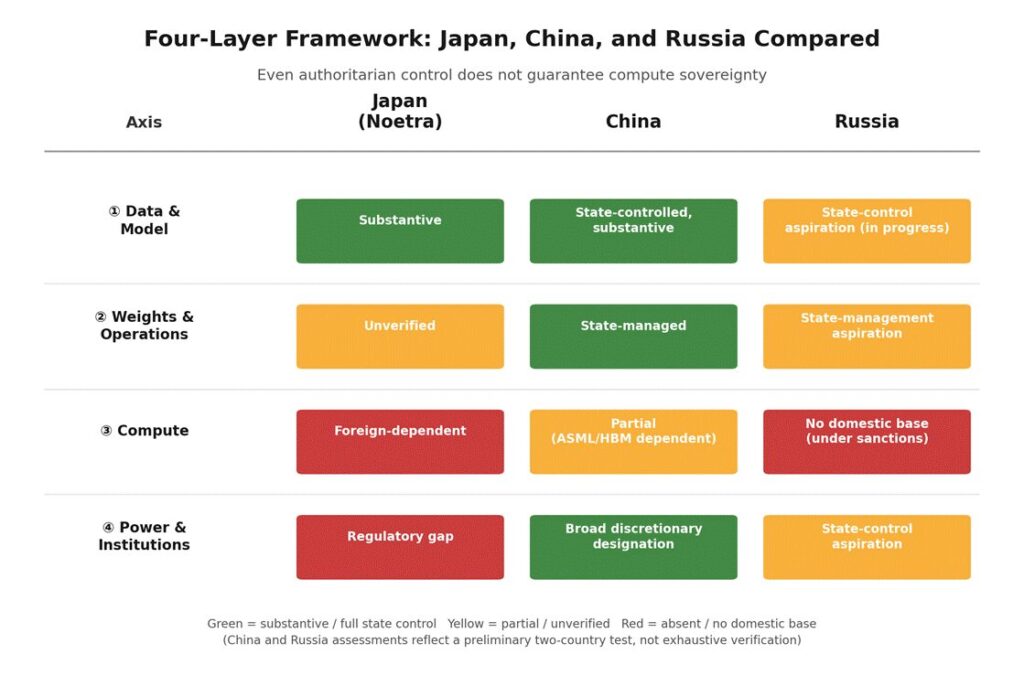
Figure 6: Comparing Japan, China, and Russia on the four-layer framework: authoritarian control alone does not guarantee compute sovereignty.
The Regulatory Gap Persists: Outcome of the 2026 Diet Session
This gap is not static. Japan’s Expert Panel on Economic Security Legislation flagged medical care for inclusion as critical infrastructure in November 2025 (subsequently adopted), and a December 2025 working-group paper explicitly discussed “measures concerning providers of data centers and cloud services handling large volumes of data” as a live policy question. A January 2026 policy outline recommended measures to protect data held in data centers and the cloud.
[Confirmed Fact] However, close reading shows Japan’s discussion leans toward a data-protection approach (preventing leakage of information processed in data centers/cloud) rather than the EU/US infrastructure-designation approach (designating data center operators themselves as a critical-infrastructure category). Whether Japan will add data centers as a 17th named sector, or instead build a separate data-security regime, remained undecided as of the January 2026 policy outline.
The Japanese government submitted an amendment bill (Cabinet Bill No. 30) to the 221st Diet session (February 18 – July 17, 2026) reflecting the panel’s recommendations.
[Confirmed Fact] Per an official research report from the House of Councillors’ research bureau (April 2026), the data-security provisions were not included in the bill and were explicitly designated a “future issue.” The same report records LDP policy chief Takayuki Kobayashi acknowledging in the Diet: “We do not have national visibility into the location or operators of data centers.” The bill (covering, among other things, the addition of the medical sector) passed with a supplementary resolution on June 9, 2026, and the session closed on July 17, 2026 — with the data-center/cloud security question left unresolved.
In short: this regulatory gap is not an oversight that this paper is the first to notice — it is a live, actively debated policy question that the government itself has acknowledged and, as of this writing, deferred.
↑ Back to the Table of Contents
8. Can Any Country Satisfy All Four Layers? China and Russia as Reference Points
Every country compared in Section 1 lacks compute sovereignty. This raises the natural question: does any country satisfy all four layers?
China is the most plausible candidate. China’s Cybersecurity Law (2017, amended October 2025) establishes a broad, discretionary “Critical Information Infrastructure” (CII) designation that can apply to data centers, cloud services, and AI systems, based on a functional national-security standard rather than a fixed list of named sectors — unlike Japan, the EU, or the US. Designated operators face data-localization, in-house security-management, and annual assessment requirements.
On compute sovereignty, China is also advancing rapidly: Huawei- and SMIC-led domestic AI chip production targets millions of Ascend-series units in 2026, aiming for 70–80% self-sufficiency by 2028. However, SMIC’s leading-edge processes still depend on Dutch ASML DUV lithography equipment (domestic EUV capability is not expected until roughly 2028–2030), and domestic high-bandwidth memory (HBM) production has not fully displaced dependence on South Korean suppliers.
[Inference] Taken together, China appears closest among the countries examined to satisfying power/institutional sovereignty (broad, discretionary state authority over AI infrastructure designation) and data/model sovereignty (state data governance), but not compute sovereignty, which remains incomplete. No country examined in this paper fully satisfies all four layers.
Russia sharpens this point by contrast. Russia, too, pursues a state-led “sovereign AI” agenda through Sber and Yandex, including reported preparation of legislation restricting AI training data to domestically generated sources — an authoritarian orientation similar in kind to China’s. However, since 2022 sanctions, Russia lacks anything comparable to SMIC or Huawei’s domestic semiconductor manufacturing base, and increasingly depends on stockpiled Western GPUs and Chinese-made chips — reportedly queued behind priority customers such as ByteDance and Alibaba.
[Inference] Russia’s case suggests that “authoritarian regime” alone does not explain proximity to compute sovereignty. What appears necessary is the combination of authoritarian control and an independent semiconductor industrial base (however incomplete) — something China possesses in degraded form and Russia largely does not.
[Methodological Limitation] The test of “which countries can satisfy all four layers” carries a structural bias: three of the four axes involve some form of state capacity to control or regulate, a criterion that authoritarian systems satisfy more easily by design. The framing of the question therefore tends toward authoritarian states (China, Russia) almost by construction. This paper examined only these two countries and has not systematically verified whether any democratic country satisfies some or all of the four layers through alternative means. The finding that authoritarian systems appear structurally advantaged under this framework is itself the finding — flagged here as a direction for future work. Broader, more exhaustive testing across additional cases is left to future research.
↑ Back to the Table of Contents
9. Conclusion: How Substantive Is Japan’s AI Sovereignty?
International comparison based on primary sources reveals the following:
● Scale: Noetra’s public support falls well short of Saudi Arabia, France, and Germany, but is comparable to or exceeds India, the UK, and Canada.
● Strategic focus: Japan has deliberately stepped back from the general-purpose frontier-model race, concentrating resources on manufacturing-sector data — a genuine point of differentiation that METI itself frames as “one of Japan’s winning strategies.”
● Security: Physical-AI-specific risks and academically documented weight-release risks lack a clearly disclosed response strategy in current public information.
● Supply chain: Nearly every sovereign-AI program examined — Japan included — depends on a single company’s (NVIDIA’s) production capacity, meaning “sovereignty” in practice applies mainly to the model layer, not hardware.
● Institutions: The gap in critical-infrastructure coverage persists even after the 2026 Diet session, despite the government itself acknowledging — through its own policy chief — that it lacks visibility into data-center locations and operators. This gap does not appear in the equivalent EU or US frameworks.
Policy Recommendations
● 1. Physical-AI safety standards: Establish cross-industry safety-verification and red-teaming frameworks, incorporating OT/ICS domains, for autonomous robot-control AI.
● 2. Model weight release guidelines: Develop technical guidelines — covering inversion-resistance testing and signature verification — before releasing models trained on sensitive data.
● 3. Critical-infrastructure clarification: Resolve, without waiting for the next legislative cycle, whether data centers/AI compute facilities will be addressed through infrastructure designation or a data-protection regime.
● 4. Supply-chain diversification: Treat diversification away from single-vendor compute dependence, and development of domestic alternatives, as a medium- to long-term policy priority.
Indicators to Watch
NEDO has stated it will conduct annual “stage-gate” reviews of the FRONTia Project beginning FY2027 to determine continuation. This paper suggests four concrete indicators to track through that process: (1) how much safety-verification and red-teaming detail is disclosed; (2) the actual scope, timing, and technical safeguards accompanying weight release; (3) how Japan’s next legislative cycle resolves the infrastructure-designation-versus-data-protection question; and (4) progress on supplier diversification beyond NVIDIA.
Limitations
This paper is based on publicly available primary sources — government and corporate announcements, academic literature, and Diet records. It has no access to Noetra’s, NVIDIA’s, or NEC’s internal design documents or undisclosed security specifications. The security risks discussed in Sections 4–5 are therefore general risk categories inferred from public information, not verified claims about Noetra’s actual system, and should be reassessed as more information becomes available.
As discussed in Section 9, the four-layer framework’s test against “which countries satisfy all four layers” has a built-in bias toward authoritarian states, and this paper examined only China and Russia. Broader verification against additional cases — and against a wider set of democratic alternatives — is left as a direction for future work.
↑ Back to the Table of Contents
References
Noetra / FRONTia Project (primary sources)
[1] METI, “Launch of the ‘Multimodal Foundation Model Development Project for AI Robots and Physical AI'” (June 30, 2026)
https://www.meti.go.jp/press/2026/06/20260630005/20260630005.html
[2] NVIDIA official blog (Japanese), “Japan Government, Industrial Leaders, and NVIDIA Launch the World’s First National AI Infrastructure” (July 16, 2026), including the “FRONTia Project” naming
[3] NEC press release, “Full-Scale Launch of Domestic Multimodal Foundation Model Development” (July 16, 2026)
https://jpn.nec.com/press/202607/20260716_01.html
[4] Noetra Inc. official press release (July 16, 2026)
https://www.noetra.co.jp/pressrelease20260716
International comparison
[5] French government official site, on the AI Action Summit and the €109bn investment announcement
https://www.info.gouv.fr/actualite/paris-accueille-le-sommet-pour-laction-sur-lia
[6] NVIDIA Newsroom, “Europe Builds AI Infrastructure With NVIDIA” (June 11, 2025), Mistral Compute GPU figures
https://nvidianews.nvidia.com/news/europe-ai-infrastructure
[7] Deutsche Telekom official press release, “AI sovereignty for Germany and Europe”
[8] NVIDIA Newsroom, “HUMAIN and NVIDIA Announce Strategic Partnership” (May 13, 2025)
[9] Government of India, Press Information Bureau, IndiaAI Mission budget
https://www.pib.gov.in/PressReleasePage.aspx?PRID=2178092®=3&lang=2
Model security literature
[10] NIST, “Adversarial Machine Learning: A Taxonomy and Terminology of Attacks and Mitigations,” NIST AI 100-2e2025 (March 2025)
https://nvlpubs.nist.gov/nistpubs/ai/NIST.AI.100-2e2025.pdf
[11] MITRE ATLAS (Adversarial Threat Landscape for Artificial-Intelligence Systems)
Critical infrastructure comparison
[12] ENISA, “Cybersecurity of Critical Sectors” (official guidance on NIS2)
https://www.enisa.europa.eu/topics/cybersecurity-of-critical-sectors
[13] CISA, “Critical Infrastructure Sectors”
[14] House of Councillors Research Bureau, “Legislative Amendments Toward Further Economic Security,” Legislation and Research, April 2026, No. 483
https://www.sangiin.go.jp/japanese/annai/chousa/rippou_chousa/backnumber/2026pdf/20260430003.pdf
China and Russia
[15] Regulations.ai, “Cybersecurity Law of the People’s Republic of China”
https://regulations.ai/regulations/RAI-CN-NA-CPRCXXX-2016
[16] TechWireAsia, “China’s chip self-sufficiency push is real this time” (May 2026)
[17] GINC, “Russia’s National AI Strategy” (January 2026)
https://www.ginc.org/russias-national-ai-strategy
[18] Tom’s Hardware, “Russia’s Sberbank wants Chinese chips for its GigaChat AI” (May 2026)
↑ Back to the Table of Contents
Glossary
Physical AI
AI systems that connect to and act upon the physical world — robots, vehicles, factory equipment — involving autonomous decision-making and action, distinct from conversational generative AI.
Sovereign AI
The principle that a nation should control the model weights, compute infrastructure, data pipelines, and talent underpinning its AI capability, motivated by supply-chain-risk and data-sovereignty concerns.
FRONTia Project
The official name, per NVIDIA and Japan’s METI Minister, for the government-led “Multimodal Foundation Model Development Project for AI Robots and Physical AI,” of which Noetra’s compute infrastructure forms the core.
Critical Information Infrastructure (CII)
China’s Cybersecurity Law framework, which can designate data centers, cloud services, and AI systems as critical infrastructure based on a functional national-security standard, in contrast to Japan/EU/US models that name fixed sectors.
Four-Layer AI Sovereignty Framework
An analytical framework proposed in this paper, evaluating AI sovereignty across data/model, weights/operations, compute, and power/institutions, derived from a single case study (Noetra) and tested against international comparison and against China/Russia.
This paper is based on analysis of publicly available information. Citations use only real, verifiable URLs referenced in the text and reference list. Facts not confirmed in primary sources are explicitly flagged as such, alongside independent secondary-source consensus where relevant. Facts and inference are explicitly distinguished throughout.
↑ Back to the Table of Contents
Author: Miho Funayama
Miho Funayama is a strategic analyst specializing in international standardization, technology intelligence, intellectual property analysis, and geopolitical and crisis risk management. She holds a degree in International Politics from Sophia University and completed graduate studies in International Political Economy, Philosophy, and Psychology at Aoyama Gakuin University. She previously led patent research and strategic analysis on international standards and emerging technologies at Canon Inc., where she served as Deputy International Secretary of ISO/IEC JTC 1/SC 28 and received the ITSCJ Award for Contribution to International Standardization three times. She is currently a Director and Chief Researcher at the Japan Institute for Crisis Management, a Fellow at the Institute of Middle East–Asia Information Strategy, and a Professional Associate Member of the Foreign Correspondents’ Club of Japan.
Her research focuses on the intersection of cybersecurity, geopolitical risk, and information warfare, examining decision-making structures and psychological operations through an interdisciplinary lens spanning international politics, philosophy, and psychology.
↑ Back to the Table of Contents