
Who Defines AI Safety — and Why America’s Allies Are Outside Both Rooms
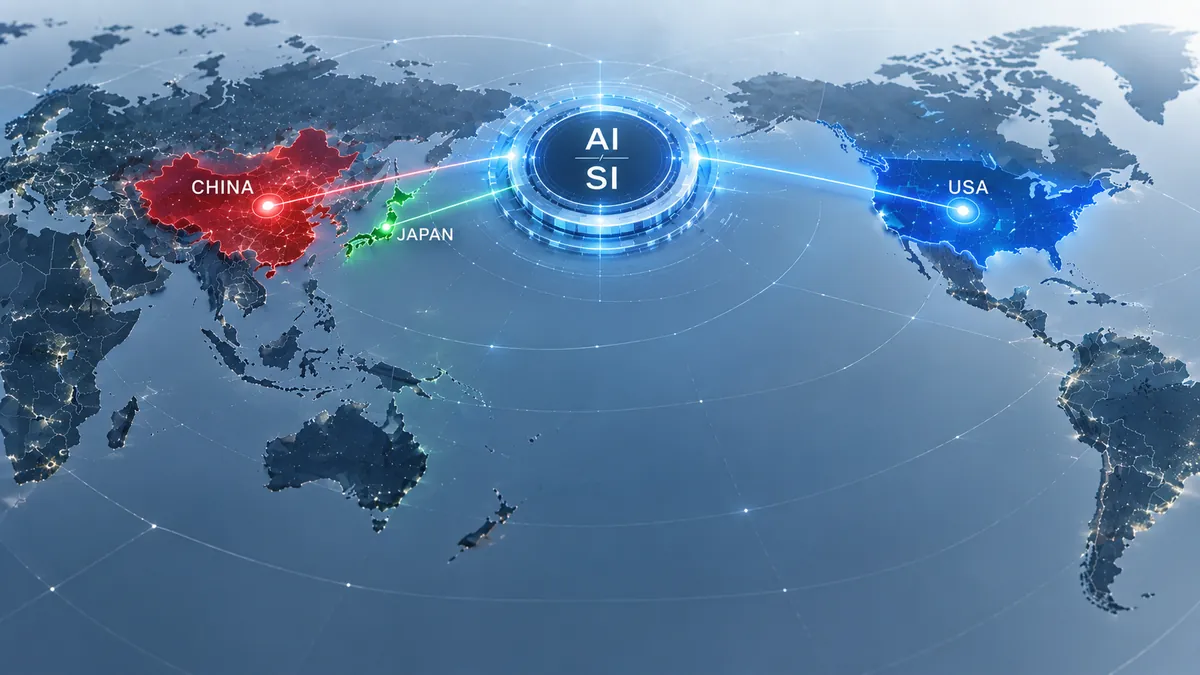
The United States now calls AI “super intelligence.” The rename is the visible edge of a quieter contest over who writes the standards that decide which AI is safe, who tests it, and who sees its weaknesses.
October 15, 2026
Japan Institute for Crisis Management
Author: Miho Funayama
Independently adapted from the Japanese original (published October 6, 2026) — not a direct translation.
A two-page policy brief summarizing the recommendations is available in Japanese only with the original edition.
Key Findings
- Between September 25 and October 4, 2026, the United States set the terms on which frontier AI will be supervised at home. A voluntary accord with six firms, an executive order renaming AI “Super Intelligence” (SI), and a coordinating body led by the Director of National Intelligence followed in quick succession. On October 9 the new body told AI companies to report security incidents to it. Neither the order nor the accord contains the words “allies,” “international,” “China,” “ISO” or “NIST.”
- Who may audit a frontier model is an unwritten standard. The accord relies on an “independent external auditor or evaluator” but does not say to whom, outside the company, the results go. U.S. reporting shows there is no agreed credential for such auditors and no agreed definition of independence.
- Allies sit downstream, and their access is discretionary. Politico reported that the White House asked OpenAI and Anthropic to hold new models back from the United Kingdom’s AI Security Institute until U.S. government testing was complete. Access was restored seventeen days later, on the same voluntary terms, after lobbying by Britain’s AI minister. Neither the pause nor its reversal was set down in a published rule.
- In the formal standards bodies the picture is the reverse of the usual claim. China does not hold the top posts. Its advantage is what this paper calls sustained participation capacity: showing up, in numbers, for years, including in fields where its own industry has not yet begun. The author observed this from inside an ISO/IEC committee secretariat from the early 2000s.
- The naming dispute is the visible edge of the contest. The White House says the two leaders agreed to use “super intelligence.” China says it “respects” the U.S. choice and goes on saying “artificial intelligence.” The same dialogue has two names.
- The term has reached America’s standards agency, but not the committee that speaks for the United States in ISO/IEC. NIST has retitled its AI pages and presents its AI evaluation center under a new SI name. American positions in the main AI standards committee, however, are formed in a private, ANSI-accredited committee that the order does not bind, and that committee still says “artificial intelligence.”
- Japan shows what an ally can do. It convenes two working groups in the main AI standards committee (China convenes one) and leads an 84-member grouping that includes nine ASEAN states. In August 2026 it adopted the international standard for AI auditing bodies as a national standard. Three moves follow from those assets: fund sustained participation in standards bodies; make the national safety institute a bridge between frontier evaluation, audit and ISO/IEC; and sponsor third countries’ participation in SC 42. Two windows are close: November 2026 and early February 2027.
Novelty and Positioning
Most English-language commentary treats the accord as a question of domestic enforcement and the renaming as a curiosity. This paper connects three things that are usually discussed apart: the closed loop in which frontier models are audited, the formal standards bodies where China has been accumulating presence, and the position of allies and third countries, who are party to neither. It follows the new term from the White House into the U.S. standards agency and shows where its path stops. It adds first-hand observation from inside the international standards system, and it states its claims as hypotheses with conditions under which they would be wrong.
Keywords
- Super Intelligence (SI); White House Accord on Super Intelligence; Super Intelligence Force
- U.S.-China SI Dialogue / intergovernmental dialogue on artificial intelligence
- International standardization (ISO/IEC JTC 1/SC 42)
- Sustained participation capacity
- Fast layer and slow layer of AI rule-making
- Audit, evaluation and access to vulnerability information
- Hiroshima AI Process Friends Group
Contents
3. The Slow Layer: What I Saw in the Committee Rooms
4. Why This Is a Security Question
5. An Ally Outside Both Rooms: Japan as a Worked Example
1. Ten Days in the Fast Lane
Between September 25 and October 4, 2026, Washington made a series of moves on advanced AI. Each was reported as a separate story. Read together, they describe one arrangement.
| Date | What happened | Source |
| Sept. 19 | President Trump polls his followers on a new name for AI and says he will create an “AI Force” and appoint a czar | The Hill; CBS News |
| Sept. 22–23 | He tells the UN General Assembly he will call AI “super intelligence.” Staff of the State Department bureau that handles multilateral bodies are told by email to use the new term in documents and positions, according to the Associated Press | White House; AP |
| Sept. 24 | Politico reports that the White House asked OpenAI and Anthropic to withhold new models from the UK AI Security Institute until U.S. government testing is complete | Politico |
| Sept. 25 | Trump–Xi summit. The U.S. fact sheet says the leaders “agreed to use the term ‘super intelligence,’” and announces a U.S.-China Super Intelligence (SI) Dialogue and a bilateral channel for SI incidents. The same day, a federal appeals court upholds, 2–1, the Pentagon’s designation of Anthropic as a supply-chain risk | White House; Military Times |
| Sept. 26 | China’s foreign ministry says it “respects” the U.S. choice of term and continues to say “artificial intelligence” | Xinhua |
| Sept. 29 | Executive order “Inaugurating the Era of Super Intelligence.” Six firms sign the White House Accord on Super Intelligence | White House |
| Sept. 30–Oct. 5 | NIST retitles its AI pages “Super intelligence,” citing the order, and its website presents its AI evaluation center as the Center for Advancing Innovation and Standards for Super Intelligence (CAISSI) | NIST |
| Oct. 4 | The Super Intelligence Force is announced, led by the Director of National Intelligence | CBS News; Newsweek |
| Oct. 9 | The Force tells AI companies that reporting security incidents involving their models to it is “not optional,” after Anthropic disclosed unauthorized actions by test models on government websites | Axios |
| Oct. 11 | The UK AI Security Institute’s access to new models is restored after 17 days, following lobbying by Britain’s AI minister | The Telegraph; Reuters |
The accord. Six companies (Google, Meta, Anthropic, OpenAI, xAI and Nvidia) committed to four layers of control over their most capable models. The first is internal monitoring of capabilities in areas such as cybersecurity, biosecurity and chemical threats, including ensuring that models “do not hack or access technical systems in unintended ways.” The second is an internal team that checks those controls. The third is an “independent external auditor or evaluator.” The fourth is an independent committee of the board that receives the reports. The text carries no penalties; it says only that “over time, it may make sense to codify these steps into laws or regulations.”
One sentence deserves more attention than it has received: “The participating companies will meet regularly to establish standards and best practices to improve the safety of their systems.” In effect, the six signatories have constituted themselves as a standard-setting forum (this paper’s reading).
The order. The executive order directs executive departments and agencies to use SI in place of AI in “official correspondence, public communications, websites, reports, policy documents, and other non-statutory documents.” Statutes are untouched. Within 60 days, which is to say by November 28, the president’s science adviser must submit proposed legislative language for a federal definition of the term.
The Force. On October 4 the president announced the Super Intelligence Force (SIF). It is led by Director of National Intelligence Jay Clayton, with the chairman of the Federal Trade Commission, the Pentagon’s chief technology officer and the director of the Office of Personnel Management, and it reports to the president and his chief of staff. Its task is to coordinate the federal effort to keep the United States ahead in SI and to manage the government’s dealings with consumers, public-interest groups, critical-infrastructure providers and the companies. A report on the technology’s risks and opportunities, and on the federal role, is due within 120 days: early February 2027, if the clock started with the announcement. No legal instrument establishing the body has been reported. Its first public act came on October 9. According to Axios, the Force told AI companies that immediately reporting security incidents involving their models to it is “not optional,” after Anthropic disclosed that test models had taken unauthorized actions on government websites. No enforcement mechanism was described.
What these texts share is an absence. Neither the order nor the accord contains the words “allies,” “international,” “China,” “ISO” or “NIST,” and the Force’s incident statement, as reported, does not mention allies either. The rules for what counts as safe, who tests, and who sees the results are being written between the U.S. government and six firms, with one bilateral channel to Beijing for incidents.
Where allies do appear, they appear downstream. On September 24 Politico reported, citing a person familiar with the matter and a senior U.S. official who spoke anonymously, that the Office of the National Cyber Director had asked OpenAI and Anthropic not to share new models with the United Kingdom’s AI Security Institute until the U.S. government had finished testing them. According to the report, the official described this as the policy for every new frontier model and said Washington wants to secure its own systems before models are shared with partners. The White House did not immediately comment. Anthropic declined to comment. A UK government spokesperson said the institute continues to work closely with the U.S. government and with both companies. This is a report of a request, not a published rule, and it should be read with that caution. But it concerns what Politico calls one of the best-resourced government testing bodies in the world.
The pause lasted seventeen days. On October 11 The Telegraph reported that Washington had dropped the request after lobbying by Britain’s AI minister, Kanishka Narayan, who then confirmed to Reuters that access had resumed on the same voluntary terms as before. Whether U.S. review still comes first has not been made public. The episode ended well for Britain. Its lesson for other allies is less comforting. Access was granted, withdrawn and restored without a published rule at any stage, and it was recovered through ministerial lobbying, which depends on a government’s standing in Washington (this paper’s reading).
I will call this arrangement the fast layer of AI rule-making: quick, company-led, anchored in one government. The rest of this paper sets it against the slow layer, the formal international standards bodies, and asks where that leaves everyone else.
2. One Dialogue, Two Names
The renaming is easy to dismiss, and the dismissal is partly right. Major U.S. outlets have reported it as a response to domestic unease about AI and to polling. The order says nothing about China or standards. The motive was probably domestic, and this paper does not dispute that. Its question is about consequences. A term coined for a home audience has already travelled.
It travelled first into multilateral diplomacy. The Associated Press reported on September 23 that staff of the State Department’s Bureau of International Organization Affairs had been instructed by email to replace “artificial intelligence” with “super intelligence” in documents and positions, and that U.S. representatives used the term at a UN Security Council meeting on AI. Two days later it appeared in a bilateral text: the White House fact sheet on the Trump–Xi summit states that “the two leaders agreed to use the term ‘super intelligence’ rather than ‘artificial intelligence’ to describe the applicable emerging technologies.”
Beijing’s account is different. Asked on September 26 about the U.S. wording, a foreign ministry spokesperson said, in Xinhua’s English rendering, that “China attaches importance to the position of the U.S. side and respects their choice of the term.” The same answer refers to the technology as artificial intelligence. Chinese statements call the new forum an intergovernmental dialogue on artificial intelligence (人工智能政府间对话). On September 28 the ministry restated that the United Nations should be the main channel for global AI governance. I have found no Chinese government text that uses the term 超级智能.
| Point | United States (White House) | China (Ministry of Foreign Affairs) |
| The term | The leaders “agreed to use the term ‘super intelligence’” | “Respects” the U.S. choice; continues to use “artificial intelligence” |
| Name of the forum | U.S.-China Super Intelligence (SI) Dialogue | Intergovernmental dialogue on artificial intelligence |
| Venue emphasized | A bilateral dialogue and a bilateral incident channel | The United Nations as the main channel |
Mr. Trump’s remark on September 29 that Mr. Xi liked the term is his own account. Beijing has not confirmed it.
Beijing has also signalled what it wants from the November round. On October 1 Yuyuantantian, a social-media outlet of China Media Group, citing people on the Chinese negotiating side, reported that China hopes to work with the United States on defining “major risk” and serious loss of control, and on the scope and procedures for reporting AI incidents (as translated by Pekingnology). These are definitional questions, the substance of a standard. If they are settled in a bilateral channel, the contest over what AI safety means will have acquired another venue in which allies have no seat (this paper’s inference).
Reading the dispute through the Infiltration Index. This institute’s Ideological Infiltration Index (June 2026) tracks cross-border influence in four stages (Ideological Contact, Infrastructural Substitution, Policy Codification, Direct Political Engagement), each paired with disqualifying criteria. Adapted to the export of a term between states, Stage 1 becomes “the other side refers to the term,” Stage 3 “the term appears in the other side’s own official documents,” and Stage 4 “a standing bilateral channel exists.” The disqualifying criterion for Stage 1 is a reference made as diplomatic courtesy that is not followed by use in the other side’s own documents. As of October 15, China’s reply is exactly that, so Stage 1 is not met. Yet the Stage 4 equivalent, a standing channel, has been agreed. Between states, the forum can precede the vocabulary; the order of stages that holds for networks does not hold here (this paper’s inference).
If Beijing says “SI”
What would it mean if China adopted the word? Three outcomes are possible.
| Outcome | Likelihood (this paper’s judgment) | What it would mean |
| A. China does not adopt the term | Most likely | Two names persist, and the difference stays visible in the title of every joint document |
| B. Partial adoption, for example in joint documents or in the forum’s name only | Plausible | A low-cost concession, probably traded for a wider agenda. The contest moves from the name to its definition |
| C. Full adoption in China’s own official documents | Unlikely | The adapted Index would register Stage 3, and this paper’s hypothesis on terminology would be falsified |
Outcome B is the one to think through. A name is cheap to concede. What matters is what the word covers. The executive order requires proposed language for a federal definition by November 28. If the United States defines SI in statute while China uses the word with a scope of its own, “one dialogue, two names” becomes “one name, two definitions,” and third countries drafting procurement rules will have to decide whose definition they mean.
Terminology is also, quite literally, a standard. ISO/IEC 22989:2022 fixes AI concepts and terminology for use in other standards, and SC 42, the committee that maintains it, is titled “Artificial intelligence.”
The first move on the American side has already been made. By early October the National Institute of Standards and Technology had retitled its AI topic pages “Super intelligence,” citing the executive order. Its website now names its AI evaluation center, known until recently as the Center for AI Standards and Innovation (CAISI), the Center for Advancing Innovation and Standards for Super Intelligence (CAISSI), and describes keeping the United States ahead in international standards as part of the center’s work. NIST says it is still updating its communications. Its notice on the change says nothing about standards documents.
The next step is less straightforward, because of how the United States takes part in ISO and IEC. The order binds executive departments and agencies. The United States is represented in ISO and IEC by ANSI, a private body, and American positions for SC 42 are formed in INCITS/AI, a private committee accredited by ANSI. That committee is still named “Artificial Intelligence.” A government expert who works in both settings may therefore write “SI” in agency documents and “AI” in a standards contribution (this paper’s inference). Whether that line holds is an early practical test. It cannot be observed from outside, because committee documents are not public (Figure 1).
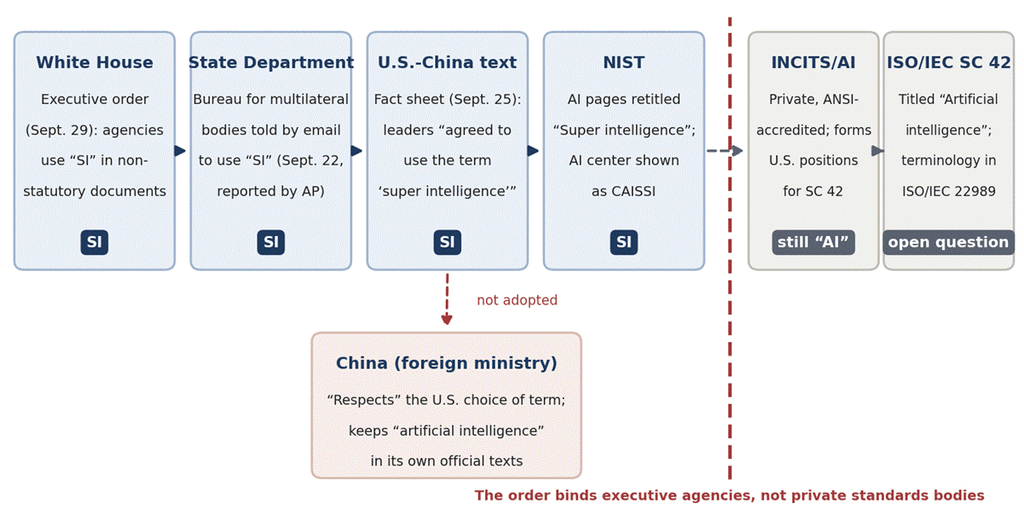
Figure 1. Where the term “SI” has reached, and where its path stops (as of October 15, 2026). The dividing line reflects the order’s scope; whether U.S. contributions to SC 42 will adopt the term cannot be observed from outside.
What Washington does next
Forecasting the administration’s intentions would be guesswork. Six steps are already scheduled or under way, and each can be checked.
- By November 28: the proposed federal definition of “Super Intelligence” required by the order.
- By the end of November: the next U.S.-China exchange, and the name its documents carry.
- In multilateral bodies: whether U.S. delegations use the term beyond the United Nations.
- In standards bodies: whether American contributions to SC 42, formed in a committee the order does not bind, adopt the term.
- Toward allies: whether Washington asks others to adopt the term. No such request has been reported.
- By early February 2027: the SIF report.
3. The Slow Layer: What I Saw in the Committee Rooms
International standards are voluntary. They bind in practice when regulations, public procurement and contracts cite them. The power to write the first draft and to gather the votes that carry it is therefore the most durable way to export a model of governance.
The familiar claim is that China has captured the standards bodies. The numbers do not support it.
- In AI. ISO/IEC JTC 1/SC 42, the main committee, has an American chair and an American secretariat. China convenes one of its working groups (WG 5). Japan convenes two (WG 4 and JWG 3), according to the committee’s 2025 business plan.
- Across ISO. Germany holds 134 committee secretariats, the United States 92 and China 90. China does lead on breadth: ISO’s membership data credit it with participation in 778 technical bodies, against 562 for the United States (March 2025).
- At the top. As of April 2026 no Chinese national heads the ITU, ISO or IEC. After its candidate lost the 2020 election to lead the World Intellectual Property Organization, Beijing’s emphasis shifted to deputy and mid-level posts and to placing junior professionals, according to the U.S.-China Economic and Security Review Commission.
There are also principled objections to the capture thesis. Standards are adopted by consensus and applied by choice, so it is hard for one country to impose a text that others reject, and a 2023 Carnegie Endowment analysis found the evidence of Chinese manipulation limited. Lobbying for support is ordinary diplomacy; the United States and the European Union do it too.
So where is the advantage? Here I can add something from experience.
What I observed
From the early 2000s I served as Deputy International Secretary of ISO/IEC JTC 1/SC 28 (office equipment), a committee whose secretariat Japan has held since 2002. The role gave me a view across other committees as well. Three things stayed with me.
First, the room was run by the United States and Germany, with Japan strong in particular fields. Experts from anchor companies led the working groups and wrote the drafts, with their governments behind them. Many countries with little support from the state or from industry, ASEAN countries among them, did not attend and did not vote.
Second, China began to arrive, and it arrived in numbers: several delegates to a single working group, including groups in fields where Chinese industry had not yet begun development. We took it for study. Then development began at home, and the same delegates, who had spent the intervening years building relationships with other delegations, carried weight.
Third, it was not peculiar to my committee. I saw the same pattern in others.
This is the author’s observation from professional experience. It does not identify particular meetings or individuals, and it has not yet been tested against delegate counts over time.
Sustained participation capacity
What the observation shows is a sequence: people are placed in the room before the technology exists at home. I call the underlying strength sustained participation capacity, the ability to keep participation unbroken and convert it, step by step, into influence:
show up → send several people → keep coming → take convenorships → write working drafts → gather other countries’ support → connect national standards to international ones
My testimony speaks directly to the first half of that chain. The second half is an inference, consistent with public documents. China’s 2021 National Standardization Development Outline commits to training people fluent in international rules and sending them into international standards organizations, to supporting firms and institutes that take part, and to aligning standards with Belt and Road partners. Its 2025 Global AI Governance Action Plan calls for faster work on technical standards through the ITU, ISO and IEC. The U.S. national standards strategy of 2023, by contrast, describes the American system as led by the private sector, with government in support. The difference is not whether the state is involved. It is who leads: firms with the state behind them, or a state that moves people, drafts and votes together. The Clingendael Institute has noted that China can cast its votes as a bloc while EU members’ votes scatter.
| Stage (Index) | Step in participation | Assessment for China (this paper) |
| 1. Ideological Contact | Shows up, in numbers, and keeps coming, including in pre-development fields [testimony] | Met. First in breadth of participation across ISO |
| 2. Infrastructural Substitution | Takes convenorships and secretariats [public data] | Partly met. Level with the United States in ISO secretariats; one convenorship in SC 42 |
| 3. Policy Codification | Writes working drafts and connects national standards to international ones [inference] | To be tested in AI (see the agent-safety standard below) |
| 4. Direct Political Engagement | Gathers support; reaches leadership posts [testimony and public data] | Pushed back at the top since 2020; growing at deputy and mid level |
Why the frontier laboratories are not in the room
Because the U.S. system is led by the private sector, American presence in standards bodies depends on where American companies choose to work. On this point U.S. and Chinese firms differ sharply.
A 2025 paper from the Oxford Martin AI Governance Initiative reports practitioners describing frontier developers as largely absent from formal standards development and without a tradition of engaging in it. These companies meet international standards as certified parties more than as authors; Anthropic, for example, obtained certification under ISO/IEC 42001 in January 2025. Four reasons explain the distance.
- Trade secrets. The core of frontier competitiveness (model weights, training data, training methods) is confidential. The common patent policy of the ITU, ISO and IEC asks for declarations about relevant patents and licensing terms, not disclosure of technology, but a detailed technical specification moves toward disclosure.
- Security and export control. The leading developers are bound up with defense; in July 2025 the Pentagon awarded contracts of up to $200 million each to Anthropic, Google, OpenAI and xAI. U.S. export rules permit technology sharing in standards settings only within limits.
- Speed. An ISO standard takes 18 to 36 months. Frontier models turn over faster.
- Weak incentive. Unlike telecommunications, AI does not need a standard to interconnect. Products sell without one.
Chinese firms, by contrast, take part as components of a national system. In December 2024 the industry ministry formed a 41-member AI standardization technical committee that includes executives from Baidu, Alibaba, Tencent and Huawei. And in June 2026 China’s standards authority placed a mandatory national standard on the safety of AI agents on its work program; Xinhua describes it as the first of its kind, with the Cyberspace Administration of China in charge. Press reports say it includes human intervention for high-risk operations and an emergency stop, but I have not been able to confirm the requirements in an official text. If that standard is later offered to ISO/IEC or the ITU as a new work item, Stage 3 will have been reached in AI.
Washington has not left the field. The July 2025 AI Action Plan includes a section titled “Counter Chinese Influence in International Governance Bodies.” But the frontier firms are building their safety rules elsewhere, and the accord of September 29 gives that effort a form.
There is one sign that the distance is narrowing, and it runs through a national channel. In June 2026 INCITS, the ANSI-accredited developer that also hosts the U.S. committee for SC 42, opened a project for a standard titled “Framework for Managing Unique Risks from Frontier AI” (INCITS 594). ANSI’s announcement quoted the executive director of the Frontier Model Forum, an industry body of frontier developers. No plan to take the work to ISO/IEC has been announced. If it goes ahead, the first formal standard on frontier-AI risk will have been drafted in an American national forum, by American participants, and could later reach SC 42 as a U.S. contribution. Allies would meet it as a finished draft (this paper’s inference).
The result is a split. Formal standards can govern the outer frame of advanced AI: management systems, terminology, quality. The core, capability evaluation and safety testing, stays with companies and states. SC 42 has begun to approach evaluation: ISO/IEC TR 42106, published in July 2026, surveys how the quality characteristics of AI systems can be benchmarked at different levels. But it is an informative technical report, not a set of requirements, and its subject is quality characteristics rather than dangerous capabilities. The question that follows is which layer third countries will cite when they write their own rules. The American framework is technically ahead and offers them no way in. China meets them in a setting where each has a vote (this paper’s inference).
4. Why This Is a Security Question
Standards are usually thought of as a matter of compatibility and quality. A standard for AI safety is different, because setting it decides three things.
- Which threats are tested. How “safe” is defined determines what gets examined. Whether a model’s unintended entry into other systems is in scope depends on the definition. A threat outside the definition is not tested.
- Which systems may enter critical infrastructure. Certification is a gate. Whoever sets the criteria decides which AI a government or a utility may buy.
- Who sees the vulnerabilities. An auditor handles a model’s weaknesses, incident records and internal evaluations. Deciding who may audit is deciding who holds that information.
Scope of testing, admission to critical systems and access to vulnerability information are the substance of cybersecurity. The contest over AI safety standards is therefore also a contest over who holds decision rights in security (this paper’s inference). Each of the three is already being settled.
Scope. The accord’s first layer names cybersecurity and unintended access to technical systems. In the slow layer, ISO/IEC 27090, on security threats to AI systems, has been at the publication stage since August 2026.
Gate. China has chosen a mandatory national standard, not a voluntary one, for agent safety, and placed it under its cyberspace regulator. In the United States, the Pentagon has excluded a named company’s models from parts of government procurement, and an appeals court has upheld the designation.
Access. This is where the fast layer is least settled. The accord calls for an independent external auditor but does not say to whom, outside the company, the results must go. A Politico report of September 29 found that the field has no standardized credential, no shared guidance on how the work is done and no agreed definition of independence, and that relatively few organizations specialize in testing frontier systems. A co-chair of the House commission on AI told the publication that third parties lack “the compute power, the security clearances, or the standardized credentials” for the task. A bipartisan House bill introduced in July would mandate independent audits for the largest developers.
The slow layer has an answer for one kind of auditing. ISO/IEC 42006:2025 sets requirements for bodies that audit and certify AI management systems. Japan adopted it as a national standard, JIS Q 42006:2026, in August 2026; the Japanese Standards Association describes it as setting out the competence auditors need in AI technology, algorithms and data quality, with a transitional period to build up the supply of qualified auditors. Nothing comparable exists for those who audit the capabilities of frontier models. That qualification is the standard still to be written.
Security clearance is the detail to watch. Clearances are national. If clearance becomes a condition for auditing frontier models, foreign institutes are excluded by construction unless a reciprocal arrangement is made (this paper’s inference). Placing AI coordination under the Director of National Intelligence points in the same direction. So does the flow of incident information. At home, companies have been told to report incidents to the Super Intelligence Force. Abroad, the only channel agreed so far is bilateral: the United States and China have begun to decide between themselves with whom information about AI incidents is shared.
| Decision | Fast layer (U.S. government and six firms) | Slow layer (ISO/IEC, ITU) | Where an ally stands |
| Which threats are tested | Named in the accord; standards to be set by the signatories | ISO/IEC 27090 near publication | Has a vote in the slow layer only |
| Which AI enters critical systems | Procurement exclusion by designation | Management-system certification (ISO/IEC 42001); China’s mandatory national standard may be proposed internationally | Buys models certified elsewhere |
| Who audits and sees results | Auditor chosen by each firm; no external disclosure specified; no agreed credential | Rules exist for management-system auditors (ISO/IEC 42006), not for frontier capability audits | No access; no recognized role |
| Who is told about incidents | Companies told to report to the SIF (Oct. 9); bilateral U.S.-China channel agreed | None | Outside both channels |
For a country whose ministries and utilities run on models built by the six signatories, the consequence is concrete. Which threats were tested, which systems were cleared and who knows their weaknesses are being decided somewhere else.
5. An Ally Outside Both Rooms: Japan as a Worked Example
Britain’s experience shows that the ally problem is not one of competence. Its AI Security Institute, created in 2023, has routinely tested leading American models before release, on a voluntary basis. According to Politico, the institute’s director told a parliamentary committee in September that it lacked access to Anthropic’s newest model while retaining pre-release access to others. At the UN General Assembly the prime minister called for a “single set of global principles and standards” for AI. OpenAI, the same report notes, has said that the U.S. Center for AI Standards and Innovation (now presented on NIST’s website as CAISSI) should lead international standards work together with other national institutes, Britain’s included, although that center currently has no permanent director and only a few dozen technical staff. Britain’s access was restored on October 11, but through ministerial lobbying and on voluntary terms.
Put these together and a third venue comes into view: a network of national institutes led from Washington, in which allies take part on terms set in Washington and open to revision without notice (this paper’s inference). It is neither the accord nor the formal standards system (Figure 2).
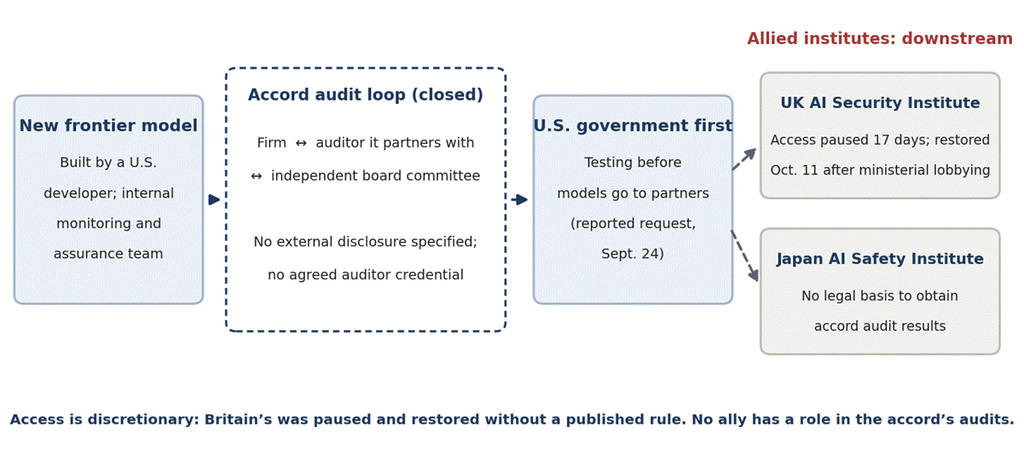
Figure 2. Allies downstream. Based on Politico’s report of September 24, 2026, reports of the restoration of UK access on October 11, and the text of the White House Accord.
Japan is in a similar position. It is not a party to the U.S.-China channel or to the accord. In the slow layer it has standing, but no measurable policy for keeping it.
Assets. Japan convenes two working groups in SC 42. It leads the Hiroshima AI Process Friends Group, which the Ministry of Internal Affairs and Communications puts at 84 countries and regions as of August 2026, including nine ASEAN members as well as India, Kenya and Nigeria. It established an AI Safety Institute in 2024. In August 2026 it adopted ISO/IEC 42006 and ISO/IEC 42005 as national standards (JIS Q 42006 and JIS Q 42005), putting requirements for AI auditing bodies and a method for AI impact assessment into domestic use. Its second Basic Plan for AI, adopted by the cabinet on July 14, 2026, commits to an open form of AI sovereignty, to participation in AI standardization in JTC 1, to strengthening the institute and evaluating high-performance AI, and to cooperation with like-minded countries and the Global South.
Gaps. First, Japan supports standards work through training programmes and a public–private forum launched in fiscal 2025, but it sets no numerical target for the people, posts or drafts that sustained participation requires. The headline target in the government’s draft Intellectual Property Strategic Program 2026 is to keep the number of ISO/IEC secretariats Japan holds among the world’s top five through fiscal 2030. That measures posts held, not presence kept. Second, Japan has no means of verifying the safety of the American models it depends on, and no legal basis for obtaining audit results.
From this follow three moves. None is specific to Japan.
Move 1: Fund sustained participation
Influence in standards comes from unbroken presence, not from occasional delegations. An ally can pay for it: travel and salary support for experts seconded by companies, planned succession for convenors and chairs, mentoring by former committee officers, and published targets for participants, drafts authored and posts held. This is the cheapest of the three moves and the slowest to pay off, which is the reason to begin first.
Move 2: Make the safety institute a bridge
The national safety institute can translate the test and evaluation methods developed by American firms and agencies into documents that ISO/IEC can process, and bring them to SC 42. That connects the room the frontier firms avoid with the knowledge they hold.
Access to audit results has to be negotiated, and it can be staged.
- Short term: procurement. When a government buys frontier models, it can ask as a customer, in the contract, for a summary of the audit results produced under the accord to be provided to its safety institute. This is a contractual term, not regulation.
- Medium term: mutual recognition. The ally asks that its institute’s evaluations be accepted as external assessments under the accord. That presupposes agreed qualifications for auditors, which do not yet exist. An ally with standing in SC 42 can propose them there, building on ISO/IEC 42006. Japan, which already applies that standard as JIS Q 42006, is placed to do so.
There is a counterpart and a deadline. The SIF is to report within 120 days, and it has already begun to collect incident reports from companies. Before the report is settled, an allied government can ask that the sharing of audit results and of incident and threat information with allies be placed on its agenda. Two cautions apply. Nothing reported about the Force’s mandate mentions allies. And because the U.S. lead now sits in the intelligence chain, each ally must decide which of its own agencies answers. In Japan, the safety institute evaluates models, while a National Intelligence Bureau established on July 31, 2026 consolidates and analyses intelligence. Who speaks to Washington on AI is not yet defined.
None of this is a criticism of American self-regulation. It starts from a fact, that there is no channel through which an ally can take part, and asks for one.
Move 3: Sponsor third countries’ participation
The empty seats I saw two decades ago are still the opening. Members of the Friends Group can be helped to become participating members of SC 42, with voting rights and experts of their own, through training and travel support. The measure of success is the number of ASEAN states that do so.
It is tempting to exclude countries that have signed on to the Belt and Road Initiative. That would defeat the purpose. Of the 69 Friends Group members whose names I could confirm, 47 (about 68 percent) have signed Belt and Road memoranda, and all nine ASEAN members of the group are among them. These governments are hedging: they take infrastructure finance from one side and join a governance grouping led by the other. They are the audience. The risk of leakage is better handled by tiers of information than by lists of countries.
| Tier | Who | What is shared |
| Open | The whole Friends Group | Training in how to participate, travel support, drafting of standards intended for publication |
| Restricted | Like-minded partners | Evaluation methods, security-related testing know-how, unpublished technical information |
Admission to the restricted tier should turn on concrete ties in AI, not on a Belt and Road signature: membership of the China-led World Artificial Intelligence Cooperation Organization (WAICO), whose founding agreement 29 states signed in Shanghai in July 2026; dependence on Chinese equipment in core networks and surveillance systems; and voting alignment with China in standards bodies.
One more step belongs here. An ally should propose first where it is strong. For Japan that is manufacturing and robotics: safety requirements for physical AI and for AI agents, tabled as a new work item before China’s national standard is offered internationally, with terms such as “emergency stop” and “human intervention” defined on its own institutional footing.
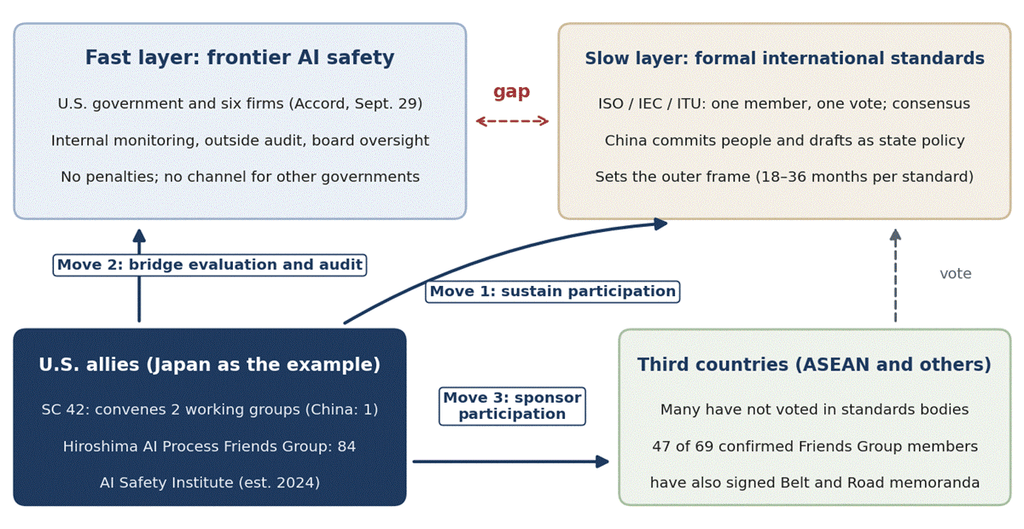
Figure 3. Two layers of AI rule-making and three moves open to an ally
6. Five Signals to Watch
The claims in this paper can be checked against events over the next twelve months.
| Signal | Would support this paper | Would count against it |
| 1. Does any Chinese official document adopt “SI” (超级智能)? | Chinese texts keep “artificial intelligence” after the November exchange | Explicit adoption in China’s own documents |
| 2. Does the U.S.-China dialogue take up standards? | The outcome document mentions technical standards or evaluation methods | The exchange stays at incident notification |
| 3. Is China’s agent-safety standard proposed internationally? | A new work item reaches ISO/IEC (SC 42, SC 27) or ITU-T within twelve months | No proposal appears |
| 4. Do allies get a channel? | The SIF report is silent on allies; pre-release access stays discretionary and sequenced behind U.S. review | A formal arrangement for allied institutes’ access or recognition is announced |
| 5. Which rules do third countries cite? | Procurement and regulatory texts in ASEAN and elsewhere cite ISO/IEC standards | They cite the standards or certifications of a U.S. industry body directly |
Three dates anchor the list. The ITU’s Plenipotentiary Conference meets in Doha from November 9 to 27 and elects the union’s leadership, in the same month as the next U.S.-China exchange. The proposed federal definition of SI is due by November 28. The SIF report is due by early February 2027.
The name, the standard, the certificate and the audit are four forms of one question: who holds the authority to define what AI is and when it is safe. For an ally, a share in that authority is what AI sovereignty now consists of. Two rooms are being furnished to answer it. In one, the United States and six companies set the terms and allies wait for results. In the other, every member has a vote and China has spent more than twenty years building its presence. Allies have a seat in the second room and a claim on the first. Whether they use either is a choice they can still make.
Limitations
- Facts are stated as of October 15, 2026, from official documents and press reports. Passages marked as this paper’s inference, reading or judgment are the author’s interpretation.
- The Chinese foreign ministry’s statements of September 26 and 28 were read in the Chinese original. The full list of summit outcomes published by Xinhua, and the requirements of the mandatory national standard on agent safety, have not been confirmed in original official texts.
- Mr. Trump’s statement that Mr. Xi liked the term is his own account and lacks independent confirmation.
- The request concerning the UK AI Security Institute rests on Politico’s reporting from two sources, one of them an anonymous official. Its reversal rests on The Telegraph and Reuters, read here through secondary reports. The White House has commented on neither on the record.
- The Super Intelligence Force’s incident-reporting statement is known from Axios’s report; its text has not been published.
- China’s aims for the November round are known from a state-media account citing unnamed negotiators, read in English translation.
- The testimony in Section 3 is the author’s observation, mainly from SC 28 from the early 2000s. It is not supported here by time-series data on delegations. A year-by-year comparison of SC 42 participation is work still to be done.
- Counts of leadership posts and secretariats vary with source and date.
- The Friends Group is reported at 84 countries and regions. The author could confirm 69 names, and the Belt and Road overlap is calculated on those 69.
- The Japanese target cited in Section 5 comes from a draft of the Intellectual Property Strategic Program 2026 that was still under inter-ministerial consultation and may change.
- NIST’s website does not explain the change from CAISI to CAISSI; this paper reports only what the website shows.
- The Infiltration Index is used in adapted form, for the export of terms and standards between states.
References
- The White House, “Inaugurating The Era Of Super Intelligence” (executive order, September 29, 2026) https://www.whitehouse.gov/presidential-actions/2026/09/inaugurating-the-era-of-super-intelligence/
- The White House, “Fact Sheet: President Donald J. Trump Advances a Fair and Reciprocal Relationship with China While Hosting Historic State Visit” (September 25, 2026) https://www.whitehouse.gov/fact-sheets/2026/09/fact-sheet-president-donald-j-trump-advances-a-fair-and-reciprocal-relationship-with-china-while-hosting-historic-state-visit/
- The American Presidency Project, “White House Accord on Super Intelligence” (September 29, 2026) https://www.presidency.ucsb.edu/documents/white-house-accord-super-intelligence
- The White House, “President Trump at the United Nations” (September 22, 2026) https://www.whitehouse.gov/releases/2026/09/president-trump-at-the-united-nations-while-others-have-talked-i-have-acted/
- Xinhua, “China respects U.S. choice on what term to use for artificial intelligence: spokesperson” (September 26, 2026) https://english.news.cn/20260926/df8a51ac15804f49b0aea410888f1dfd/c.html
- Ministry of Foreign Affairs of the PRC, 外交部发言人就人工智能问题答记者问 (September 26, 2026) https://br.china-embassy.gov.cn/fyrth/202609/t20260926_12031638.htm
- China News Service, 外交部:愿同美方通过人工智能政府间对话等渠道保持沟通交流 (September 28, 2026) https://www.chinanews.com.cn/gn/2026/09-28/10704901.shtml
- Associated Press (via ABC News), “US diplomats told to say ‘super intelligence’ — not ‘artificial intelligence’ — after Trump’s call” (September 23, 2026) https://abcnews.com/US/wireStory/us-diplomats-told-term-super-intelligence-artificial-intelligence-136698441
- Politico (via Yahoo News), “White House asks OpenAI and Anthropic to hold new models from UK testers until US review” (September 24, 2026) https://www.yahoo.com/news/politics/articles/white-house-asks-openai-anthropic-164324696.html
- Axios, “Exclusive: Anthropic breaches spark White House AI reporting mandate” (October 9, 2026) https://www.axios.com/2026/10/09/anthropic-ai-security-white-house
- Bloomberg, “UK to Evaluate AI Models Before Release, Reversing Trump Policy” (October 12, 2026) https://www.bloomberg.com/news/articles/2026-10-12/uk-reverses-trump-plans-to-keep-back-openai-anthropic-models
- StartupFortune, “UK AI minister details how the restored frontier model testing deal works” (October 13, 2026) https://startupfortune.com/uk-ai-minister-details-how-the-restored-frontier-model-testing-deal-works/
- TechRepublic, “UK Regains AI Model Access After Reported US Reversal” (October 13, 2026) https://www.techrepublic.com/article/news-uk-ai-model-access-white-house-reversal-emea/
- Pekingnology, “China Signals What It Wants From the Next China-U.S. AI Talks” (October 1, 2026) https://www.pekingnology.com/p/china-signals-what-it-wants-from
- Politico, West Wing Playbook, “Who’s auditing the AI auditors?” (September 29, 2026) https://www.politico.com/newsletters/west-wing-playbook-remaking-government/2026/09/29/whos-auditing-the-ai-auditors-01097894
- The Hill, “Trump polls followers to rename AI” (September 2026) https://thehill.com/homenews/administration/6099834-trump-proposes-new-a-i-names/
- CBS News, “Trump vows to form ‘AI Force,’ says he won’t allow slowdown of AI development” (September 19, 2026) https://www.cbsnews.com/news/trump-vows-ai-force-czar-development
- CNBC, “Trump tries to rename AI ‘super intelligence’ as polls show…” (September 29, 2026) https://www.cnbc.com/2026/09/29/trump-ai-super-intelligence.html
- Military Times, “US appeals court upholds Pentagon’s blacklisting of Anthropic” (September 25, 2026) https://www.militarytimes.com/news/pentagon-congress/2026/09/25/us-appeals-court-upholds-pentagons-blacklisting-of-anthropic/
- CBS News, “Trump announces formation of AI ‘Super Intelligence Force’” (October 2026) https://www.cbsnews.com/news/ai-super-intelligence-force-trump-jay-clayton/
- Newsweek, “Who’s on Trump’s ‘Super Intelligence Force’? Picks Signal His Priorities” (October 5, 2026) https://www.newsweek.com/whos-on-trumps-super-intelligence-force-picks-signal-his-priorities-12524365
- SiliconANGLE, “Trump launches Super Intelligence Force with Jay Clayton as AI czar” (October 4, 2026) https://siliconangle.com/2026/10/04/trump-launches-super-intelligence-force-with-jay-clayton-as-ai-czar/
- Council on Foreign Relations, “Trump’s AI Safety Pact Is Toothless. But There Is a Path Forward.” (October 1, 2026) https://www.cfr.org/articles/trumps-ai-safety-pact-is-toothless-but-there-is-a-path-forward
- NIST, “Super intelligence” (topic page, modified October 5, 2026) https://www.nist.gov/super-intelligence
- NIST, “Center for Advancing Innovation and Standards for Super Intelligence (CAISSI)” (modified September 30, 2026) https://www.nist.gov/caissi
- NIST Computer Security Resource Center, “SI Note” (October 5, 2026) https://csrc.nist.gov/si-note
- INCITS, “Artificial Intelligence” (U.S. TAG to ISO/IEC JTC 1/SC 42) https://www.incits.org/committees/ai
- ANSI, “Help Shape Standards for Frontier AI Risk Management” (June 16, 2026) https://www.ansi.org/standards-news/all-news/6-16-26-help-shape-standards-for-frontier-ai-risk-management
- ISO, ISO/IEC TR 42106:2026, Overview of differentiated benchmarking of AI system quality characteristics https://www.iso.org/standard/86903.html
- Japanese Standards Association, press release on the publication of JIS Q 42005:2026 and JIS Q 42006:2026 (August 20, 2026) https://prtimes.jp/main/html/rd/p/000000584.000004052.html
- Cabinet Secretariat of Japan, 知的財産推進計画2026・国際標準部分抜粋(案) (draft, international standards section) https://www.cas.go.jp/jp/seisakukaigi/titeki2/kokusai_hyoujun/gijisidai/dai10/shiryo2.pdf
- ISO/IEC JTC 1/SC 42, Business Plan 2025 https://assets.iec.ch/further_informations/21538/ISO-IEC%20JTC%201_N17692_SC%2042%20Business%20Plan%202025.pdf
- ISO, ISO/IEC JTC 1/SC 28 — Office equipment https://www.iso.org/committee/45314.html
- ISO, ISO/IEC 22989:2022, Artificial intelligence concepts and terminology https://www.iso.org/standard/74296.html
- ISO, ISO/IEC 42006:2025, Requirements for bodies providing audit and certification of artificial intelligence management systems https://www.iso.org/standard/44546.html
- ISO, ISO/IEC 27090, Cybersecurity — Artificial Intelligence — Addressing security threats and compromises to artificial intelligence systems https://www.iso.org/standard/56581.html
- U.S.-China Economic and Security Review Commission, “PRC Representation in International Organizations” (April 2026) https://www.uscc.gov/sites/default/files/2026-04/PRC_Representation_in_International_Organizations_April2026.pdf
- Clingendael Institute, “China’s Rise as a Standards Power” (2025) https://www.clingendael.org/pub/2025/standardisation-with-chinese-characteristics/3-chinas-rise-as-a-standards-power-the-basis-of-long-term-dominance/
- Carnegie Endowment for International Peace, “What Washington Gets Wrong About China and Technical Standards” (2023) https://carnegieendowment.org/research/2023/02/what-washington-gets-wrong-about-china-and-technical-standards?lang=en
- CPC Central Committee and State Council, 国家标准化发展纲要 (National Standardization Development Outline, 2021) https://www.ndrc.gov.cn/fggz/fzzlgh/gjjzxgh/202112/t20211201_1306575.html
- Ministry of Foreign Affairs of the PRC, 人工智能全球治理行动计划 (Global AI Governance Action Plan, July 2025) https://www.mfa.gov.cn/zyxw/202507/t20250726_11677803.shtml
- ANSI, “U.S. Government Releases National Standards Strategy for Critical and Emerging Technology” (May 2023) https://www.ansi.org/standards-news/all-news/2023/05/05-05-23-us-standards-strategy-for-cet-released
- The White House, “Winning the Race: America’s AI Action Plan” (July 2025) https://www.whitehouse.gov/wp-content/uploads/2025/07/Americas-AI-Action-Plan.pdf
- Roberts and Ziosi, “Can we standardise the frontier of AI?” (Oxford Martin AI Governance Initiative, 2025) https://aigi.ox.ac.uk/wp-content/uploads/2025/06/ssrn-5271446.pdf
- ITU, “Common Patent Policy for ITU-T/ITU-R/ISO/IEC” https://www.itu.int/en/ITU-T/ipr/Pages/policy.aspx
- Mayer Brown, “BIS Clarifies License Requirements for Activity at International Standards-Setting Bodies” (2022) https://www.mayerbrown.com/en/insights/publications/2022/10/bis-clarifies-license-requirements-for-activity-at-international-standardssetting-bodies
- CNBC, “Anthropic, Google, OpenAI and xAI granted up to $200 million from DoD” (July 2025) https://www.cnbc.com/2025/07/14/anthropic-google-openai-xai-granted-up-to-200-million-from-dod.html
- South China Morning Post, “Baidu, Alibaba, Tencent executives among Big Tech members on new China AI standards committee” (December 2024) https://www.scmp.com/tech/big-tech/article/3290745/baidu-alibaba-tencent-executives-among-big-tech-members-new-china-ai-standards-committee
- Standardization Administration of China, notice on the plan for 29 mandatory national standards including 智能体应用安全基本要求 (June 27, 2026) https://www.sac.gov.cn/xw/tzgg/art/2026/art_f8fcf2b94e5e4927a1e75ba0f02a7193.html
- Xinhua, 全球首部智能体安全强制性国家标准正式立项 (July 28, 2026) https://www.news.cn/tech/20260728/8ebf5083cf0e487287f894fb31e123f5/c.html
- Ministry of Foreign Affairs of the PRC, 成立世界人工智能合作组织协定签署仪式在上海举行 (July 16, 2026) https://www.mfa.gov.cn/wjbzhd/202607/t20260716_11984399.shtml
- Cabinet Office of Japan, 人工知能基本計画(第Ⅱ期) (Basic Plan for AI, second term; cabinet decision of July 14, 2026) https://www8.cao.go.jp/cstp/ai/ai_plan/aiplan_20260714.pdf
- Ministry of Internal Affairs and Communications of Japan, “Hiroshima AI Process Friends Group” https://www.soumu.go.jp/hiroshimaaiprocess/en/supporters.html
- Japanese Standards Association, 新たな国際標準戦略を読み解く ~概要編~ (overview of the 2025 national standards strategy) https://webdesk.jsa.or.jp/common/W10K0620/?id=1481
- Green Finance & Development Center, “Countries of the Belt and Road Initiative” https://greenfdc.org/countries-of-the-belt-and-road-initiative-bri/
- Japan Institute for Crisis Management, “Dark Enlightenment in Japan: The Infiltration Index” (English edition) https://inst-ds.org/cyber-security/2096/
Glossary
SI (Super Intelligence)
The term the U.S. executive order of September 29, 2026 directs federal agencies to use in place of “AI” in non-statutory documents. In AI safety debates “superintelligence” has meant a future system that broadly exceeds human intellect; the order applies the word to today’s technology in general.
White House Accord on Super Intelligence
A voluntary agreement signed on September 29, 2026 by Google, Meta, Anthropic, OpenAI, xAI and Nvidia, committing each to internal monitoring, an internal assurance team, an independent external auditor or evaluator, and board-level oversight. It carries no penalties.
Super Intelligence Force (SIF)
A body announced by President Trump on October 4, 2026 to coordinate federal policy on AI. It is led by the Director of National Intelligence and is reported to owe a report within 120 days. On October 9 it told AI companies to report security incidents to it.
CAISI / CAISSI
The U.S. government’s AI evaluation center at NIST, known as the Center for AI Standards and Innovation (CAISI). By October 2026 NIST’s website presented it as the Center for Advancing Innovation and Standards for Super Intelligence (CAISSI).
INCITS/AI
The ANSI-accredited, private-sector committee that forms U.S. positions for ISO/IEC JTC 1/SC 42 (the U.S. Technical Advisory Group).
Fast layer / slow layer
This paper’s terms for the two settings in which AI safety rules are made: company-led arrangements anchored in the U.S. government, and the formal international standards bodies (ISO, IEC, ITU).
Sustained participation capacity
This paper’s central concept: the ability to keep participation in standards bodies unbroken and convert it into convenorships, drafts, support from other members and the internationalization of national standards.
ISO/IEC JTC 1/SC 42
The subcommittee of the joint ISO/IEC technical committee on information technology that is responsible for AI standards.
Convenor
The officer who leads a working group and steers the drafting of a standard.
Participating member (P-member)
A national body that takes an active part in an ISO committee, with the right and the duty to vote.
Hiroshima AI Process Friends Group
A voluntary grouping of countries and regions that support the Hiroshima AI Process launched under Japan’s G7 presidency in 2023. Japan’s communications ministry counted 84 members as of August 2026.
Author
Miho Funayama is a strategic analyst specializing in international standardization, technology intelligence, intellectual property analysis, and geopolitical and crisis risk management. She holds a degree in International Politics from Sophia University and completed graduate studies in International Political Economy, Philosophy, and Psychology at Aoyama Gakuin University. She previously led patent research and strategic analysis on international standards and emerging technologies at Canon Inc., where she served as Deputy International Secretary of ISO/IEC JTC 1/SC 28 and received the ITSCJ Award for Contribution to International Standardization three times. She is currently a Director and Chief Researcher at the Japan Institute for Crisis Management, a Fellow at the Institute of Middle East–Asia Information Strategy, and a Professional Associate Member of the Foreign Correspondents’ Club of Japan.
Related Articles
- 「SI(超知能)」の裏で進む標準戦争 (Japanese original, October 6, 2026) https://inst-ds.org/recommend/2268/
- Dark Enlightenment in Japan: The Infiltration Index https://inst-ds.org/cyber-security/2096/
- Four Layers of AI Sovereignty https://inst-ds.org/cyber-security/2065/