
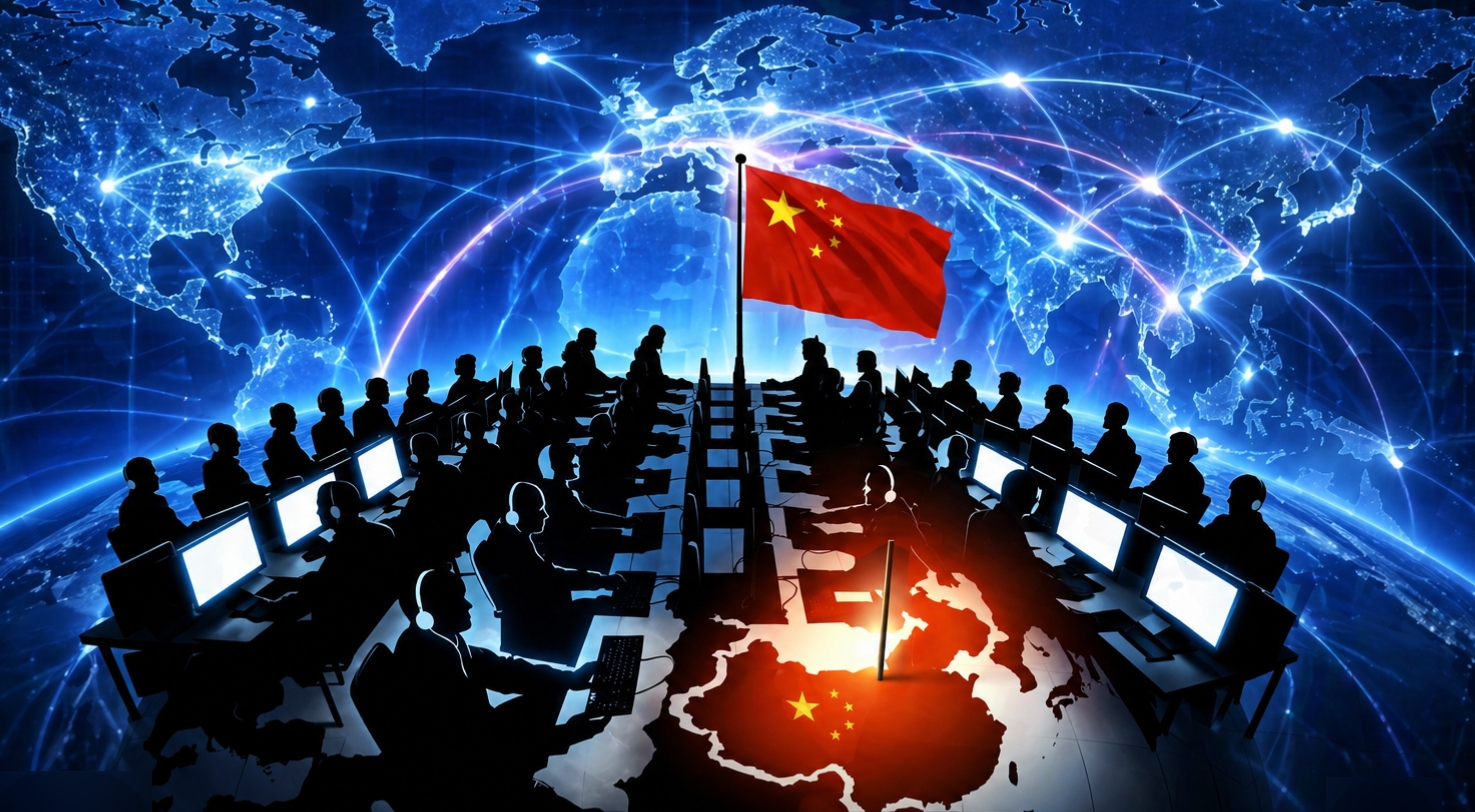
How Geedge Networks packages China’s censorship system for export — and how far it has already spread.
Published: April 27, 2026
Publisher: Japan Institute of Crisis Management
A Japanese edition is also available.(日本語版)
In September 2025, approximately 600 GB of internal documents were leaked from Geedge Networks, revealing for the first time the true scope of the export of the Great Firewall — China’s internet censorship system — which had long been shrouded in secrecy. The leaked documents were examined over the course of a year by a collaborative investigation involving Amnesty International, Justice For Myanmar, InterSecLab and the Tor Project, together with several news organisations, and their authenticity was independently confirmed (References No. 3, No. 8 and No. 9).
This report sets out what Geedge Networks is, what it sells, and what its spread means for democracies — including Japan, which has yet to issue any official response.
Table of Contents
Keywords
Background
Executive Summary
Chapter 1: What Is the “Great Firewall” in the First Place? — The True Nature of the Wall That Confines 1.4 Billion People
Chapter 2: What Kind of Company Is Geedge Networks? — A National Project Behind the Sign of a “Private Company”
[Column] The Man Who Built the Wall — Who Is Fang Binxing?
The Half-Life of a Man Blocked by the Wall He Built / Deep Ties with the Chinese Government
Chapter 3: The Contents of the “Surveillance Package” — A “Citizen Surveillance Kit” That Anyone Can Use Without IT Knowledge
Chapter 4: Which Countries Is It Being Sold To? — Myanmar, Pakistan, and 150 Countries
Chapter 5: Why Are Western Companies Involved? — An Era When “We Didn’t Know” Is No Longer Acceptable
Chapter 6: The Risk for Japan — Your Communications Are Being Targeted, and “Surveillance” Is Being Made the Global Standard
Chapter 7: The International Response and Recommendations for Japan — The United States Has Acted. Japan Has Not Yet.
Closing Remarks — Democracy or Surveillance Society: When Japan Breaks Down the Wall
References / Glossary
Keywords
| Great Firewall (Golden Shield) | |
| Internet Censorship & Surveillance | |
| Geedge Networks | |
| Deep Packet Inspection (DPI) | |
| Export of Digital Authoritarianism | |
| Belt and Road Initiative (BRI) | |
| VPN Blocking Technology | |
| Tiangou Secure Gateway | |
| Supply Chain Risk | |
| Human Rights & Technology |
Background
This report is aimed primarily at politicians, media professionals, and journalists. Its purpose is to explain — without technical jargon — what China’s Geedge Networks is, what it does, and why it is a threat to democratic nations including Japan.
In September 2025, approximately 600 GB of internal documents from the company were leaked, revealing for the first time the true scope of the export of the Great Firewall (China’s internet censorship system), which had long been shrouded in secrecy. The leaked documents were examined over the course of a year by a collaborative investigation involving Amnesty International, Justice For Myanmar, InterSecLab and the Tor Project, together with several news organisations, and their authenticity was independently confirmed (References No. 3, No. 8 and No. 9).
This report organizes their contents and presents the perspective that the international community and Japan should take.
Executive Summary
| What the Company Is | A Chinese company founded in 2018. Fang Binxing — known as the “Father of the Great Firewall” — serves as Chief Scientist. |
| What It Does | Exports a commercial version of the Great Firewall (a surveillance and censorship package) to authoritarian regimes around the world. |
| The Evidence | Approximately 600 GB of internal documents leaked in September 2025. Authenticity independently verified by Amnesty International, Justice For Myanmar and InterSecLab. |
| Customers | Myanmar, Pakistan, Kazakhstan, and Ethiopia (confirmed). Approximately 150 countries participating in China’s Belt and Road Initiative are potential targets. |
| Impact on Japan | Risk of interception of communications by Japanese nationals visiting countries where the Geedge surveillance system has been deployed. Long-term risk that the “standardization” of digital authoritarianism will erode democracy. |
| Western Response | U.S. Congress and think tanks have recommended sanctions and tightened export controls. Amnesty has called for criminal investigations. |
| Japan’s Current Status | No official government response yet. Urgent fact-finding and international cooperation are required. |
Chapter 1: What Is the “Great Firewall” in the First Place?
China’s internet has a “wall.”
When someone in China attempts to connect to the internet using a smartphone or computer, all communications pass through a filtering system managed by the government. This system is what is called the “Great Firewall” — also known as the “Golden Shield.” What is critical is the fact that this system has now become an export product.
| Example | Search terms such as “Tiananmen Incident” or “Xi Jinping criticism” are blocked, and access to overseas services equivalent to Google, YouTube, Facebook, and international versions of LINE is cut off. The result is a structure in which 1.4 billion Chinese citizens can only receive information within the range visible to the government. |
Chapter 2: What Kind of Company Is Geedge Networks?
Geedge Networks was founded in China in 2018. Its official website states that it “solves network security and performance problems,” and at first glance it appears to be an ordinary cybersecurity company. However, the reality is very different.
The Company Led by the “Father of the Great Firewall”
The company’s Chief Scientist is Fang Binxing, a figure known as the technical designer of the Great Firewall and called its “Father” both inside and outside China.
Geedge Networks is a company led by the man who built the Great Firewall, and selling a commercial version of that system to the world is the core of its business.
Deep Ties with the Chinese Government
Geedge Networks is nominally a private company, but the leaked documents revealed deep ties with the “MESA Lab,” a research laboratory within the Chinese Academy of Sciences’ Institute of Information Engineering (IIE). The MESA Lab is a research institution directly connected to the Chinese government and Communist Party.
| Key Point | The sign of a “private company” and the reality of “direct connection to a government institution” — this dual structure is the single greatest characteristic that distinguishes Geedge from an ordinary cybersecurity company. |
[Column] Chapter 2 Supplement
The Man Who Built the Wall — Who Is Fang Binxing?
The Half-Life of a Man Blocked by the Wall He Built
In April 2016, a prominent Chinese researcher gave a lecture at his alma mater. The topic was “Cybersecurity.” The audience was several hundred students.
Midway through the lecture, he attempted to reference a page from the South Korean government’s website. But — the screen displayed “Access Denied.”
The page had been blocked by the system he himself had designed.
In a panic, he attempted to use a VPN to circumvent the “wall.” But the connection dropped twice within a minute. In the end, he searched for a screenshot of Google on Baidu (China’s version of Google) and projected that on the screen to somehow continue his lecture.
The venue fell silent. No Q&A was held.
Blocked by the wall he had built himself.
The name of this researcher is Fang Binxing — the designer of the world’s most powerful internet censorship system, the “Great Firewall,” and Chief Scientist of Geedge Networks.
— The Man Who Accomplished the “Impossible” —
Born in 1960 in Harbin, Heilongjiang Province in northeast China, Fang Binxing was a pure technologist who earned his doctorate in computer science from Harbin Institute of Technology.
From 1999 he joined China’s National Network Emergency Response Technical Team, and from 2000 onward, as Chief Engineer, he led the technical development of the “wall.”
Former U.S. President Clinton once laughed that China trying to control the internet was “like trying to nail Jell-O to the wall.” The internet is, at its foundation, a system designed for free and open communication. That a single national government could manage it seemed technically near-impossible — or so it was thought.
Fang Binxing accomplished that “impossible.”
He built a system that filters the internet used by 1.4 billion people in the form the government desires, and it continues to operate today. For this achievement — or “sin” — he became known both inside and outside China as the “Father of the Great Firewall.”
— He Became a University President, and Had a Shoe Thrown at Him —
Having risen to prominence as a technologist, Fang Binxing eventually obtained the pinnacle of academia — the presidency of Beijing University of Posts and Telecommunications. He was also elected as a member of the Chinese Academy of Sciences, and was treated on the surface as a “great scholar who contributed to the nation.”
However, ordinary Chinese citizens saw him differently.
In May 2011, when Fang Binxing visited Wuhan University, a student removed a shoe and threw it at him from behind. The first shoe hit its mark. Another student present said, “Because of him, we have to pay for access to sites we should be able to use for free. He’s someone who made internet surfing extremely inconvenient.”
Inside China, a “bounty” campaign appeared on social media openly attacking Fang Binxing, and the shoe-throwing incident spread rapidly.
Anger at the man who built the “wall” was widely shared among Chinese people outside the establishment.
The anger of the student who threw the shoe lies quietly within 1.4 billion people.
In July 2013, Fang Binxing suddenly resigned as president of Beijing University of Posts and Telecommunications. At the commencement speech, he cited “health reasons,” but within China, many pointed to a connection with corruption suspicions. The truth remains unclear to this day.
— Now on the Selling Side of the “Wall” —
Fang Binxing disappeared from public view, but he had not “retired.”
According to Chinese corporate registry databases, in 2019, he became an investor in a company called Jicheng (Hainan) Technology Investment, acquiring a 40% stake. This Jicheng is an investor in Geedge Networks, and the two companies share senior executives.
Furthermore, in 2024, Chinese state media Xinhua reported that “Fang Binxing has established a new cybersecurity research studio in cooperation with Geedge.”
In other words, he not only “built” the Great Firewall — he is now also deeply involved in a business “selling” its commercial version to the world.
Building the wall, then selling the wall. This is the arc of one person’s life.
According to WIRED’s reporting, Geedge is not only exporting Chinese-style censorship abroad, but is also moving to re-import operational data from overseas to further refine domestic repression in China. The first domestic deployment target was the Xinjiang Uyghur Autonomous Region. (Reference No. 14)
— What This Person Represents —
Looking back at Fang Binxing’s life, it is clear that Geedge Networks is not simply a “private cybersecurity company.”
The designer of the Great Firewall — a national project — has, after retirement, joined the export business using the same technology. This is neither coincidence nor personal “entrepreneurship” — it should be viewed as part of an organized technology export strategy in which national intent and individual capability are unified.
When asked by media about the Great Firewall, when asked about how it works, he replied with a single word: “State secret.” That secret is now being sold to the governments of Pakistan and Myanmar.
Chapter 3: The Contents of the “Surveillance Package”
The following are the main products and services sold by Geedge Networks, explained without technical jargon.
[Product 1] Tiangou Secure Gateway
The company’s flagship product. In a single phrase: a “national-level communications surveillance and interception device.”
Installing this device at a country’s communications infrastructure (the entry and exit points of the internet) enables surveillance of all communications entering and leaving that country. VPNs can also be blocked, sealing off citizens’ means of escaping government surveillance. It also has the capability to attack specific websites.
[Product 2] Cyber Narrator
A dashboard (management interface) that allows users (government officials) to visually check the communications status of surveillance targets on a map. Designed so that even officials without IT knowledge can see at a glance “who is using what apps right now in this area.”
| Note | In actual demonstration footage, it was shown being used to identify and track the communications of participants when a demonstration (protest) occurred in a specific area. |
[Product 3] TSG Galaxy
A system for accumulating and storing collected citizen communications data. In other words, a “surveillance data warehouse.”
Chapter 4: Which Countries Is It Being Sold To?
The leaked documents confirmed that Geedge Networks has provided technology to the following countries:
| Country | Situation / Details |
|---|---|
| Myanmar | Deployed after the 2021 military coup. 33.4 million internet users are subject to surveillance (IWS 2023 statistics). Used to track criticism of the military and communications of pro-democracy activists. The human rights organization “Justice For Myanmar” has indicated the possibility that this technology contributed to torture and killings following the coup (Report No. 3). |
| Pakistan | The government has adopted Geedge technology for its “Web Monitoring System 2.0 (WMS 2.0).” After Western censorship technology previously in use withdrew due to sanctions, Pakistan switched to Geedge (Amnesty Report No. 8). |
| Kazakhstan | Reported to be used for interception of all domestic internet and mobile communications (from leaked documents). Note: At the time of writing, independent verification by PBS or Amnesty has not been confirmed. Further investigation is needed. |
| Ethiopia | Geedge technology is believed to have been used for internet blackouts during the civil war (Tigray conflict) (from leaked documents). Same note: Third-party independent verification unconfirmed. |
Future Proliferation Risk
The leaked documents contain records of Geedge recruiting engineers proficient in Spanish and French, suggesting expansion into Latin America and Africa. With approximately 150 countries participating in the Belt and Road Initiative, the potential export market is vast.
[Note] Of the country-specific information in this report, Myanmar has been verified by Justice For Myanmar, and Pakistan by Amnesty International. Kazakhstan and Ethiopia are based on leaked documents, and third-party verification has not been confirmed at this time.
Chapter 5: Why Are Western Companies Involved?
A troubling “complicity structure” lurks in this problem — but the structure is not simple.
The Problem of Western Technology “Repurposing”
This investigation revealed that the Geedge Networks surveillance system incorporates technology and components from Western companies in the United States, France, and Germany.
| Company | Country / Field | Involvement in Geedge System |
|---|---|---|
| Niagara Networks | U.S. / Communications analysis equipment | Commercially available products incorporated into communications analysis and surveillance functions |
| Thales | France / Security technology | Security-related technology repurposed |
| Utimaco | Germany / Encryption and interception technology | Encryption and interception-related technology repurposed |
How these companies responded to the allegations is itself part of the record. Amnesty International approached 29 companies and government bodies for comment during its year-long investigation. Only Niagara Networks and AppLogic Networks (formerly Sandvine) responded substantively. Utimaco and Datafusion acknowledged earlier research queries but did not address the report’s findings. Geedge Networks, Huawei, Thales and ELINC did not reply at all, and the governments of Germany, Canada, China, the UAE and the United States provided no meaningful answers regarding export licences or human rights due diligence (References No. 8 and No. 15).
| Important Distinction | These companies are not directly complicit in the human rights violations documented here. In each case, products sold for the general market were unintentionally repurposed through UAE-based intermediaries. However, we are now in an era where “we didn’t know” is no longer acceptable. This is a structural problem of “loopholes” in export controls and due diligence being exploited, and urgent international institutional reform is needed. |
Chapter 6: The Risk for Japan
At first glance, this may appear to be a problem of developing countries. However, there are two layers of risk relevant to Japan.
Risk ① The Danger of Japanese Nationals Being Directly Surveilled
The Georgetown Security Studies Review has warned that “citizens of democratic nations who visit countries where Geedge equipment has been deployed are also exposed to risks of personal information leakage and surveillance” (Reference No. 4).
| Example | If Japanese businesspeople or diplomats use the internet in Pakistan, Kazakhstan, or other countries where Geedge Networks technology has been deployed, their communications may be intercepted by the local government or Chinese parties. |
Risk ② The Long-Term Risk of “Standardization” of Digital Authoritarianism — The Battle over the ITU
[Author’s note: The analysis in this section draws on the author’s experience as Vice International Secretary of ISO/IEC JTC1 SC28.]
The Geedge Networks case is only the visible surface of a deeper contest: whether surveillance becomes a technical norm written into the global internet itself.
There is a more fundamental problem. China has not suddenly acquired influence at the ITU — through decades of behind-the-scenes preparation, it has systematically obtained positions of influence at international standardization bodies. The ITU (International Telecommunication Union) is the frontline arena for this.
◆ What Kind of Organization Is the ITU?
The ITU (International Telecommunication Union) is a specialized agency of the United Nations and one of the world’s oldest international organizations, founded in Paris in 1865. It has 194 member states, and its main roles are: ① management of international radio waves and frequencies; ② international standardization of telecommunications (formulation of recommendations); and ③ technical assistance to developing countries.
The “Recommendations” formulated by the ITU are treated as “de jure standards” that become benchmarks for government procurement and policy-making in each country through WTO agreements. In other words, it is the institution that writes “the world’s telecommunications rulebook,” and who leads the editing of that rulebook carries decisive geopolitical significance.
◆ The “Power of Process” in Standardization — The Significance of Secretary and Chair Positions
The ITU’s standardization work is conducted in Study Groups (SGs) established for each theme. Each SG has positions such as Chair, Vice-Chair, and Rapporteur (agenda manager), and the nations and companies that hold these positions lead the agenda-setting, management of deliberations, and drafting of documents.
Similar structures exist in other international organizations such as ISO and the IMF. Holding secretariat and chair positions means being able to grasp other nations’ technology trends in advance and effectively control the direction of standardization. This is not purely technical work — it is sophisticated geopolitical strategy.
| The “Number” of Participants Also Becomes a Weapon | At the ITU and ISO, even in fields where a country is not deeply expert, sending large numbers of representatives to participate in meetings allows the country to steer the flow of discussion in a direction favorable to itself. The “dominate through quantity” strategy is a method China has systematically practiced in international standardization forums (PwC Intelligence, Reference No. 12). |
◆ China’s ITU Operations: A 30-Year Strategy
China did not suddenly acquire influence at the ITU. There is a history of China sending staff to the ITU from at least 1986, systematically accumulating key positions over more than 30 years.
| Period | Key Developments |
|---|---|
| 1986 | Zhao Houlin joins the ITU (from China’s Ministry of Posts and Telecommunications) |
| 1998 | Zhao elected Director of the ITU Telecommunication Standardization Bureau (TSB) — a key position overseeing standardization operations |
| 2006–2010 | Zhao elected and re-elected as ITU Deputy Secretary-General |
| 2012 | At the ITU World Conference on International Telecommunications (WCIT-12) in Dubai, China and Russia submit a proposal to transfer national control authority over the internet to the UN and ITU. Rejected through U.S.-led opposition, but the spark remains |
| 2014 | Zhao elected ITU Secretary-General — the first Chinese Secretary-General in the ITU’s 150-year history |
| 2018 | Zhao re-elected Secretary-General. Huawei submits “New IP” proposal to the ITU |
| 2019–2020 | Chinese companies including Huawei submit numerous contributions to ITU Study Groups (SGs), promoting standardization of surveillance and control technologies |
| 2022 | Zhao’s Secretary-General term expires. Doreen Bogdan-Martin (U.S.-supported) takes office, partially shifting the dynamic. However, China’s speaking power and participation numbers within SGs remain high |
| 2023 | Seizo Onoe of Japan appointed Director of the ITU Telecommunication Standardization Bureau (TSB) — Japan’s first director position in decades |
Zhao Houlin’s term as Secretary-General (2014–2022) can be called the culmination of this long-term strategy. During his tenure, Zhao publicly expressed support for Huawei and promoted China’s Belt and Road Digital Silk Road policy. He also attempted to expand the ITU’s authority beyond telecommunications into AI and IoT broadly (References No. 10 and No. 11).
◆ The “New IP” Problem — A Challenge to the Design Philosophy of the Internet
From 2018 to 2020, Huawei compiled and submitted to the ITU — with Chinese government backing — a “New IP (New Internet Protocol)” that symbolizes this ambition.
The current internet is based on the design philosophy of “anyone can connect freely,” but New IP incorporated into the core of its technical specifications a mechanism that allows specific nations or institutions to block and control users. Technical experts criticized it as “an attempt to embed the Great Firewall into the internet standard,” and standardization was blocked by opposition from Western nations, but this movement is expected to continue in altered forms.
| In Plain Terms | The current internet presupposes free movement like a “highway.” If New IP were realized, “gates managed by the state” would be installed on that highway, with a mechanism for selecting and blocking travelers embedded in the core of the internet. |
◆ Japan’s Current Status and Challenges
Japan has been an ITU Council member since 1959 and has continuously contributed to standardization activities. The appointment of Japan’s Seizo Onoe as Director of the ITU Telecommunication Standardization Bureau (TSB) in January 2023 can be evaluated as a recent achievement. Japan also secured the Chair of SG13 at WTSA-24 (World Telecommunication Standardization Assembly 2024) (Ministry of Internal Affairs and Communications, Reference No. 13).
However, there are many challenges. Compared to the United States and China, Japan’s submission of contributions (proposal documents) to ITU-TSGs is small, and its human resource base is fragile. The Ministry of Internal Affairs and Communications has designated “developing personnel expected to become future ITU chairs and vice-chairs” as a policy challenge, but effective measures are only just beginning.
Before China spreads “surveillance-OK” internet norms through technologies like those of Geedge Networks, allowing them to approach international standards as an established fact, Japan needs to participate more proactively in international standardization forums as a guardian of democratic internet norms.
Chapter 7: The International Response and Recommendations for Japan
International Developments
- U.S. Congress and Think Tanks (Georgetown, Hudson): Have recommended imposing sanctions on Geedge Networks and strengthening export controls
- U.S. CISA: Has recommended countermeasures through coordination with allied agencies
- Amnesty International and Justice For Myanmar: Have issued statements calling for international criminal investigations and sanctions against Geedge leadership
Recommendations for Japan
Japan’s government has not yet issued an official response. The following responses are needed:
- Fact-finding and deliberation in the Diet, Foreign Affairs Committees, etc.
- Strengthening of export control due diligence by the Ministry of Economy, Trade and Industry
- Travel and communications advisories for countries that have adopted Geedge technology
- Active participation in G7 and democratic nations’ frameworks for countering digital authoritarianism
- Strengthening participation in ITU-T SG standardization deliberations and acceleration of human resource development — Under the strategic recognition that “standards are not things to follow but things to create,” setting submission counts and position acquisition as national objectives
Closing Remarks — Democracy or Surveillance Society: When Japan Breaks Down the Wall
The problem of Geedge Networks is not simply a technical matter of cybersecurity. It is a geopolitical question of who makes the rules of the world’s internet.
The democratic value of “the internet should be free” and the authoritarian value of “the government should manage citizens’ communications” are now clashing on a global scale.
Geedge’s leaked documents make the frontline of that clash visible. The leaked documents have been independently verified by Amnesty International, Justice For Myanmar and InterSecLab, confirming that this is fact, not information manipulation. Japan’s politicians, media, and journalists are called upon to directly confront this issue and form public opinion.
References
This report was produced based on the following primary sources and investigative journalism. Sources marked (independently verified) indicate that the institution has independently confirmed the authenticity of the leaked documents.
| No. | Source | Content |
|---|---|---|
| 1 | PBS NewsHour (October 18, 2025) ”Massive leak exposes how China’s Great Firewall is being exported to other countries | “Massive leak exposes how China’s Great Firewall is being exported to other countries” ※ Interview with WIRED’s Zeyi Yang on the leak |
| 2 | Follow the Money (September 11, 2025) | “China exports censorship tech to authoritarian regimes – aided by EU firms” |
| 3 | PDF: Justice For Myanmar (September 9, 2025) Press Release: https://www.justiceformyanmar.org/press-releases/report-reveals-how-chinas-geedge-networks-and-myanmar-telecoms-companies-are-enabling-the-illegal-juntas-digital-terror-campaign | “Silk Road of Surveillance: The role of China’s Geedge Networks and Myanmar telecommunications operators in the junta’s digital terror campaign”※ Independently verified authenticity of leaked documents. |
| 4 | Georgetown Security Studies Review (November 21, 2025) | “Exporting the Great Firewall: The CCP’s Exposed Efforts to Spread Digital Authoritarianism” |
| 5 | Hudson Institute (September 22, 2025) | “Tearing Down China’s Great Firewall” |
| 6 | The Diplomat (September 19, 2025) | “Inside China’s Surveillance and Propaganda Industries: Where Profit Meets Party” |
| 7 | Daily Security Review (September 23, 2025) | “Great Firewall Leak Exposes China’s Global Surveillance Exports” |
| 8 | Amnesty International (September 2025) PDF: https://www.amnesty.org/en/wp-content/uploads/2025/09/ASA3302062025ENGLISH.pdf (“Shadows of Control: Censorship and Mass Surveillance in Pakistan”)(Report No.: ASA 33/0206/2025) Securith Lab edition: https://securitylab.amnesty.org/latest/2025/09/pakistan-mass-surveillance-and-censorship-machine-is-fueled-by-chinese-european-emirati-and-north-american-companies/ | Analysis report on Geedge technology operations in Pakistan ※ Independently verified authenticity of leaked documents. |
| 9 | InterSecLab (2025) URL: https://interseclab.org/ | Technical analysis report (Great Firewall Export project) ※ Independent technical verification by private cybersecurity research institution. See official website for location and background. |
| 10 | Heritage Foundation (2021) | “Countering China’s Growing Influence at the International Telecommunication Union” |
| 11 | China Focus, UC San Diego (2021) | “The Fight over the Fate of the Internet: The Economic, Political, and Security Costs of China’s Digital Standards Strategy” |
| 12 | PwC Intelligence (2025) | “Geopolitical Competition over International Standardization — Trends in China, EU, and the United States” |
| 13 | Ministry of Internal Affairs and Communications, Japan (2024) | “Achievements and Challenges of Japan’s Standardization Activities at the ITU” / Cabinet Office National Standards Comprehensive Strategy Review Materials |
| 14 | WIRED (September 24, 2025, “Leaked Documents Show Chinese Company Selling Great Firewall Tech to Foreign Governments”) (Japanese only) | Reporting on Geedge’s overseas export of Chinese-style censorship and re-importation of operational data domestically |
| 15 | Business & Human Rights Resource Centre (September 2025) | Record of responses and non-responses from Geedge Networks and other companies named in the “Silk Road of Surveillance” report. |
Glossary
| Term | Explanation |
|---|---|
| Great Firewall (Golden Shield) | China’s government-operated internet censorship and surveillance system. Monitors and restricts all internet access from within China. |
| VPN (Virtual Private Network) | Technology that encrypts communications to circumvent government surveillance and blocking. Its use is essentially prohibited in China. |
| Deep Packet Inspection (DPI) | Technology that analyzes in detail the “content” of communications — imagine opening and reading a sealed envelope rather than just seeing the address. |
| Supply Chain | The series of procurement and supply flows through which a product is manufactured and sold. A single product is assembled from components produced by companies in multiple countries. |
| Belt and Road Initiative (BRI) | An infrastructure investment project promoted by China. Approximately 150 countries participate, with roads, ports, and digital infrastructure developed under Chinese leadership. |
| Digital Authoritarianism | A political system that uses the internet, social media, and surveillance technology to manage and control citizens’ information, speech, and behavior. |
| ITU (International Telecommunication Union) | A specialized agency of the United Nations. Responsible for international standardization of radio waves and telecommunications technology, frequency allocation, and technical assistance to developing countries. Has 194 member states. The Plenipotentiary Conference is the supreme decision-making body, held every four years. |
| ITU-T (Telecommunication Standardization Sector) | The division within the ITU that formulates international telecommunications standards. Study Groups (SGs) are established by theme, and countries submit contributions (proposal documents) to discuss standardization. |
| ITU-T SG (Study Group) | Abbreviation for Study Group. Expert committees that conduct standardization work within ITU-T. Positions such as Chair, Vice-Chair, and Rapporteur (agenda manager) have major influence over the direction of standardization. |
| De Jure Standard | International standards formally established by official bodies such as the ITU, ISO, and IEC. Have legal binding force requiring compliance in government procurement under WTO agreements. |
| New IP (New Internet Protocol) | An internet technology specification proposed to the ITU by Huawei in 2018. Rather than the current free communications structure, it incorporated a design enabling states to manage communications. Received strong criticism from Western technical experts. |
| Cyber Sovereignty | A concept promoted by China. The principle that “states have the authority to manage the internet within their territory” — in opposition to the concept of a free internet. |
| CISA | The U.S. Cybersecurity and Infrastructure Security Agency. Equivalent to Japan’s Cabinet Secretariat NISC (National center of Incident readiness and Strategy for Cybersecurity). |
| Sanctions | Diplomatic measures restricting trade, financial transactions, travel, etc. against specific nations, companies, or individuals. |
| Due Diligence | Thoroughly investigating and confirming the risks of a counterparty before a transaction or investment. |
| Fang Binxing | A Chinese researcher known as the designer of the Great Firewall. Serves as Chief Scientist of Geedge Networks. |
| Verification of Authenticity | The process by which an independent third party confirms whether leaked documents are genuine. This report uses documents independently verified by PBS and Amnesty. |
© 2026 Japan Institute of Crisis Management. All rights reserved. Unauthorized reproduction prohibited.
Author: Miho Funayama
Director, Japan Institute for Crisis Management / Fellow, Middle East Asia Intelligence Strategy Institute/Professional Associate Member of Foreign Correspondents’Club of Japan.
Served at Canon Inc., specializing in patent research and analysis of international standards and emerging technologies. Held the position of Vice International Secretary of ISO/IEC JTC1 SC28 (Office Equipment), leading the development and coordination of international standards through multilateral negotiation processes. B.A. in International Politics, Sophia University; M.A. in International Political Economy, Philosophy, and Psychology, Aoyama Gakuin University Graduate School.
Research Focus:
Specializes in the structural analysis of decision-making and behavioral patterns through systematic linguistic and behavioral analysis methodologies. Conducts research and analysis in security intelligence from the perspectives of PSYOP (Psychological Operations), information warfare, and crisis management policy. Drawing on an interdisciplinary foundation in international politics, psychology, and philosophy, focuses on elucidating the mechanisms of cognitive domain intervention by state and non-state actors.