

―Only private actors, at home and abroad, can freeze stolen funds. Japan’s 66-item emergency package gives its authorities neither a procedure nor a legal basis to ask them
15 November 2026
Published by: Japan Institute for Crisis Management (JICM)
Author: Miho Funayama
This is the English edition of a Japanese article published on 10 November 2026. It is an independently adapted edition rather than a direct translation: the framing, the explanatory material and the comparative sections have been rewritten for readers outside Japan. The Japanese original is available here.
At a glance
On 4 November 2026, a French bank lost more than €100 million from its own proprietary account. The attackers entered through an outside contractor’s platform and the money left through crypto. Neither fact is new. What this paper adds is the regulatory anatomy of the same pattern in a second jurisdiction — and the finding that, in Japan, the entity that must be reached is not the entity the law addresses.
A Brief summarising this paper’s recommendations, with two of the figures, is available as a PDF (A4, 5 pages, about 7 minutes). Free to reproduce and distribute.
Why this concerns readers outside Japan
The Arkéa case has been widely reported. The part that has not been examined is what a government can actually do once money has left in this form.
The answer, in every jurisdiction examined here, is the same: the only actors able to freeze stolen funds within hours are private. Stablecoin issuers can freeze specific addresses for the tokens they themselves issue. Exchanges can freeze what passes through their own books. No public authority can do either.
The United States has a working route to those private actors — an informal one, currently the subject of litigation. This paper examines what happens in a country that has no route at all, formal or informal, and that has just adopted a 66-item emergency cyber package which does not create one.
Japan is a useful case for three reasons. It adopted its package on 6 November 2026, two days after the French incident, so the timing is unusually clean. It had already experienced the identical pattern — contractor entry, crypto exit — in 2024, at a scale of roughly ¥48.2 billion. And its statutory design makes the gap legible in a way that is likely to recur elsewhere: the duty to manage a contractor is imposed on the licensee, not on the contractor. The supervised party and the breached party are not the same party.
Executive summary
1. The contractor was identified as the cause, yet never became the addressee of any obligation (Chapters 1–3, 5)
The package’s own text opens by acknowledging that recent breaches show inadequate basic controls “at the organisation itself or at its contractors.” A National Cyber Office advisory issued the day before the decision asked for “strengthened measures across the supply chain, including contractors.”
In both documents the party asked was the contracting principal. Nothing among the 66 items makes a contractor itself subject to a reporting obligation. Cloud providers receive an invitation to join a consultative council; telecommunications carriers receive a commitment to “carry out the necessary institutional arrangements.” The two were treated differently. Data centres as physical facilities — power, cooling, physical protection, siting — are not addressed at all.
2. Stolen funds are being frozen by private firms, and Japan’s authorities have no route to ask them (Chapter 6)
On 4 November, Crédit Mutuel Arkéa was penetrated through an external contractor’s platform and more than €100 million was transferred out of the bank’s own proprietary account — not customer accounts. The money was converted into crypto-assets. The anomaly was first flagged publicly by an independent blockchain investigator, not by any authority. The bank’s communiqué states that part of the funds was “blocked” and that recovery is ongoing. Who blocked it, and by what route, has not been disclosed.
Immediate freezing is a private capability. Stablecoin issuers can freeze specific addresses for the tokens they issue on the major chains; Tether reports cumulative involvement in roughly US$4.4 billion of frozen assets across more than 2,300 cases. But the issuer is a foreign private company, it acts on informal requests from US authorities, and it is being sued over the lawfulness of those freezes. No public route from Japanese authorities to that company appears in the 66 items or in any public source. For domestic exchanges, there is likewise no established procedure for reporting a detected outflow to the authorities and receiving a decision.
The gap has two different shapes. Domestically, the power exists but the procedure does not. Internationally, there is no channel at all.
3. The same entry point and the same exit already occurred in Japan in 2024 (Chapter 6)
Roughly ¥48.2 billion in bitcoin left DMM Bitcoin — the second-largest such loss in Japan after Coincheck in 2018. The intrusion did not begin at the exchange. It began with an employee of Ginco, the company to which DMM Bitcoin had outsourced wallet management. Japan’s National Police Agency, jointly with the FBI and DC3, attributed the attack to the North Korea-linked group TraderTraitor.
Neither the contractor entry point nor the crypto exit is a new observation. What this paper claims as new is narrower: that the target was a commercial bank’s own balance sheet.
The public response stopped at the principal. The business improvement order issued on 26 September 2024 under Article 63-16 of the Payment Services Act was addressed to DMM Bitcoin. A duty to manage contractors does exist, at statutory level, in Article 63-9 (Guidance to Contractors) — but its addressee is also the exchange, not the contractor. The statute is built to make the principal supervise the contractor.
4. Of four gaps identified in the predecessor paper, one has been partly closed (Chapters 4–5)
The package comprises four pillars and 66 items, with approximately ¥10 billion from contingency reserves. Victim support and AI-assisted vulnerability inspection respond to the fourth gap. The outreach team runs in the opposite direction to what was asked: the text specifies that the National Cyber Office will “proactively make contact” with organisations at potential risk, whereas the gap concerned a procedure for receiving requests from the private sector and returning a decision.
The words “ransom” and “ransomware” appear nowhere in the text or the item list. No payment reporting scheme, no defined support for firms that refuse to pay.
5. Five recommendations, none requiring a new organisation (Chapter 7)
Designate shared digital infrastructure by statutory amendment; add a receive-and-respond function to the outreach team; design access suppression and domestic communications intelligence together with their oversight; set the procedure and the legal basis for freezing funds, separately for domestic and foreign counterparts; and adopt a national policy on extortion-type attacks.
What this paper does
The predecessor paper, “Four Gaps Remaining in Japan’s Active Cyber Defence” (29 October 2026, in Japanese; an English edition is in preparation), identified four areas where Japan’s new active cyber
defence powers exist but do not reach. All four are restated and scored in Chapter 5, so this paper can be read without it.
This paper does two things.
First, it scores the Emergency Cybersecurity Countermeasures Package adopted on 6 November 2026 — its text and its annexed list of all 66 items — against those four gaps (Chapters 4–5). As a sequel, showing how far the four have been closed is this paper’s obligation.
Second, it examines the one point the scoring did not cover: the money gap, approached from the exit side (Chapter 6).
As groundwork, Chapters 1–3 establish that the same entry point exists in Japan. The recommendations are in Chapter 7.
The axis of this paper is the contractor entry point and the crypto exit. Neither has an addressee under current law. At the entry there is no mechanism imposing a reporting duty on contractors. At the exit there is no route for asking that stolen funds be stopped.
Chapters 1–3 and 6 test that axis. Chapters 4–5 do something separate: they score the whole package against the predecessor’s four gaps. The scoring covers six items. Of these, two overlap with the axis — the first gap (scope) at the entry, and the sixth recommendation (extortion) at the exit. The second (timing), third (procedure) and fourth (speed) gaps are distinct from the money question. They are included because a sequel owes its readers an account of what became of all four.
The question this paper asks is not “will Japanese banks be attacked?” No one can answer that. It asks whether the same entry point and the same exit exist in Japan, and if so, who stops them. That question already has a documented answer: the 2024 DMM Bitcoin case (Chapter 6).
What this paper does not ask. It does not attribute the French incident; no official statement identifying the actor existed at the time of writing. It does not assess the vulnerability of any particular Japanese financial institution, which cannot be done from public sources. And it does not discuss physical attacks on Japanese data centres. Where it refers to a physical attack abroad, it does so only for one recorded causal fact: when a data centre stops, banks and payments stop.
Following this institute’s practice, each principal claim is paired with a falsification criterion — the condition under which the claim would not hold.
Three terms used in a specific sense
Three words in this paper carry meanings that differ from established usage elsewhere. Each is fixed here in advance.
Addressee. The party to whom an obligation or an order is directed. Japan’s Administrative Procedure Act uses the term for the subject of an adverse disposition (Articles 13 and 14). This paper’s entire argument reduces to one observation: the place attacks enter and the party obligations are directed at are not the same place.
Entry and exit. “Entry” means where the attacker got in. “Exit” means where the stolen money was converted or moved. In security practice, “exit controls” conventionally means preventing information from leaving a compromised network. This paper’s “exit” concerns money, not information.
Funds. The money taken from the victim by the attack — not the attacker’s own war chest, and not capital set aside for a purpose. It is property the victim organisation held itself, or assets it held on behalf of customers. The word “funds” rather than “assets” is used because the subject is the moment of movement — transfer and conversion. “Stopping the funds” means freezing that movement.
Keywords
• Emergency Cybersecurity Countermeasures Package
• Access suppression / blocking
• Public-Private Cyber Rescue Team
• Outreach Team
• Joint Response Team / Fast Forensic Force (FFF)
• Proprietary account
• Third-party compromise
• Shared digital infrastructure
• Data centre
• App-to-Backend (A2B) attack
• Crypto laundering / stablecoin issuer
• Asset freezing
• TraderTraitor
• Virtual private server (VPS)
• Supervisory gap
• Financial Intelligence Unit (FIU)
• Payment Services Act, Article 63-9
• Economic Security Promotion Act, Article 50(1)
Figures
| Figure | Subject |
| Figure 1 | Where the money went, and who stopped it — the structure of the Arkéa case |
| Figure 2 | Who is supervised, and where attacks enter — three layers |
| Figure 3 | Were the four gaps closed? — scoring the 66 items |
| Figure 4 | Who can freeze funds — a map of authority |
| Figure 5 | Where the entry point was — four cases |
Contents
[Testing the entry point]
• Chapter 1 4 November: what happened in France
• Chapter 2 The same entry point exists in Japan
• Chapter 3 The mismatch between who is supervised and where attacks enter
[Scoring the package against the four gaps]
• Chapter 4 What the Emergency Package decided
• Chapter 5 Were the four gaps closed?
[Testing the exit — this paper’s new ground]
• Chapter 6 The money gap: leaked information is to be stopped; who stops stolen funds?
[Recommendations]
• Chapter 7 Policy recommendations
• Limitations — what this paper could not verify
• Glossary
Chapter 1 4 November: what happened in France
The incident
[Confirmed]
Crédit Mutuel Arkéa is a cooperative banking group based in Brittany, western France. It holds some 40 subsidiaries including the online bank Fortuneo, serves roughly 5.8 million customers and members, and holds €211.5 billion in total assets.
On 4 November 2026 the group announced that it had been the target of a cyberattack and that fraudulent transactions had been executed.
| Amount | Not established. On 6 November, Daniel Baal, chairman of the national confederation (CNCM), acknowledged on France 5 a magnitude of “more than €100 million” but did not confirm a precise figure. Le Télégramme reported €118 million; the blockchain investigator ZachXBT traced the equivalent of US$133 million (near-identical at prevailing rates). AFP reported approximately ¥17.7 billion. The bank’s own communiqué does not confirm €118 million, stating only that the order of magnitude can be acknowledged and that it is premature to give a definitive figure. This paper uses the best-supported figure, “more than €100 million.” |
| Account targeted | Not customer accounts, but the bank’s own account (proprietary account). The bank states customers suffered no financial loss |
| Entry point | Through an external contractor’s platform. In a communiqué updated on 5 November the bank stated explicitly that “the attackers passed through a contractor’s platform and reached Crédit Mutuel Arkéa directly” (the contractor is not named). It simultaneously denied that the subsidiary Fortuneo was the route. Le Monde reported that the bank’s systems were entered by compromising the computer of a third party holding transaction authority |
| Destination of funds | Transferred to other financial institutions, then converted into crypto-assets on specialist platforms |
| Recovery | The bank’s communiqué states that part of the funds was “blocked” (bloquée) and that further action towards recovery is under way. On 6 November the CNCM chairman was reported as saying on France 5 that “part has been recovered.” Blocking and recovery are not the same thing. Neither the recovered amount nor the method has been disclosed |
| Cause | The group denies human error and describes a sophisticated external attack |
Who noticed, and who stopped it
[Confirmed] What distinguishes this case is the route by which it was detected and arrested.
• The anomaly was first flagged publicly by ZachXBT, an independent investigator who analyses public blockchain data. He traced suspicious crypto movements on 2 November and identified the bank as the victim on 3 November.
• [Includes assessment] The exchange Kraken is reported to have detected unusual large transfers, issued a warning on 3 November and halted transactions in progress. This comes from Korean media citing Le Monde; no statement from Kraken itself has been verified. This paper does not treat it as established.
• The bank’s communiqué (updated 5 November) states that part of the funds was blocked, with recovery “in progress.” On 6 November the CNCM chairman was reported to have said part had been recovered. What matters for this paper is the blocking. The funds stopped; who stopped them, and through what route, has not been disclosed. Whether this was done by an authority, or with the cooperation of an exchange or an issuer, is unknown.
• Arkéa disclosed on 4 November and filed a complaint with the Paris prosecutor’s cybercrime unit the same morning. The prosecutor opened an investigation immediately, concerning an attack on automated data processing systems by an organised group.
• The group stated in its first announcement that the incident was closed and under control.
The structure of the case
[Assessment] Three layers connect in a single line.
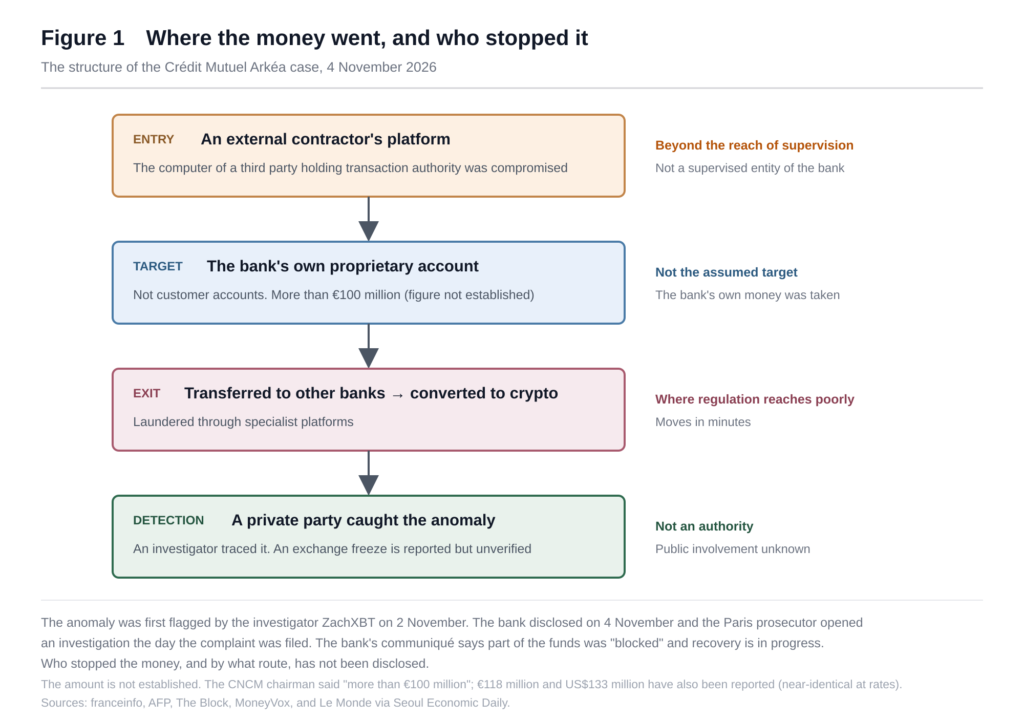
Figure 1: The entry point lay outside supervision; the target was the bank’s own funds rather than customer accounts; the exit lay in a domain regulation reaches poorly. The anomaly was caught by a private party, not an authority.
Cyberattacks on financial institutions have historically centred on account takeover or data theft. This case satisfies three conditions at once: the bank’s own funds were the target, the entry point lay outside supervision, and the exit lay where regulation reaches poorly.
Falsification criterion: if it is later confirmed that the transfers from Arkéa’s proprietary account arose from internal factors rather than a contractor compromise, this chapter’s characterisation — that the entry point lay outside supervision — does not hold.
Chapter 2 The same entry point exists in Japan
How the question is posed
This paper does not ask whether Japanese banks will suffer the same loss. The defences of a particular institution cannot be assessed from public sources, and such a question only invites speculation.
The question worth asking is whether the same entry point and the same exit exist in Japan. That can be settled from the public record.
The entry point: the government has acknowledged it
[Confirmed] The Emergency Package opens with this:
In recent breach cases — unpatched known vulnerabilities, misconfigured websites, insufficient security during application development — many instances show that basic controls at the organisation itself or at its contractors were inadequate.
[Confirmed] In October 2026 Japan saw a run of incidents entering through contractors and shared platforms.
| Date | Incident | Nature of the entry point |
| 7 Oct | Ransomware against IDCF Cloud’s East Japan region, affecting 495 contracting companies and local governments | Non-designated cloud platform |
| 9 Oct | JR East (Eki-net and others, up to c. 2.06 million records), View Card and JR Kyushu disclosed possible leakage from a mail distribution service running on IDCF infrastructure (on 15 October, based on the contractor’s report, judged that no leak had occurred) | A contractor of a contractor of a designated operator |
| 19–21 Oct | Unauthorised access to GMO Internet’s “Onamae.com Desktop Cloud.” Potentially affected servers: 26,739 | Unsupervised VPS |
The GMO case ran straight into finance. The service is a virtual desktop used for automated FX trading, and automated trading software runs while logged in to the trading account. Login credentials for FX and securities accounts are therefore commonly stored inside the VPS. GMO’s own announcement describes the possibility that account credentials stored in trading tools were obtained and misused.
[Confirmed] The harm materialised.
• On 22 October the Financial Services Agency issued an emergency notice, through the Financial Futures Association of Japan, to every FX operator: prompt users to change passwords, alert them to check for unrecognised transactions, and tighten monitoring of customer activity.
• On 27 October, Satsuki Katayama, Minister for Financial Services, disclosed at a post-cabinet press conference that five FX operators had reported customer losses: Gaitame.com (Golden Way Japan), OANDA Japan, AvaTrade Japan, Forex Finest and Dukascopy Japan.
• The firms suspended trading for affected customers, blocked orders judged fraudulent and reset passwords.
The attack method has also been identified
[Confirmed] The package text names A2B attacks as one cause of the run of domestic breaches, crediting the National Institute of Information and Communications Technology (NICT) with identifying them. An App-to-Backend attack analyses a publicly available application and exploits what it learns to attack the backend server the application connects to.
[Assessment] The technique treated as the fourth gap in the predecessor paper — probing APIs inferred from public applications — has now been given a name in a government document. As set out below, however, no item among the 66 imposes a minimum standard for public APIs as a condition of doing business.
Where is the entry point? The shared foundation nobody has designated
A step down is needed here. Arkéa’s “external contractor’s platform,” GMO’s VPS and IDCF’s cloud infrastructure are all, physically, inside somebody’s data centre.
[Confirmed] What happens when a data centre itself stops is already on the record. On 1 March 2026, AWS data centres in the UAE and Bahrain were struck by drone attacks; two of three availability zones in the UAE region and one zone in Bahrain ceased functioning. Multiple compartments on separate power supplies failed simultaneously, nullifying the redundancy design on which cloud architecture rests. The outage propagated to payment applications (Careem, Alaan, Hubpay) and banks (ADCB, Emirates NBD). The Bahrain region remained impaired five months later and AWS suspended billing for it (this institute’s “Four-Layer Frame: Failure Cases and Countermeasures,” 30 July 2026; English edition).
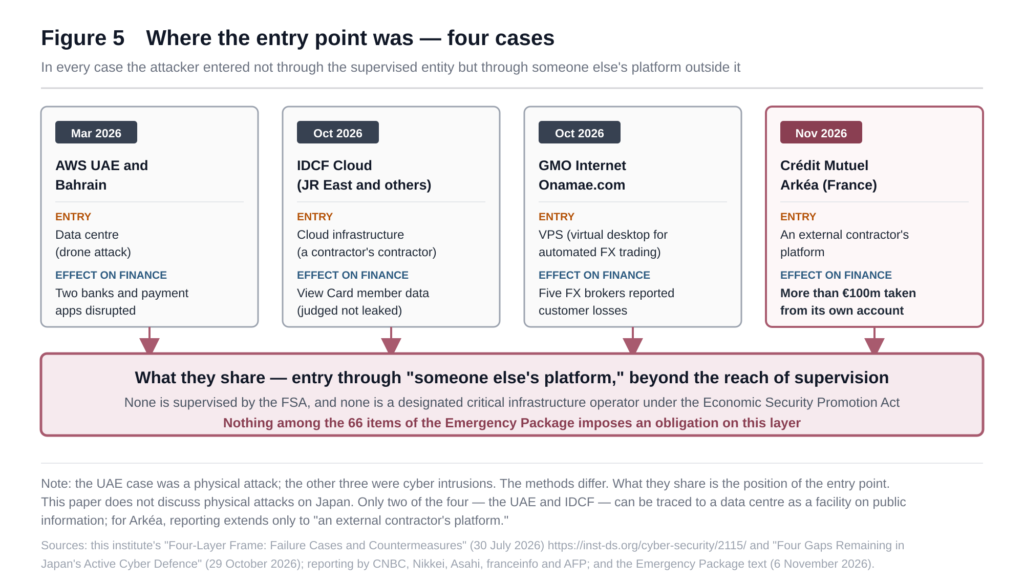
Figure 5: In all four cases the attacker entered not through the supervised entity but through someone else’s platform outside it.
[Assessment] This paper does not discuss physical attacks on Japan. One point only is taken from the UAE case — when a data centre stops, banks and payments stop. It is the recorded causal fact that shows how much of finance rests on that layer.
The scope of the claim must be limited here. What the four cases share is one thing: entry through someone else’s platform, beyond the reach of supervision. The methods differ — the UAE case was a physical attack, the other three were cyber intrusions. Moreover, only two of the four — the UAE and IDCF — can be traced to a data centre as a facility on public information. What is reported of Arkéa extends only to “an external contractor’s platform”; this paper does not assert that the platform sat in a data centre. What binds the four is not the facility but their position in the regulatory structure.
[Confirmed] That foundation has no category of its own among the 15 critical infrastructure sectors under the Economic Security Promotion Act. This institute has treated data centres in “Four-Layer Frame” (July) and contractor-route intrusion in “Shinkansen and Kasumigaseki Are Both Under Threat” (April). The predecessor paper (October) called the same void “Gap 1: Scope.”
[Assessment] From siting strategy, from the reach of the statute, and from financial supervision: three different angles arriving at the same void. This is, however, three observations by one institute, not independent third-party verification. Absent external review, this paper does not present it as proof that the gap exists. What can be stated is only that three papers written on different subjects each arrived at the same institutional seam.
Falsification criterion: if the unauthorised trading arising from credentials stolen in the GMO case — including the five FX firms’ reports — turns out to have been limited in scale and blocked early by each firm’s monitoring, the practical weight of the claim that “the same entry point exists” is reduced.
Chapter 3 The mismatch between who is supervised and where attacks enter
The reports did arrive
One point deserves care. In the GMO case, the reports reached the Financial Services Agency. The five FX firms reported their losses and the minister disclosed them at a press conference. The problem is not a failure to report.
[Assessment] The problem is that the supervisory net and the attack route do not overlap.
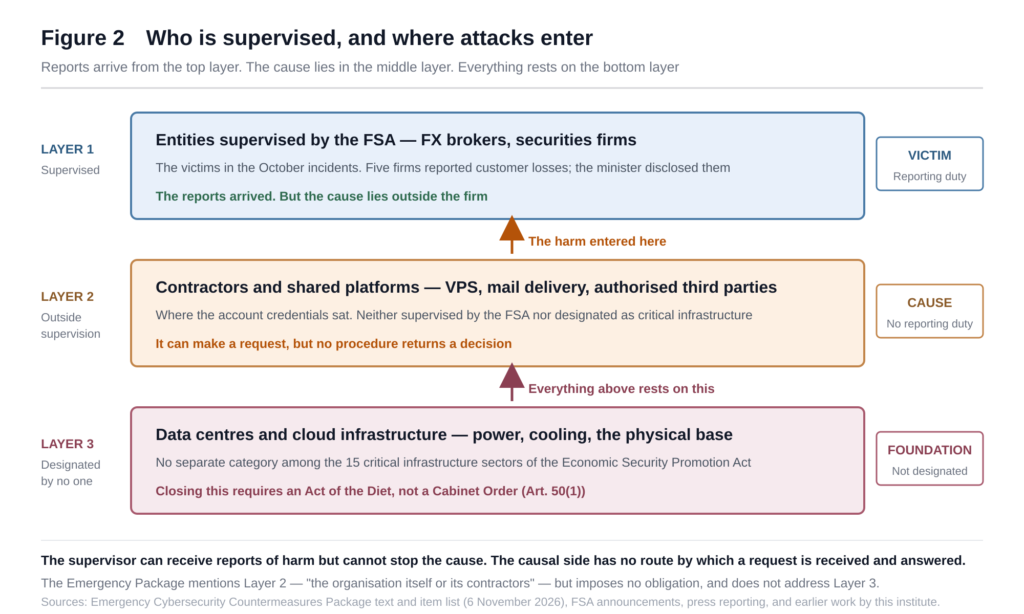
Figure 2: Reports arrive from Layer 1. The cause lies in Layer 2. Everything rests on Layer 3. The package mentioned Layer 2 but imposed no obligation on it, and did not address Layer 3.
The FSA’s emergency notice of 22 October was directed at FX operators. Prompting password changes and tightening transaction monitoring are measures asked of the victims. The notice went only to the victim side. Nothing was issued to the VPS provider on the causal side.
On the causal side, GMO asked the government to apply active cyber defence. A senior official of the National Cyber Office explained that no mechanism exists for accepting requests from individual companies (the predecessor paper’s third gap).
[Assessment] The resulting configuration: the supervisor can receive reports of harm but has no power to stop the cause; the causal side has no route by which a request is received and answered.
6 November: the FSA asked users to protect themselves
[Confirmed] On 6 November, following the package decision, the FSA published “A Request to Users of Financial Institutions in Light of the Current Situation.” It asks users not to click links in emails casually, not to reuse passwords, to use phishing-resistant multi-factor authentication, and to contact their institution promptly if notified of an unrecognised transaction.
[Assessment] The party addressed is the user and what is asked is self-protection. The measure is necessary, but it does not touch the structure by which harm enters from a place supervision does not reach.
Three reporting channels
[Confirmed] A financial-sector firm that suffers an incident may have to report to several places: the Personal Information Protection Commission (statutory duty, for personal data breaches); the Financial Services Agency (crime-occurrence and related reports under supervisory guidelines); and the National Cyber Office (incident reports under the Cyber Response Capability Enhancement Act, for designated operators in the 15 critical infrastructure sectors, in force since 1 October 2026).
[Confirmed] The package moves to consolidate this. The item list provides that for incidents causing serious harm, the competent ministry will “promptly collect information and report to the NCO,” on the model of the information-sharing scheme under the Critical Infrastructure Cybersecurity Action Plan.
[Assessment] This is reporting from ministries to the NCO, not a rationalisation of operators’ own reporting duties. From the victim firm’s side, the destinations remain plural. Whether consolidation lightens the operational burden depends on implementation.
Falsification criterion: if subsequent operational guidance clarifies the relationship between existing FSA reporting and NCO consolidation, and presents a mechanism avoiding duplicate reporting by operators, the point made in this section is resolved.
Chapter 4 What the Emergency Package decided
[Confirmed] On 6 November 2026 the government convened the second meeting of the Ministerial Council on Cybersecurity at the Prime Minister’s Office and adopted the Emergency Cybersecurity Countermeasures Package. It consists of a nine-page text and an annexed list of measures, 66 items in total. The same cabinet meeting approved approximately ¥10 billion from the FY2026 contingency reserve.
The package states its goal as “a society with world-leading cyber resilience” and positions itself as “a starting point” for shifting Japan to a form of cybersecurity appropriate to the AI era.
Four pillars
| Pillar | Principal measures |
| (1) Thorough basic controls, using AI | Advisories across operations, design/development and supply chain / minimisation of retained personal data, revision of the safety-management guidelines (target: January 2027) / expanded identity verification via My Number Card IC chip / Top Gun talent team (within November, at IPA) / accelerated AI vulnerability diagnosis of government systems, IT asset management including SBOM / local-government cybersecurity support team / strengthening the AI Safety Institute, aiming to build an information-sharing framework with the UK AISI / resilience in the financial sector [FSA] / sector measures for telecoms, healthcare, schools, universities and port terminal operating systems |
| (2) Information collection, investigation and analysis | Encouraging security vendors and ISMAP-registered cloud providers to join the Cyber Council / early acquisition of pre-disclosure vulnerability information from major overseas digital and frontier-AI companies / incident reporting from ministries to the NCO / strengthening NICT’s analytical capacity, which identified A2B attacks; construction of “STARDUST BD” to reproduce AI-agent attacks / pilot supply-chain attack observation network (target: early 2027) / under the SCS evaluation scheme (starting March 2027), a mechanism to request information from “★”-rated firms / police equipment including crypto-asset tracing |
| (3) Strategic response to attacks | Outreach team (within November; NCO makes contact proactively) / Public-Private Cyber Rescue Team (secretariat within FY2026) / Joint Response Team (operational early in FY2026) / Fast Forensic Force (FFF) (National Police Agency and regional police bureaux) / all-Japan joint investigation structure across all 47 prefectural police / adding recovery and backup to the “Cyber Security Rescue Squad” / government-led threat hunting / access and neutralisation measures, takedown of attack infrastructure / building “face-to-face relationships” with allies and like-minded states |
| (4) Victim support and limiting damage | Police to open a corporate-only consultation and reporting desk, “Cyber Damage 110” (provisional) / free consultation via IPA and Yorozu support centres / Consumer Affairs hotline (188) as the general individual-facing contact / “Cyber Response Special Site” (opened 30 October) / urgent study, including legal issues, of access suppression by telecommunications carriers [MIC] / countermeasures against false and misleading information / training for some 60,000 digital promotion officers |
| (5) Other | Human resources / study of system-related contracts defining who is responsible for vulnerability remediation / roadmap for post-quantum cryptography migration in FY2026 / quantum key distribution network across the Tokyo–Nagoya–Osaka trunk |
How cloud and data centres were treated
[Confirmed] Three of the 66 items concern cloud.
| Provision | Ministry | Character |
| ISMAP-registered cloud providers are encouraged to join the Cyber Council and strengthen cooperation | NCO / MIC | Voluntary request |
| Steady migration to the Government Cloud; its use for important shared government systems and stronger operational monitoring | Digital Agency | Government systems |
| AI source-code vulnerability inspection required for Government Cloud systems by FY2027 | Digital Agency | Source code |
[Confirmed] For telecommunications carriers, by contrast:
Conduct a comprehensive review of data protection and security at telecommunications carriers, who carry the infrastructure of infrastructure, and carry out the necessary institutional arrangements. [MIC]
[Assessment] Telecommunications carriers get “institutional arrangements”; cloud providers get “encouraged to join a council.” Neither the text nor the item list says anything about data centres as facilities — power, cooling, physical protection, siting. Cloud is addressed as a service, not as a facility.
This is the same distinction as the Layer 3 problem in Chapter 3. For cloud as a service, frameworks already exist — ISMAP, the Cyber Council. For the facility, there is no framework at all. Recommendation 1 addresses this second void.
The ¥10 billion
AI vulnerability checks on government systems, approximately ¥2 billion; police equipment and training for cyber investigations, approximately ¥4.1 billion; security hardening of Digital Agency systems, approximately ¥3.8 billion.
[Assessment] The published breakdown is entirely capacity-building on the government side. No item is directed at protecting private shared infrastructure, or at supporting firms subjected to extortion.
An instruction issued outside the text
[Confirmed] At the meeting, Prime Minister Takaichi instructed Toshiharu Furukawa, Minister for Cybersecurity, to consider amending the Cyber Response Capability Enhancement Act, saying the government should “advance consideration of legislative amendment in order to strengthen the capacity to collect information on cyberattacks that also target Japan.” According to the Nikkei, options include extending the scope of analysis — currently limited to foreign-related communications — to domestic communications.
[Confirmed] This instruction does not appear in the package text. The text addresses only one medium-term item, “institutional development including the manner of information collection.”
Chapter 5 Were the four gaps closed?
The text and the 66-item list are read against the four gaps and six recommendations of the predecessor paper.
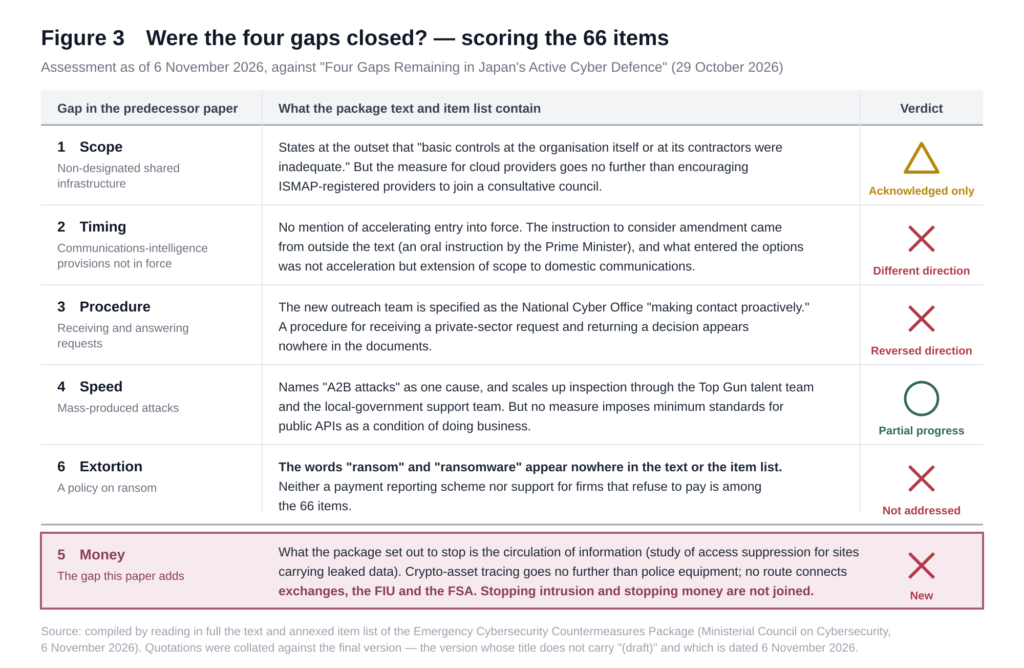
Figure 3: Scoring the predecessor’s four gaps, plus the fifth gap this paper adds.
Scoring
| Gap / recommendation | What the package contains | Verdict |
| Gap 1 — Scope (non-designated shared infrastructure)Rec. 1: designate shared digital infrastructure | Opens by acknowledging inadequate controls “at the organisation itself or at its contractors.” For cloud providers, only a request to ISMAP-registered providers to join the Cyber Council. No designation as critical infrastructure, no extension of reporting duties. Nothing on data centres as facilities. Telecommunications carriers get “the necessary institutional arrangements” — the two are treated differently. The NCO advisory of 5 November also asked the principal, not the contractor | △ Acknowledged, not legislated |
| Gap 2 — Timing (communications-intelligence provisions not yet in force)Rec. 3: accelerate entry into force together with stronger oversight | The text says nothing about acceleration. Amendment arose instead from an instruction outside the text, with extension to domestic communications among the options | × A different direction. Not acceleration but widening of scope may come first |
| Gap 3 — Procedure (receiving and answering private-sector requests)Rec. 2: a receive-and-respond procedure | The outreach team is specified as the NCO making contact proactively. The rescue team responds to requests from victim organisations, but no procedure is described for receiving and answering a request for a neutralisation measure. The special site opened two days after the decision is a list of existing contact points | × Addressed but unresolved. The direction is reversed |
| Gap 4 — Speed (mass-produced attacks against manual remediation)Rec. 5: minimum standards for public APIs | A2B attacks named; Top Gun team, local-government support team, and acquisition of pre-disclosure vulnerability information from AI companies all specified. Nothing requires minimum API standards within the SCS evaluation scheme | ○ Partial progress. Inspection scales up; the minimum standard as a condition of business does not exist |
| Rec. 4 — A contact point for AI-origin incidents and criteria for international cooperation | Strengthened AISI, and an explicit aim to build an information-sharing framework with the UK AISI. International cooperation framed as “face-to-face relationships.” No criteria for what Japan gives, and to whom | △ One side only. The receiving side is designed; the giving side has no standard |
| Rec. 6 — A policy on extortion-type attacks | The words “ransom” and “ransomware” appear nowhere in the text or the item list. No payment reporting scheme; no support for firms that refuse. Only the study of access suppression | × Not addressed. Information flow is to be stopped; money is not mentioned |
On the wording of verdicts: this paper distinguishes “not addressed” from “unresolved.” “Not addressed” means no measure corresponding to the issue has been put in place. “Unresolved” means a measure exists but the problem remains. Only Gap 3 is the latter: an outreach team was created, but it is not designed to receive requests and return answers.
Assessment
[Assessment] The package’s centre of gravity is support after harm and inspection beforehand. Both were asked for in the predecessor paper, and both deserve credit. The rescue team, the Joint Response Team, the FFF and the all-Japan joint investigation structure raise the floor for the initial response of firms without money or specialist staff. The “Cyber Damage 110” desk settles, for a corporate victim, where to call first.
By contrast, the three matters the predecessor paper raised as questions of institutional reach — scope (who bears a reporting duty), procedure (what comes back after a request), and extortion (what happens to the money) — are not met head-on.
Two points deserve particular attention.
First, the text recognises the contractor problem. It says “the organisation itself or its contractors” in its opening lines. Yet no measure imposes an obligation on contractors. What exists is a recommendation that the SCS scheme be used “as a method of contractor management by large firms,” and an encouragement to ISMAP-registered cloud providers to join a council. Both are voluntary. There is a gap between recognition and regulation.
That gap is not confined to the package. [Confirmed] On 5 November, the day before the decision, the National Cyber Office issued an advisory titled “On Measures Against Unauthorised Access Leading to Leakage of Personal Information,” asking that “basic measures be reaffirmed, including strengthened measures across the supply chain as a whole, including contractors.” On 6 November the Ministry of Internal Affairs and Communications circulated the same message to the operators it oversees. The addressees are businesses that operate websites and mobile applications and handle personal data. The sentence ends “we ask that you undertake,” not as a legal duty.
In other words, the government is telling principals to manage their contractors. It has not made the contractor itself the addressee. The package of the following day has the same structure. Recognition was stated on two consecutive days; an obligation was imposed on neither. The reason Layer 2 is out of reach is not a lack of will but the absence, under current law, of any instrument that makes Layer 2 an addressee.
Second, the handling of Gap 2. The predecessor paper asked that the communications-intelligence provisions be accelerated together with stronger oversight, and did not recommend extension to domestic communications. What has emerged is not acceleration but consideration of a wider scope, and it sits outside the package text. The access suppression measure in Pillar 4 also touches the secrecy of communications. Two separate questions may begin moving independently, without the oversight design that should accompany them.
Falsification criterion: if a subsequent roadmap or draft amendment is confirmed to contain any of the following — designation of cloud and data centres, a procedure for answering private-sector requests, or a ransom payment reporting scheme — the corresponding verdict is revised.
Chapter 6 The money gap: leaked information is to be stopped; who stops stolen funds?
A fifth gap
[Assessment] To the predecessor paper’s four gaps, this paper adds a fifth.
Gap 5 — Money: the system for stopping intrusion and the system for stopping stolen funds are not connected.
What the package announced under Pillar 4 was that it would “urgently study, including legal issues, the manner of access suppression by telecommunications carriers in order to prevent misuse of leaked personal information.” What is to be stopped is the circulation of information.
What the French case demonstrated is an attack in which the money itself leaves. Here what must be stopped is not information but a transfer, and what must be followed is a crypto address.
Crypto is mentioned; a channel is not
[Confirmed] The National Police Agency items include this:
Because incidents exploiting anonymity in cyberspace are becoming more sophisticated, compounded by the misuse of AI, procure the equipment necessary to advance investigation and fact-finding, including crypto-asset tracing and the use of AI (continuing from before FY2026).
[Assessment] This is investigative capacity, and it is a continuing programme. A route by which an exchange that detects outflowing funds notifies the authorities; a route by which the authorities ask an exchange to freeze; a procedure connecting the suspicious-transaction information held by the Financial Intelligence Unit with cyber incident information — none of the three is among the 66 items.
In Japan, who stops it?
[Assessment] Transposed to Japan, authority over the French case would divide as follows.
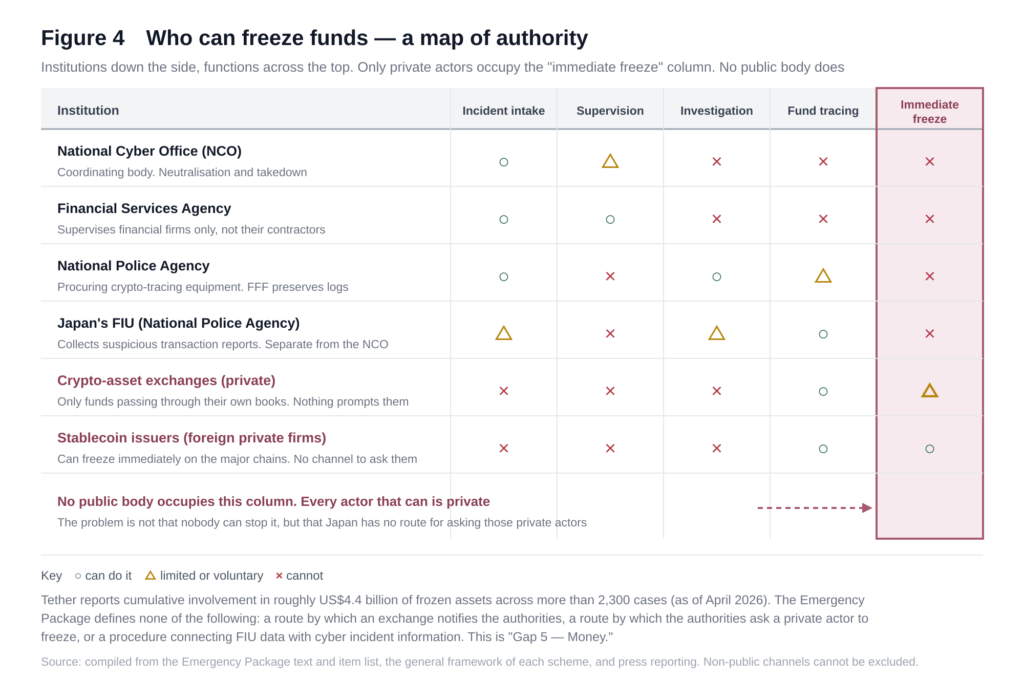
Figure 4: Institutions down the side, functions across the top. No public body occupies the “immediate freeze” column.
Someone can stop it
A misunderstanding should be avoided here. Actors able to freeze funds immediately do exist. They are not public authorities.
[Confirmed] Stablecoin issuers hold, and exercise, the technical power to freeze specific addresses for the tokens they themselves issue, on the major chains where those tokens circulate. According to reporting of 23 April 2026, Tether has been involved in freezing roughly US$4.4 billion in assets cumulatively (approximately US$2.1 billion of it connected to US authorities), has assisted in more than 2,300 cases, and states that it cooperates with more than 340 law enforcement agencies across 65 countries. On the same day it froze more than US$344 million linked to illicit activity in cooperation with OFAC and US law enforcement. Some outlets describe the company as “crypto’s shadow law enforcement.”
[Confirmed] Those freezes are not, however, the execution of an order grounded in law. Reporting indicates that some were made in response to informal requests from US law enforcement, and the company is being sued over their lawfulness.
So the structure is this. The actor able to stop crypto-converted funds fastest is a foreign private company. That company does, in practice, respond to requests from US authorities. No public route by which Japanese authorities could make the same request can be confirmed from the package text or from any public source.
[Assessment] The gap this paper points to is not that nobody can stop it. It is that someone can, and Japan has no way of asking. The same holds domestically: if a Japanese exchange detects outflowing funds, no institutional route exists for notifying the NCO, the National Police Agency or the FSA and receiving a decision.
Japan already has a precedent
The same entry point and the same exit occurred in Japan in 2024.
[Confirmed] In May 2024, approximately 4,502.9 bitcoin — worth roughly ¥48.2 billion at the time — left DMM Bitcoin. In domestic terms this is the second-largest such loss, after the Coincheck case of 2018 (NEM, roughly ¥58 billion).
[Confirmed] On 24 December 2024, drawing on the investigation and analysis of the Kanto Regional Police Bureau’s Cyber Special Investigation Unit and the Tokyo Metropolitan Police Department, the National Police Agency jointly with the FBI and the US Department of Defense Cyber Crime Center (DC3) attributed the attack to TraderTraitor, a North Korea-linked group. The NPA, the National Center of Incident Readiness and Strategy for Cybersecurity and the FSA issued a joint advisory the same day.
[Confirmed] The intrusion did not begin at DMM Bitcoin. The published method: posing as a recruiter on LinkedIn, the attacker approached an employee of Ginco, the company to which DMM Bitcoin had outsourced crypto-asset custody. Under the guise of a hiring test, the attacker sent a URL for a malicious Python script and compromised the environment of an employee holding access rights to the wallet management system. In mid-May, using a session cookie, the attacker impersonated that employee and gained access to Ginco’s unencrypted communications system. In late May, the attacker altered a legitimate transaction request made by a DMM employee.
[Assessment] The DMM case, too, came through a contractor. The supervised exchange was not what broke. What broke was the custody contractor outside it. The structure this paper has traced since Chapter 2 had already appeared in Japan, in 2024, at the second-largest scale on record.
What is new, and what is not
This paper therefore defines its novelty narrowly.
[Confirmed] Attacks targeting a bank’s own money are not new. In the 2016 Bangladesh Bank case, SWIFT payment instructions were abused and approximately US$81 million left.
[Confirmed] The combination of a contractor entry point and a crypto exit is not new either. The DMM case is the 2024 precedent.
[Assessment] What this paper claims as new is confined to one point: the target was a bank’s own balance sheet. What was taken in the DMM case was crypto-assets an exchange held on behalf of customers. What was taken at Arkéa was money the bank held in its own right. Not a crypto exchange but a deposit-taking commercial bank had its own assets reduced, directly, through a contractor.
[Assessment] And for this paper’s argument, the DMM precedent is not a weakness. It is the opposite. The combination has already succeeded once in Japan. The Arkéa case showed that the same combination also reaches a commercial bank’s own account.
What followed the DMM case
[Confirmed] On 26 September 2024, the Kanto Local Finance Bureau issued a business improvement order to DMM Bitcoin under Article 63-16 of the Payment Services Act, requiring analysis of the facts and root cause of the outflow, assurance of proper and reliable operations, and thorough protection of affected customers.
[Confirmed] The addressee of that order was DMM Bitcoin itself.
[Assessment] This paper has not verified whether Ginco is registered as a crypto-asset exchange service provider. The company supplies wallet management software, and registration as a crypto-asset exchange service provider appears unlikely. The point is recorded as unverified.
On whom is the duty to manage contractors imposed?
[Confirmed] A duty to manage contractors does exist — and it sits in the statute itself, not in a Cabinet Office ordinance. Article 63-9 of the Payment Services Act (Guidance to Contractors) provides that where a crypto-asset exchange service provider outsources part of its operations to a third party (including outsourcing across two or more tiers), it must take
measures necessary to ensure the proper and reliable performance of the operations, including guidance to the contractor to which the operations are outsourced
[Confirmed] The party bearing the duty is the exchange. The contractor appears as the object of guidance. The Cabinet Office Ordinance issued under that article (Cabinet Office Ordinance on Crypto-Asset Exchange Service Providers, Article 16) specifies periodic confirmation of the contractor’s performance, “measures to conduct necessary and appropriate supervision,” re-outsourcing where a contractor becomes unable to perform, and amendment or termination of the contract as required. All of these are obligations on the principal.
[Assessment] The design is consistent: make the principal direct the contractor. The contractor is not an addressee of this statute.
[Assessment] That the business improvement order in the DMM case stopped at DMM Bitcoin can be read as the consequence of this design. Even where the entry point is at the contractor, the party the law contemplates as addressee is the principal. And this is the same structure as the package examined in Chapter 2. The NCO advisory of 5 November also directed its request for contractor management at the principal. The addressee of supervision stays with the principal while the attack comes in through the contractor. The same design repeats across domains.
[Assessment] What Recommendation 1 therefore asks is that a “duty to make someone manage a contractor” be connected to “a duty the contractor bears itself.” A design that places the obligation on the party giving guidance works only so far as the principal can observe the contractor’s actual state. In the DMM case what was compromised was the access rights of a contractor’s employee and the contractor’s unencrypted communications system. That lies beyond what a principal can reach by giving guidance.
[Limitation] This paper has not verified whether Article 63-14 (requests for reports) and Article 63-15 (on-site inspection) of the Payment Services Act reach contractors. The Act contains provisions on reports and inspection of contractors for prepaid payment instrument issuers (Article 24(2)) and funds transfer service providers (Article 54(2)), and equivalent provisions may exist for crypto-asset exchange service providers. If they do, the authorities would hold the power to look at a contractor while lacking any mechanism to place a duty on it directly. This paper’s point holds in that case as well.
Connection to earlier work
[Assessment] This institute’s “Are Japan’s Banks Paying Attention? Iran’s ¥900 Billion Is Closing In on the Japanese Financial Network.” (April) examined how Iranian sanctions-evasion networks enter the international financial system through crypto-assets and fintech. Its subject was sanctions evasion, but the tracing techniques and routes are the same as for funds stolen by hacking.
That paper recommended strengthening the FSA’s information-sharing framework with FinCEN and mandating sanctions screening at crypto exchanges. From the present paper’s standpoint, those are also capabilities for responding to cyber incidents. Japan’s FIU function sits with the National Police Agency’s criminal proceeds transfer prevention office (internationally referred to as JAFIC) — an organisation separate from the NCO, which handles cyber incidents. That separation reproduces the pattern identified in Chapter 4 of the predecessor paper: two reporting systems that do not connect.
Falsification criterion: if it is confirmed that a channel already exists and operates in Japan, connecting crypto-asset exchanges with investigative and financial authorities for funds stolen through cyberattack, the diagnosis of a “money gap” in this chapter is weakened.
Chapter 7 Policy recommendations
There are five. They carry forward those of the predecessor paper that the package did not meet, and add the money question. None requires creating a new organisation.
The division first. Recommendations 1, 4 and 5 bear directly on this paper’s axis — the contractor entry point and the crypto exit. Recommendations 2 and 3 are not money recommendations; they follow directly from the scoring in Chapter 5 and are included as the continuation of the predecessor paper.
Recommendation 1 Designate shared digital infrastructure by statutory amendment
Add cloud services, data centres and submarine cable landing stations, as “shared digital infrastructure,” to the scope of the Economic Security Promotion Act and the active cyber defence legislation. Require designated operators to disclose the non-designated shared infrastructure on which their critical systems depend.
This gap cannot be closed by an emergency package. [Confirmed] The businesses subject to regulation (specified critical infrastructure businesses) are set out in the body of the statute, as an enumerated list of items in Article 50(1) of the Economic Security Promotion Act; the matter is not delegated to Cabinet Order or ministerial ordinance. When healthcare was added in 2026, it was done by amending that paragraph to insert a fourteenth item (House of Councillors Committee Research Office, Legislation and Research, April 2026, No. 483; Cabinet Office briefing materials). [Assessment] Adding data centres to the protected scope therefore requires an Act of the Diet, not an amendment to subordinate legislation. It is not a matter the executive can dispose of within a fiscal year.
[Assessment] This also changes how one should judge the package’s silence on the gap. Before it is a question of priority, it is a gap that an emergency package cannot, in principle, close. Which is precisely why the legislative review the Prime Minister ordered should cover not only wider information-collection powers but wider reporting obligations.
Even after an item is added, the criteria for designating operators and the scope of specified critical equipment are set by Cabinet Order and ministerial ordinance, so two stages are required before the rules bite. In the healthcare case, up to one year and six months was allowed between promulgation and entry into force.
• Short term: require designated operators to notify their dependencies, by ordinance and guidance
• Medium term: add an item to Article 50(1) at the next ordinary session of the Diet
Verification point: the 2027 ordinary Diet session. Whether a bill is introduced making cloud and data centre operators subject to reporting duties.
Recommendation 2 Add a “receive and respond” function to the outreach team
(This recommendation does not concern money; it follows from the Chapter 5 verdict on Gap 3.)
The outreach team to be established within November runs from government to companies. Add to it a function for receiving requests from the private sector and notifying the requesting party of the outcome of the decision — not whether a measure was taken, but that consideration has concluded. The notification may be confidential. No new organisation is needed.
The decision on whether to act can remain with the government. What is needed is that the requesting party knows what will come back.
[Update, as of 9 November 2026] After this paper went to press, the National Cyber Office published a special page, the “Contact Point and Advisory Hub.” What it lists is existing consultation and reporting destinations: the National Police Agency’s reporting desk, IPA’s special desk for unauthorised access and its general security desk, the consumer hotline (188), and SME desks. No procedure for receiving a request and returning a decision is set out. No response deadline is defined. As the name indicates, these are a contact point and advisory services, and both run from government to the private sector. Gap 3 remained open two days after the package was adopted.
Verification point: the launch of the outreach team (within November 2026). Whether its operating rules include the receipt of, and response to, private-sector requests.
Recommendation 3 Design access suppression and domestic communications intelligence together with their oversight
(This recommendation likewise does not concern money; it follows from the Chapter 5 verdict on Gap 2.)
Access suppression by telecommunications carriers and the use of domestic communications intelligence both touch the secrecy of communications. Avoid advancing them as two separate studies in parallel; design them together, conditional on strengthening the staffing and inspection capacity of the Cyber Communications Intelligence Oversight Commission.
The “institutional separation of information and authority” set out in the predecessor paper — placing the function that collects information and the authority that takes measures under separate approval chains — applies here too. Extending the scope to domestic communications before the controls on foreign-related communications intelligence are shown to work in practice is not advisable.
Verification point: when the amendment bill is introduced. Whether strengthening the Commission is contained in the same bill.
Recommendation 4 Set the procedure and the legal basis for stopping funds, separately for domestic and foreign counterparts
For funds that leave through a cyberattack, establish the following four things — filling the empty column in Figure 4.
The gap must be divided in two. What is missing domestically and what is missing abroad are different things, and one measure will not close both.
| Domestic crypto exchanges | Foreign stablecoin issuers | |
| Japan’s authority | Supervisory power exists (registered under the Payment Services Act) | None |
| What is missing | A procedure. Who to notify on detecting outflowing funds, and what the authorities return, is undefined | A channel. Neither who makes the request nor on what basis is defined |
| What exists today | Suspicious transaction reports under the anti-proceeds legislation — not designed with cyber incidents in mind | Informal requests by US authorities, functioning in practice |
(a) Domestic — define the procedure and write it into supervisory documents. Formalise the route by which an exchange notifies the NCO, the National Police Agency and the FSA when it detects an incoming transfer that appears to be stolen funds, and the route by which the authorities raise an alert. Connect the crypto-tracing equipment the package funds to that route.
[Assessment] This appears capable of being handled without new legislation. Crypto-asset exchange service providers are registered under the Payment Services Act and the FSA already holds supervisory power; setting out the procedure would be an exercise of that power, written into administrative guidelines. This paper has not, however, verified how far current guidelines already address stolen funds in cyber incidents. Reconciling the new text with existing provisions requires practical review.
(b) Domestic — connect the FIU. Establish a procedure allowing mutual reference between the suspicious-transaction information held by the National Police Agency’s criminal proceeds transfer prevention office (JAFIC) and the cyber incident information consolidated by the NCO.
(c) Abroad — decide who makes the request, and on what basis. This is harder than (a) and (b). Japanese authorities are not in a position to issue orders to a foreign issuer. But US authorities do make requests and issuers do comply. The problem is therefore not the presence or absence of power. It is that who asks, on what basis, and through which channel has not been settled on the Japanese side.
[Assessment] The first thing to settle is who asks: the investigative authority (National Police Agency), the supervisor (FSA), or the coordinating body (NCO). The second is on what basis: within a mutual legal assistance framework, as a supervisory request for cooperation, or connected to FIU-to-FIU information exchange.
Until those two are settled, any contact made case by case will depend on the judgement and personal network of the individual official. No record remains, and the reasoning cannot be reviewed afterwards. When that official moves on, the channel ends there.
[Confirmed] Freezes by issuers are themselves contested. The company has been sued over freezes made on informal US requests. This paper therefore does not say “do as the United States does.” What Japan should establish is a form in which a request is recorded, its basis can be stated, and it can be reviewed afterwards.
(d) International information sharing. Extend information sharing with FinCEN and other national FIUs to funds stolen in cyber incidents. The scope of what is shared should follow the criteria set out in the predecessor paper’s fourth recommendation: counterpart, content, reciprocity, decision rights, documentation and suspension conditions, channel security, redundancy, and post-hoc inspection.
Verification point: end of March 2027. For (a), whether a procedure appears in supervisory documents; for (c), whether it is made clear who makes the request. (a) and (b) may be achievable through administrative practice and can be started earlier than (c).
Recommendation 5 Adopt a national policy on extortion-type attacks
This carries forward the predecessor paper’s sixth recommendation. That the word “ransom” appears nowhere in the 66 items shows the issue was not carried over.
1. Create a ransom payment reporting scheme. Before prohibition, establish what is actually being paid. Australia’s scheme (reporting within 72 hours of payment) is a reference point.
2. Formalise support for firms that refuse to pay. Takedown requests to limit the spread of exposed data, alerts to users, and preparation for secondary harm, set out as a national support procedure. Position the study of access suppression as part of that procedure.
3. Publish after-action reviews. Individual measures may remain confidential, but once an incident has settled, publish a review of what the state did.
Verification point: the 2027 ordinary Diet session. Whether payment reporting is included in a bill.
What can be checked shortly
• Whether the outreach team’s operating rules include receipt of, and response to, private-sector requests (within November)
• Whether the amendment to the Cyber Response Capability Enhancement Act includes wider reporting obligations and a strengthened Oversight Commission
• How the relationship with the secrecy of communications is resolved in the study of access suppression
• Whether minimum standards for public APIs are included in the SCS evaluation scheme (starting March 2027)
• Whether cloud and data centres are included in the “necessary institutional arrangements” the Ministry of Internal Affairs and Communications is pursuing for telecommunications carriers
• On what conditions the information-sharing framework with the UK AISI is built (whether the scope of what is shared, and the conditions for suspension, are specified)
Outside Japan’s control, but decisive for this paper’s conclusions
The following lie beyond the Japanese government’s authority. The outcomes will nonetheless change this paper’s premises.
• How far the Paris prosecutor’s investigation of the Crédit Mutuel Arkéa case proceeds, and how much of the money is recovered. If recovery advances, crypto-converted funds can be stopped, and the feasibility of Recommendation 4 rises. If not, the exit gap is deeper than stated here
• Whether the details of the entry point — which contractor, which privileges — are published. If they are, financial institutions can check whether the same conditions hold with their own contractors. If not, the same structure persists with nothing to inspect against
Limitations — what this paper could not verify
• The facts are based on official materials and reporting confirmed as of 9 November 2026. Passages marked [Assessment] are the author’s interpretation.
• The texts of Articles 63-14 (requests for reports) and 63-15 (on-site inspection) of the Payment Services Act have not been verified. Whether they reach the contractors of a crypto-asset exchange service provider is unconfirmed. The Act contains contractor provisions for prepaid payment instrument issuers (Article 24(2)) and funds transfer service providers (Article 54(2)), and equivalent provisions may exist for crypto-asset exchange service providers. This paper’s point — that the contractor is not the addressee of an obligation — rests on the confirmed fact that Article 63-9 and the Cabinet Office Ordinance issued under it make the principal the addressee. It does not assert that the authorities’ inspection powers fail to reach contractors.
• The text of Article 63-9 was verified through a quotation on a law firm’s commentary page. That quotation uses the pre-2019 terminology (“virtual currency exchange service provider”); this paper reads it as the current “crypto-asset exchange service provider.” The original on the e-Gov legal database was not reached.
• Whether Ginco is registered as a crypto-asset exchange service provider has not been verified. This paper treats the company as a provider of wallet management software; its legal status was not confirmed.
• The original PDF of the National Cyber Office advisory of 5 November could not be obtained. The wording quoted here comes from the passage reproduced on the Ministry of Internal Affairs and Communications notice page published the following day. The full set of measures in the original was understood through reporting (JAPANSecuritySummit Update, 9 November 2026) and has not been confirmed to match the original headings exactly.
• This paper collated its principal quotations against the final version of the package — the version whose title does not carry “(draft)” and which is dated 6 November 2026. The meeting-materials version consulted during initial drafting was titled “(draft)” with the date left blank; cross-checking against the final version published at a separate URL confirmed that every point quoted here matches: the opening reference to “the organisation itself or its contractors,” “carry out the necessary institutional arrangements” for telecommunications carriers, “encourage participation in the Cyber Council and strengthen cooperation” for cloud providers, and the establishment of the outreach team “within this month” with its proactive-contact character. That the words “ransom” and “ransomware” never appear was also confirmed in the final version. The summary version published alongside it was not obtained.
• The absence from the text and item list of the words “ransom” and “ransomware,” and of any reference to data centres as facilities (power, cooling, physical protection, siting), was confirmed by reading the documents in full. The possibility that equivalent expressions are used in another context cannot be entirely excluded.
• The breakdown of the ¥10 billion is from reporting. Where the running costs of the Public-Private Cyber Rescue Team are budgeted has not been confirmed.
• The original text of Crédit Mutuel Arkéa’s communiqué has not been verified. The amount is not established. The figures in circulation are the chairman’s acknowledged “more than €100 million,” Le Télégramme’s €118 million, and the US$133 million equivalent traced by ZachXBT, the latter two being near-identical at prevailing exchange rates. This paper adopts the figure stated by a participant, “more than €100 million.” The details of the entry point — which contractor, which privileges were abused — have not been published.
• This paper does not assert that the entry point in the Arkéa case was infrastructure in a data centre. Reporting extends only to “an external contractor’s platform,” and no public information showing that the platform was housed in a data centre could be confirmed.
• The figures on stablecoin issuers’ freezing record come from crypto trade media. Tether’s own published materials were not verified in the original. That no route exists from Japanese authorities to the company means that none appears in public sources; the existence of a non-public route cannot be excluded.
• Freezing by an issuer is limited to assets that have an issuer. For assets without one, such as Bitcoin and Ether, the request route described in Recommendation 4(c) does not reach. Which asset the Arkéa funds were converted into has not been published, and this paper has not verified it. The effectiveness of Recommendation 4(c) therefore depends on which asset stolen funds are converted into. This limitation does not apply to (a) and (b), which concern domestic exchanges.
• The account of Kraken’s freeze comes from Korean media citing Le Monde; no statement from Kraken itself has been verified.
• The original text of the FSA’s notice of 22 October has not been verified; the account is from reporting.
• The account of the data centre attacks in the UAE and Bahrain relies on the analysis in this institute’s “Four-Layer Frame: Failure Cases and Countermeasures” (30 July 2026). The reporting on which that paper relied (CNBC, TechPolicy.Press and others) was not re-verified in the original here.
• The account of the three reporting channels is based on the general framework of each scheme. Which reports are required in a particular incident depends on the nature of the incident and the type of business.
• The assessments of each institution in Figure 4 are the author’s own, based on public information. The possibility that a non-public channel already connects crypto exchanges with investigative and financial authorities in Japan cannot be excluded.
• Neutralisation measures are reported to be subject to a policy of non-disclosure, so whether any measure has been taken cannot be verified externally. This limitation is the same as in the predecessor paper.
References
Emergency Package (primary sources)
1. Ministerial Council on Cybersecurity, “Emergency Cybersecurity Countermeasures Package,” adopted 6 November 2026. Final version (title without “(draft),” dated). https://www.cas.go.jp/jp/seisaku/cybersecurity_kakuryokaigi/pdf/countermeasure.pdf
2. Same, “Emergency Cybersecurity Countermeasures Package (draft),” meeting-materials version, text and annexed list of measures. Consulted during initial drafting and collated against the final version. https://www.cas.go.jp/jp/seisaku/cybersecurity_kakuryokaigi/dai2/shiryo2.pdf
3. Cabinet Secretariat, “Ministerial Council on Cybersecurity.” https://www.cas.go.jp/jp/seisaku/cybersecurity_kakuryokaigi/index.html
4. Financial Services Agency, “A Request to Users of Financial Institutions in Light of the Current Situation,” 6 November 2026. https://www.fsa.go.jp/news/r8/sonota/20261106/20261106.html
5. Prime Minister’s Office, “Ministerial Council on Cybersecurity (first meeting),” 26 October 2026. https://www.kantei.go.jp/jp/105/actions/202610/26kaigi_cyber.html
6. National Cyber Office, “Cyber Response Special Site (Contact Point and Advisory Hub).” Accessed 9 November 2026. https://www.cyber.go.jp/tokusetsu/contactpoint_advisory_hub/index.html
7. Cabinet Secretariat, National Cyber Office, “On Measures Against Unauthorised Access Leading to Leakage of Personal Information,” 5 November 2026 (PDF: https://www.cyber.go.jp/pdf/press/261105_taiou.pdf ). Content confirmed via the Ministry of Internal Affairs and Communications page below.
8. Ministry of Internal Affairs and Communications, “On Measures Against Unauthorised Access Leading to Leakage of Personal Information (advisory for businesses),” 6 November 2026. https://www.soumu.go.jp/menu_kyotsuu/important/kinkyu02_000683.html
Emergency Package (reporting)
9. Jiji Press, “Government adopts cyberattack ‘emergency countermeasures package’,” 6 November 2026. https://www.jiji.com/jc/article?k=2026110600989&g=pol
10. Kyodo News, “Government studies blocking; AI to be used in cyber countermeasures,” 6 November 2026. https://www.chunichi.co.jp/article/1335754
11. Nikkei, “Prime Minister orders review of amendments to the active cyber defence law,” 6 November 2026. https://www.nikkei.com/article/DGXZQOUA0426D0U6A101C2000000/
12. Impress Watch, “Government formulates ‘Emergency Cybersecurity Countermeasures Package’; ¥10 billion from contingency reserve,” 6 November 2026. https://www.watch.impress.co.jp/docs/news/2154548.html
13. NTV NEWS NNN, “Government compiles ‘Emergency Cybersecurity Countermeasures Package’,” 6 November 2026 (66 items). https://news.yahoo.co.jp/articles/0c08b6b46585671e32f5266dc380fe2c777eca56
14. Jiji Press, “¥10 billion for strengthened cyber measures; government approves contingency spending,” 6 November 2026. https://news.yahoo.co.jp/articles/49bec3e5e3b51b44253805d49f5071d818455bf7
Crédit Mutuel Arkéa
15. franceinfo, “Des millions d’euros volés, une attaque inédite, une enquête ouverte… Ce que l’on sait du piratage du Crédit mutuel Arkéa,” 5 November 2026. https://www.franceinfo.fr/internet/securite-sur-internet/cyberattaques/des-millions-d-euros-voles-une-attaque-inedite-et-une-enquete-ouverte-ce-que-l-on-sait-du-piratage-du-credit-mutuel-arkea_8269124.html
16. AFP, “Crédit Mutuel Arkéa: cyberattaque pour près de 100 millions d’euros, enquête ouverte,” 4 November 2026 (via Boursorama). https://www.boursorama.com/actualite-economique/actualites/credit-mutuel-arkea-cyberattaque-pour-pres-de-100-millions-d-euros-enquete-ouverte-7a25b65f08450c07e9ea616dca1bfc71
17. ITmedia NEWS, “Cyberattack on French bank Crédit Mutuel Arkéa: entry via a contractor; fraudulent transfers of about €100 million,” 5 November 2026. https://www.itmedia.co.jp/news/article/2611/05/2000002891/
18. The Block, “Crédit Mutuel Arkéa confirms cyberattack after ZachXBT flags $133M in suspected losses,” 4 November 2026. https://www.theblock.co/news/business/2026-11-04-french-bank-confirms-cyberattack-434372
19. Seoul Economic Daily, “Hackers Steal 100 Million Euros From French Regional Bank,” 5 November 2026 (citing Le Monde and Kraken’s response). https://en.sedaily.com/finance/2026/11/05/hackers-steal-100-million-euros-from-french-regional-bank
20. presse-citron, “Fraude chez Crédit Mutuel Arkéa : la banque en dit plus sur la cyberattaque dont elle a été victime,” 4 November 2026 (updated 5 November; includes quotations from the bank’s communiqué — entry point, the distinction between blocking and recovery, and the basis for not confirming the amount). https://www.presse-citron.net/fraude-chez-credit-mutuel-arkea-la-banque-en-dit-plus-sur-la-cyberattaque-dont-elle-a-ete-victime/
21. MoneyVox, “Crédit Mutuel Arkéa a récupéré « une partie » des 100 millions d’euros dérobés par la cyberattaque,” 7 November 2026 (remarks by CNCM chairman Daniel Baal on France 5). https://www.moneyvox.fr/banque/actualites/111149/credit-mutuel-arkea-a-recupere-une-partie-des-100-millions-euros-derobes-par-la-cyberattaque
22. euronews, “Crédit Mutuel Arkéa victime d’une cyberattaque : 118 millions d’euros auraient été volés,” 4 November 2026. https://fr.euronews.com/2026/11/04/credit-mutuel-arkea-victime-dune-cyberattaque-118-millions-deuros-auraient-ete-voles
The GMO case and the FSA’s response
23. Nikkei, “FSA asks FX firms to strengthen monitoring of suspicious transactions after unauthorised access at a GMO company,” 23 October 2026. https://www.nikkei.com/article/DGXZQOUB23AR60T21C26A0000000/
24. Asahi Shimbun, “Unauthorised FX access: five domestic firms report losses; FSA calls for alerts,” 27 October 2026. https://news.yahoo.co.jp/articles/13af3c1dda4372a7f75d4a4e56f7ac88f07a553c
25. Yomiuri Shimbun, “Unauthorised access in FX trading: five firms report customer losses in GMO-related case,” 27 October 2026. https://news.yahoo.co.jp/articles/7f0be109989e61c6736d122d2f3565edd5c46d0a
26. Business+IT, “FSA issues emergency notice to FX firms; GMO and five domestic firms report unauthorised access,” 27 October 2026. https://news.yahoo.co.jp/articles/c4d11ceb85b0aef3d0fa26558ccfcdd7b2822a47
27. Nikkei, “GMO company: unauthorised access to automated FX trading service; customer information possibly viewed,” 21 October 2026. https://www.nikkei.com/article/DGXZQOUC2155P0R21C26A0000000/
The DMM Bitcoin case
28. Impress Watch, “DMM bitcoin outflow: North Korean group involved,” 24 December 2024. https://www.watch.impress.co.jp/docs/news/1650273.html
29. Atarashii Keizai, “Method of the DMM Bitcoin outflow revealed: North Korean hackers approached a Ginco employee — National Police Agency,” 24 December 2024. https://www.neweconomy.jp/posts/441333
30. ITmedia NEWS, “Business improvement order for DMM over the ¥48.2 billion bitcoin outflow,” 26 September 2024. https://www.itmedia.co.jp/news/articles/2409/26/news208.html
Freezing crypto-assets
31. Bitcoin.com News, “Tether Freezes 344MillioninUSDTWithOFACandUSLawEnforcement,”23April2026(reportingTether’spublishedfigures:approximatelyUS4.4 billion cumulative, more than 2,300 cases, cooperation with 340 agencies in 65 countries). https://news.bitcoin.com/tether-freezes-344-million-in-usdt-with-ofac-and-us-law-enforcement/
32. CoinDesk Japan, “Tether freezes USDT worth US$344 million linked to illicit activity on Tron,” 23 April 2026. https://www.coindesk.com/ja/business/2026/04/23/tether-freezes-usd344-million-in-usdt-on-tron-tied-to-illicit-activity
33. Phemex, “Tether faces lawsuit over a 42.4 million USDT freeze.” https://phemex.com/ja/news/article/tether-faces-lawsuit-over-424-million-usdt-freeze-tied-to-informal-us-request-95528
Statutes and guidance
34. Payment Services Act, Article 63-9 (Guidance to Contractors). Text verified through the quotation on the commentary page of Mirai Sogo Law Office (the quotation uses the pre-2019 terminology). https://www.mc-law.jp/kigyohomu/26119/
35. Cabinet Office Ordinance on Crypto-Asset Exchange Service Providers (Cabinet Office Ordinance No. 7 of 2017), Articles 14 and 16. Text verified via the version published on LawPlayer. https://lawplayer.com/jp/act/429M60000002007
36. Payment Services Act, Article 24(2) (reports and on-site inspection of contractors of prepaid payment instrument issuers) and Article 54(2) (the same for funds transfer service providers). Verified via the Japanese Law Translation Database System. https://www.japaneselawtranslation.go.jp/ja/laws/view/4477
37. Information-technology Promotion Agency (IPA), “Design and Operation Guide for Countermeasures Against ‘New Types of Attacks,’ 2nd revised edition,” November 2011 (the entry-control / exit-control framework). https://www.ipa.go.jp/en/security/vulnerabilities/gg76us0000008owo-att/000017308.pdf
Procedure for designating critical infrastructure
38. House of Councillors Committee Research Offices, “Legislative amendment towards further advancing economic security,” Legislation and Research, April 2026, No. 483. https://www.sangiin.go.jp/japanese/annai/chousa/rippou_chousa/backnumber/2026pdf/20260430003.pdf
39. Cabinet Office, “The system for ensuring the stable provision of specified critical infrastructure services under the Economic Security Promotion Act (briefing materials),” 7 July 2026. https://www.cao.go.jp/keizai_anzen_hosho/suishinhou/infra/doc/infra_setsumeikai.pdf
Earlier work by this institute
- Japan Institute for Crisis Management, “Four Gaps Remaining in Japan’s Active Cyber Defence — the holes that the first month’s attacks and extortion exposed, and recommendations for the emergency package,” 29 October 2026 (in Japanese; an English edition is in preparation).
https://inst-ds.org/cyber-security/2331/
41. Same, “Four-Layer Frame: Failure Cases and Countermeasures — physical attacks on data centres, autonomous intrusion by AI agents, and the export-control contest,” 30 July 2026 (updated 29 October 2026). https://inst-ds.org/cyber-security/2115/ (English edition: https://inst-ds.org/cyber-security/2185/ )
- Same, “Are Japan’s Banks Paying Attention? — Iran’s ¥900 Billion Is Closing In on the Japanese Financial Network,” 2 April 2026 (last updated 5 November 2026). English translation follows the Japanese text:
https://inst-ds.org/cyber-security/850/#English
- Same, “Shinkansen and Kasumigaseki Are Both Under Threat — Analysis of Chinese State-Sponsored Hacker Units and an Assessment of Vulnerabilities in Japan’s Critical Infrastructure,” 5 April 2026 (updated 22 June 2026). English translation follows the Japanese text:
https://inst-ds.org/cyber-security/905/#English
44. Same, “The ‘Real-World Native AI’ Wager — can Japan establish AI sovereignty, or will it create a new dependency?,” 22 July 2026.(in Japanese) https://inst-ds.org/ai/2044/
Glossary
| Term | Explanation |
| Funds (as used here) | Money taken from the victim by an attack. Not the attacker’s operating funds or war chest, and not capital set aside for a purpose, but property the victim organisation held itself, or assets it held for customers. The word “funds” rather than “assets” is used because the subject is the moment of movement — transfer and conversion; “stopping the funds” means freezing that movement. This is a different question from policies aimed at cutting off an adversary’s funding, such as counter-terrorist financing |
| Entry and exit (as used here) | “Entry” is where the attacker got in; “exit” is where the stolen funds were converted or moved. In security practice, “exit control” conventionally means preventing information from being taken out by malware already inside the network; this paper’s usage concerns a different object |
| Addressee | The party to whom an obligation or order is directed. Japan’s Administrative Procedure Act uses the term for the subject of an adverse disposition (Articles 13 and 14). Used here to identify who reporting duties, supervision, administrative dispositions and advisories are actually directed at. That the place attacks enter and the party obligations are directed at do not coincide is this paper’s central observation |
| Proprietary account | The account a financial institution uses for transactions with its own money, distinct from assets held for customers. In the French case this, not customer accounts, was the target |
| VPS (virtual private server) | A computer rented over the internet. In automated FX trading, trading software is commonly run on a VPS operating around the clock so that trading continues when the user’s own PC is switched off — which means account credentials tend to be stored inside the VPS |
| Data centre | A facility housing large numbers of servers and supplying power, cooling and connectivity. Both cloud and VPS physically sit inside such buildings. In Japan there is no separate category for them among the 15 critical infrastructure sectors under the Economic Security Promotion Act |
| Shared digital infrastructure | A collective term for cloud services, data centres, submarine cable landing stations and similar foundations on which large numbers of operators commonly depend. This paper and earlier work by this institute recommend designating them together as protected infrastructure |
| A2B attack | App-to-Backend attack. Analysing a publicly available application and exploiting what is learned to attack the backend server it connects to. Named by the Emergency Package as one cause of the run of domestic breaches |
| Access suppression (blocking) | Telecommunications carriers suppressing connections to particular websites. The Emergency Package provides for urgent study, including legal issues, as a measure against sites carrying leaked personal data. The relationship with the constitutionally guaranteed secrecy of communications is the point at issue |
| Outreach team (provisional name) | A team that, on the basis of threat analysis, makes contact proactively from the National Cyber Office with organisations potentially at risk. To be established within November 2026 |
| Public-Private Cyber Rescue Team (provisional name) | A support team of public and private specialists, dispatched where a victim organisation requests it and the need and urgency are recognised as particularly high. Secretariat to be established early in FY2026 |
| Joint Response Team (provisional name) | For incidents causing serious harm to life, limb or property and major effects on security or the economy, staff from the NCO, competent ministries, the police and the Ministry of Defence / Self-Defense Forces are dispatched to the victim organisation |
| Fast Forensic Force (FFF) (provisional name) | A team of specialists handling initial response at the time of an incident — log preservation and rapid root-cause analysis. To be placed in the National Police Agency and regional police bureaux |
| Top Gun talent team | A team of specialists at IPA conducting simulated attack testing (penetration testing) using high-performance AI. To be launched within November 2026 |
| SCS evaluation scheme | A security measures evaluation scheme for strengthening supply chains, assessing firms’ security posture as a common yardstick in commercial dealings. Due to start March 2027 |
| ISMAP | The Information System Security Management and Assessment Program. Registered cloud services become eligible for government procurement |
| FIU (Financial Intelligence Unit) | The central agency for anti-money-laundering and counter-terrorist-financing work. In Japan this function sits with the National Police Agency’s criminal proceeds transfer prevention office (internationally referred to as JAFIC) |
| FinCEN | The Financial Crimes Enforcement Network, the FIU within the US Treasury. It enforces the Bank Secrecy Act and analyses suspicious activity reports for sharing with law enforcement |
| Active cyber defence (ACD) | A framework under which the government accesses attackers’ servers and takes neutralisation measures to forestall attacks. Principal provisions of the Cyber Response Capability Enhancement Act came into force on 1 October 2026 |
| Cyber Communications Intelligence Oversight Commission | An independent body conducting prior approval and inspection of the acquisition and use of communications intelligence and of neutralisation measures. Established 1 April 2026 |
| National Cyber Office (NCO) | The cybersecurity coordinating body within the Cabinet Secretariat, established on 1 July 2025 through reorganisation of the National Center of Incident Readiness and Strategy for Cybersecurity (NISC) |
| Critical infrastructure / specified critical infrastructure operators | Operators designated under the Economic Security Promotion Act as carrying important infrastructure. The businesses covered are enumerated in the body of Article 50(1) of the Act and not delegated to Cabinet Order, so adding a sector requires an Act of the Diet. Fifteen sectors are currently covered; cloud and data centres are not among them |
| Crypto-asset exchange service provider | A business buying, selling and exchanging crypto-assets, registered under the Payment Services Act. Where stolen funds are converted into crypto-assets, such a provider is in a position to detect the anomaly and freeze |
© 2026 Japan Institute for Crisis Management
This paper may be reproduced and distributed freely for policy discussion and citation. Please state the source (publisher and date of publication).
Author
Miho Funayama is a strategic analyst specializing in international standardization, technology intelligence, intellectual property analysis, and geopolitical and crisis risk management. She holds a degree in International Politics from Sophia University and completed graduate studies in International Political Economy, Philosophy, and Psychology at Aoyama Gakuin University. She previously led patent research and strategic analysis on international standards and emerging technologies at Canon Inc., where she served as Deputy International Secretary of ISO/IEC JTC 1/SC 28 and received the ITSCJ Award for Contribution to International Standardization three times. She is currently a Director and Chief Researcher at the Japan Institute for Crisis Management, a Fellow at the Institute of Middle East–Asia Information Strategy, and a Professional Associate Member of the Foreign Correspondents’ Club of Japan.